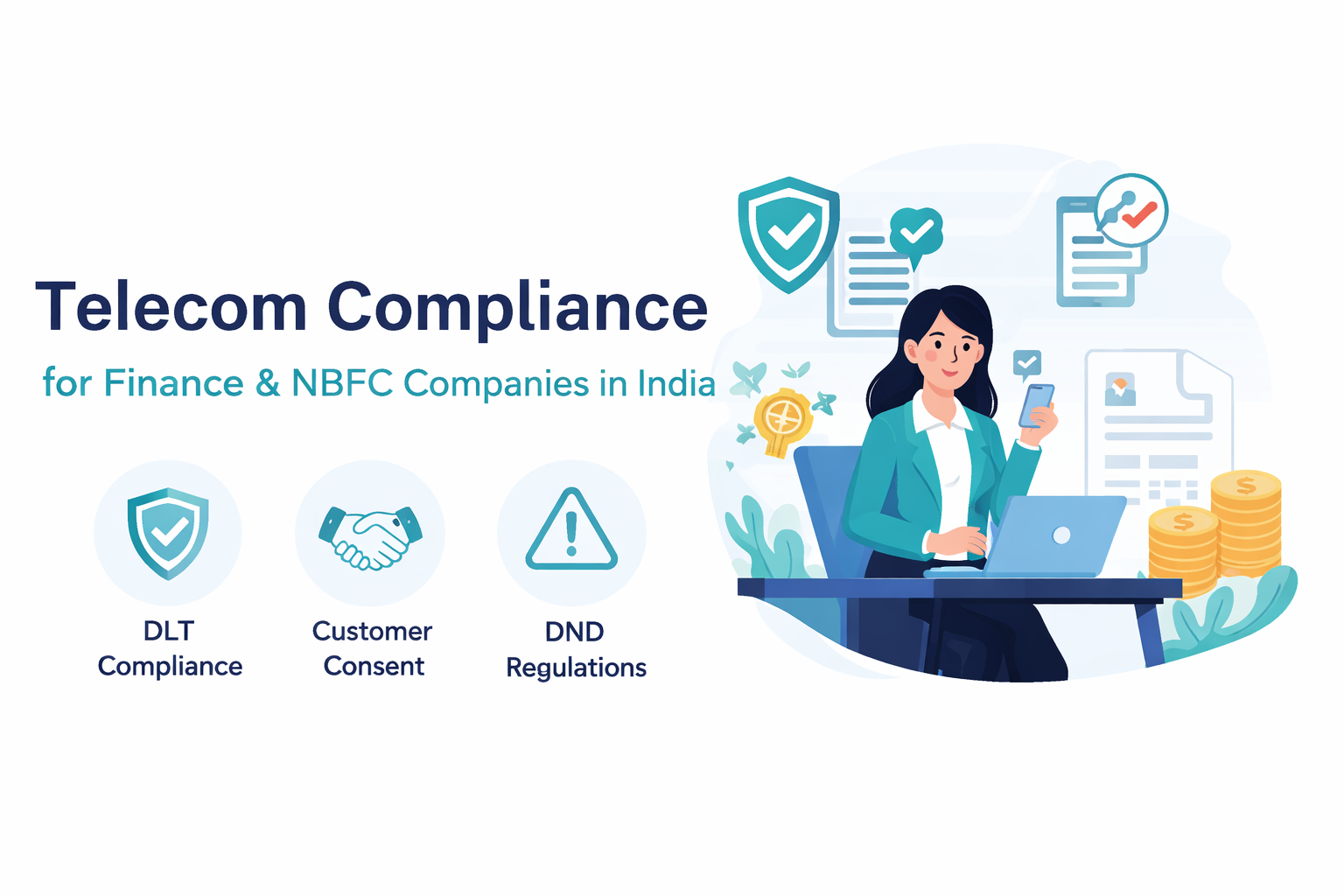
Telecom channels—SMS, voice calls, and WhatsApp—are the primary communication backbone for NBFCs and financial institutions. From loan disbursals and EMI reminders to KYC alerts and collections, billions of interactions happen every month.
Key Industry Data Points:
-
India sends 100+ billion commercial SMS annually, with BFSI among the top contributors
-
Over 60–70% of customer complaints in telecom are linked to spam or unsolicited communication
-
According to Reserve Bank of India, digital lending complaints saw a significant surge post-2020, especially related to harassment via calls/messages
-
Telecom Regulatory Authority of India processes billions of DLT-based SMS monthly, enforcing strict filtering and traceability
-
Non-compliant messages can see delivery failure rates exceeding 40–60%
This has made telecom compliance not just a regulatory requirement—but a business continuity necessity.
2. Core Regulatory Bodies & Frameworks
🏛️ Telecom Regulations
-
TRAI (DLT Framework)
-
Mandatory Distributed Ledger Technology (DLT) for messaging
-
Entity, header, and template registration required
🏦 Financial Regulations
-
RBI Digital Lending Guidelines
-
Explicit borrower consent mandatory
-
No coercive communication practices
-
Vendor accountability enforced
🔐 Data Protection
-
Information Technology Act 2000
-
Digital Personal Data Protection (DPDP) Act (upcoming enforcement)
3. Key Telecom Compliance Requirements
✅ A. DLT Registration (Mandatory)
Operators include:
-
Vodafone Idea Limited
-
Bharti Airtel
-
Reliance Jio
Requirements:
-
Entity registration
-
Sender ID approval
-
Template whitelisting
✅ B. Consent Management
-
Must be explicit, recorded, and auditable
-
Required before any promotional or transactional communication
✅ C. DND Scrubbing
-
Mandatory filtering against National Do Not Disturb registry
-
Violations can lead to number blocking
✅ D. Template Matching
-
Exact match with approved templates required
-
Even minor variations → message failure
✅ E. Voice Call Compliance
-
No auto-dial spam
-
Restricted calling hours
-
Mandatory call recording for audit
4. RBI-Specific Telecom Guidelines for NBFCs
🔴 Prohibited:
-
Harassment or threatening language
-
Excessive calling frequency
-
Contacting unauthorized references
🟢 Required:
-
Full audit trail of communication
-
Vendor compliance checks
-
Customer grievance mechanisms
5. Penalties & Risks of Non-Compliance
🚨 Financial Risks
-
Campaign failures due to SMS blocking
-
Increased CAC due to poor delivery
⚖️ Regulatory Risks
-
RBI penalties
-
Business restrictions
📉 Brand Risks
-
Customer churn
-
Negative brand perception
6. Common Challenges Faced by NBFCs
|
Challenge |
Impact |
|
Frequent DLT rejections |
Campaign delays |
|
Poor consent tracking |
Legal exposure |
|
Multi-vendor ecosystem |
Compliance gaps |
|
Manual operations |
High error rates |
7. Best Practices for Telecom Compliance
🔧 Unified Communication Stack
-
SMS, Voice, WhatsApp in one platform
📊 Consent Automation
-
API-based consent capture & storage
📞 Smart Calling Systems
-
Time-restricted & rule-based dialing
🤖 AI Monitoring
-
Detect spam patterns and compliance risks
8. Role of Cloud Telephony (VNO Licensed Platforms)
Modern NBFCs are shifting to licensed telecom providers (VNOs) to simplify compliance.
🚀 Capabilities:
-
Built-in DLT integration
-
Automated template syncing
-
Consent management APIs
-
Call masking & audit logs
-
Real-time compliance dashboard
9. Conclusion: Why CloudConnect is the Smarter Choice
Telecom compliance is no longer just about avoiding penalties—it directly impacts delivery rates, customer trust, and operational efficiency.
Platforms like CloudConnect, India’s licensed B2B Digital Telco (VNO), enable NBFCs to:
✅ Achieve end-to-end compliance with TRAI & RBI guidelines
✅ Eliminate dependency on multiple vendors
✅ Improve message delivery rates by 20–30%
✅ Ensure 100% audit-ready communication systems
✅ Scale communication securely across SMS, Voice & WhatsApp
👉 With 350+ businesses already trusting CloudConnect, NBFCs can transition from fragmented systems to a fully compliant, scalable communication infrastructure.
10. FAQs
1. Is DLT registration mandatory for NBFCs and financial institutions?
Yes. As per regulations by the Telecom Regulatory Authority of India, any business sending commercial SMS (transactional or promotional) must register on a Distributed Ledger Technology (DLT) platform.
For NBFCs, this is especially critical because:
-
EMI reminders, OTPs, and KYC alerts fall under regulated communication
-
Messages sent without DLT registration are blocked by telecom operators
-
Non-compliance can lead to permanent sender ID blacklisting
2. What is the difference between transactional and promotional messages under DLT?
DLT categorizes messages into:
Transactional Messages
-
Sent to existing customers
-
Include OTPs, payment alerts, account updates
-
Delivered even to DND users
Promotional Messages
-
Marketing or sales communication
-
Sent only to users who have opted in
-
Restricted by time windows and preferences
NBFCs must correctly classify messages, or they risk delivery failures and penalties.
3. What is template approval, and why do messages get rejected?
Under DLT, every message must match a pre-approved template.
Messages are rejected when:
-
Variables are not properly defined
-
Content deviates from approved format
-
Unregistered URLs or phone numbers are used
Even small variations (like punctuation or word changes) can cause blocking. This is one of the most common operational challenges for NBFCs.
4. How should NBFCs manage customer consent for communication?
Consent must be:
-
Explicit (clearly agreed by the customer)
-
Recorded (stored with timestamp and source)
-
Verifiable (auditable when required)
-
Revocable (customer can opt out anytime)
For example:
-
Consent collected during loan application
-
Opt-in checkbox for marketing communication
-
API-based consent capture for digital journeys
Failure to maintain proper consent records can lead to regulatory action from the Reserve Bank of India.
5. What is DND scrubbing, and how does it impact campaigns?
DND (Do Not Disturb) scrubbing ensures that promotional messages are not sent to users who have opted out.
Implications:
-
Messages to DND numbers are automatically blocked
-
Repeated violations can lead to sender penalties
-
Campaign reach may reduce if consent data is poor
NBFCs must maintain clean and updated customer databases to optimize delivery.
6. Are voice calls also regulated under telecom compliance?
Yes. Voice communication is regulated by both TRAI and RBI guidelines.
Key requirements include:
-
Calling only during permitted hours
-
Avoiding excessive or automated spam calls
-
Ensuring respectful and non-coercive communication
-
Recording calls for audit and dispute resolution
This is especially important for collections and recovery teams.
7. Can NBFCs outsource SMS and calling operations to third-party vendors?
Yes, but compliance responsibility still lies with the NBFC.
As per RBI outsourcing guidelines:
-
NBFCs must conduct vendor due diligence
-
Vendors must follow telecom and data protection regulations
-
Full audit trails must be maintained
Any violation by a vendor can directly impact the NBFC legally and reputationally.
8. What are the penalties for telecom non-compliance?
Penalties can include:
-
Blocking of SMS templates or headers
-
Blacklisting of numbers or entities
-
Financial penalties from regulators
-
Suspension of communication services
In severe cases, repeated violations can impact business operations and customer acquisition.
9. How does telecom compliance impact delivery rates and ROI?
Non-compliance leads to:
-
High message failure rates (often 40–60%)
-
Increased customer acquisition costs
-
Poor customer experience
On the other hand, compliant systems:
-
Improve delivery rates significantly
-
Ensure faster communication
-
Increase engagement and conversions
10. What role does a licensed telecom provider (VNO) play in compliance?
A Virtual Network Operator (VNO) like CloudConnect operates with telecom licensing, enabling:
-
Direct integration with telecom networks
-
Pre-configured DLT compliance systems
-
Better control over delivery and routing
-
Reduced dependency on multiple intermediaries
This simplifies compliance management for NBFCs.
11. How can NBFCs ensure they are audit-ready at all times?
To stay audit-ready, NBFCs should:
-
Maintain logs of all communications (SMS, calls, WhatsApp)
-
Store consent records with timestamps
-
Keep DLT approvals and templates documented
-
Monitor vendor activity regularly
Automated platforms can significantly reduce manual effort and errors.
12. How does CloudConnect help NBFCs stay compliant?
CloudConnect provides a licensed, unified communication infrastructure designed for compliance:
-
Built-in DLT registration and template management
-
Automated consent tracking and storage
-
Secure call masking and recording
-
Real-time compliance dashboards
-
Centralized communication across channels
This allows NBFCs to focus on growth while ensuring regulatory adherence.
11. References
-
Telecom Regulatory Authority of India – DLT & Telecom Commercial Communication Regulations
-
Information Technology Act 2000 – Data protection framework
-
Telecom operator DLT platforms (Airtel, Jio, Vi documentation)