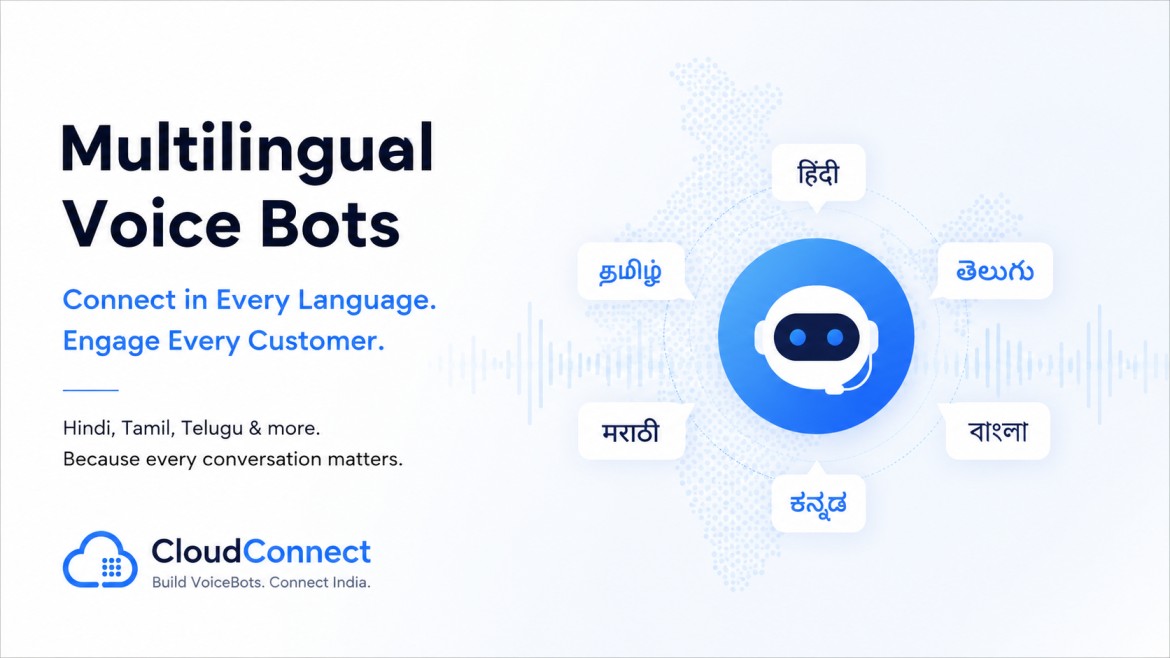
India is one of the most linguistically diverse markets in the world, and that diversity is reshaping how businesses approach customer communication.
Consider these numbers:
-
India has over 1.4 billion people
-
More than 22 officially recognized languages
-
Over 90% of new internet users prefer regional languages over English
-
Less than 15% of Indians speak English fluently
-
India is expected to have over 900 million internet users, with the majority coming from Tier 2, Tier 3, and rural regions
At the same time, voice-based interactions are growing rapidly across:
-
Customer support
-
Banking
-
eCommerce
-
Healthcare
-
Education
-
Logistics
This creates a major challenge for businesses deploying AI-powered communication systems.
An English-only voice bot cannot effectively serve India.
To truly scale customer engagement in India, multilingual voice bots are no longer optional. They are essential.
India Is Not a Single-Language Market
Unlike many Western markets, India operates through hundreds of linguistic and cultural variations.
Customers across regions naturally prefer communication in:
-
Hindi
-
Tamil
-
Telugu
-
Kannada
-
Bengali
-
Marathi
-
Malayalam
-
Gujarati
-
Punjabi
-
Odia
-
Assamese
and many other regional languages.
A customer in Chennai may prefer Tamil.
A customer in Hyderabad may be more comfortable in Telugu.
A customer in Lucknow may expect Hindi support.
When businesses force English-only communication, they create friction, confusion, and distrust.
Why English-Only Voice Bots Fail in India
1. Customers Trust Native Language Conversations More
Research consistently shows that users engage more when spoken to in their preferred language.
Regional language communication improves:
-
Customer comfort
-
Conversation completion rates
-
Lead conversion
-
Trust levels
-
Retention rates
In sectors like finance or healthcare, language clarity directly affects customer confidence.
2. India Uses Mixed-Language Communication
Indian consumers rarely communicate in “pure English.”
Most conversations include:
-
Hinglish
-
Tanglish
-
Telugu-English combinations
-
Regional slang and local phrasing
Examples:
-
“Payment ho gaya kya?”
-
“Order kab deliver hoga?”
-
“EMI available hai?”
-
“Tomorrow technician aayega?”
Traditional IVRs and outdated bots struggle with these conversational patterns.
Modern AI voice bots must understand:
-
Code-switching
-
Accent variations
-
Regional pronunciation
-
Natural Indian speech behavior
3. Accent Diversity Is a Massive Challenge
India has one of the world’s most diverse accent ecosystems.
Even the same language changes across states and districts.
For example:
-
Hindi spoken in Delhi differs from Bihar or Rajasthan
-
Tamil pronunciation differs across Tamil Nadu
-
English accents vary dramatically across regions
AI systems trained only on Western datasets often fail to accurately interpret Indian speech.
This leads to:
-
Misunderstood queries
-
Frustrated customers
-
Call abandonment
-
Poor customer experience
The Rise of Voice AI in Bharat
India’s next digital growth wave is being driven by Bharat — users outside major metros.
These users are:
-
Mobile-first
-
Voice-first
-
Regional-language-first
Voice search and conversational AI adoption are growing rapidly because many users are more comfortable speaking than typing.
This is especially important in:
-
Rural markets
-
Semi-urban cities
-
Elderly demographics
-
First-time internet users
Businesses that support regional language voice interactions gain a major competitive advantage.
Industries Where Multilingual Voice Bots Are Creating Real Impact
Banking & Financial Services
Regional-language bots help with:
-
EMI reminders
-
Loan collections
-
KYC verification
-
Account support
-
Fraud alerts
Banks using multilingual voice automation often see:
-
Better customer response rates
-
Improved collections
-
Lower operational costs
Healthcare
Patients are more likely to respond accurately in their native language.
Voice bots support:
-
Appointment booking
-
Follow-up reminders
-
Medicine reminders
-
Insurance communication
This is especially useful for elderly and rural patients.
eCommerce & Logistics
Delivery-related calls often happen in local languages.
Voice bots can automate:
-
Delivery confirmations
-
COD verification
-
Order updates
-
Return requests
This reduces support workload while improving customer satisfaction.
Education & EdTech
India’s regional-language learner base is expanding rapidly.
Voice bots help with:
-
Student counseling
-
Admissions
-
Parent communication
-
Fee reminders
-
Course engagement
Students and parents respond better when communication happens in familiar languages.
What Businesses Should Look for in a Multilingual Voice Bot
Not every voice bot platform is truly India-ready.
Businesses should evaluate whether the platform supports:
Indian Language Recognition
Accurate understanding of Hindi, Tamil, Telugu, Kannada, Marathi, Bengali, and other Indian languages.
Hinglish & Mixed-Language Understanding
Ability to interpret real conversational speech patterns.
Indian Accent Training
AI models trained specifically for Indian pronunciations and speech behavior.
Natural Text-to-Speech
Human-like regional language pronunciation.
Real-Time Language Switching
Ability to move between languages naturally during a conversation.
Omnichannel Communication
Integration with:
-
Voice calls
-
WhatsApp
-
SMS
-
CRM
-
Contact centers
Why Multilingual Voice Bots Improve Business ROI
Many businesses initially view voice bots as cost-saving tools.
But multilingual AI directly improves revenue and customer acquisition.
Better Lead Conversion
Customers stay engaged longer when spoken to comfortably.
Lower Call Drop Rates
Regional communication improves understanding and reduces frustration.
Improved Customer Satisfaction
Users feel heard and respected.
Expansion Into Tier 2 & Tier 3 Markets
Businesses can scale beyond English-speaking urban audiences.
Reduced Support Costs
AI automates repetitive multilingual conversations at scale.
The Future of Conversational AI in India Is Multilingual
India’s digital economy will not be built around English-only interactions.
The next generation of AI systems must understand:
-
Indian accents
-
Regional languages
-
Mixed-language conversations
-
Cultural communication behavior
Businesses that adopt multilingual conversational AI early will build:
-
Stronger customer trust
-
Better engagement
-
Wider market reach
-
Higher operational efficiency
Conclusion
In India, language is deeply connected to trust, accessibility, and customer experience.
Businesses that deploy English-only voice bots limit their own growth potential in one of the world’s fastest-growing digital markets.
Multilingual voice bots are no longer a premium feature. They are a core business requirement for brands that want to scale across India.
Modern conversational AI platforms must be capable of:
-
Understanding Indian speech patterns
-
Handling Hinglish and mixed-language communication
-
Supporting multiple regional languages
-
Delivering natural voice experiences at scale
For businesses looking to deploy multilingual conversational AI, CloudConnect helps organizations build advanced AI-powered VoiceBots while also providing the SIP trunking and voice channels required to run them reliably at scale.
As India’s 1st licensed B2B Digital Telco (VNO), CloudConnect is trusted by 400+ brands for:
-
AI VoiceBot infrastructure
-
Cloud telephony
-
SIP trunking
-
Contact center solutions
-
Omnichannel communication
-
Voice automation and analytics
By combining conversational AI with enterprise-grade telecom infrastructure, CloudConnect enables businesses to create seamless multilingual customer experiences across India.
FAQs
What is a multilingual voice bot?
A multilingual voice bot is an AI-powered conversational system that can understand and respond in multiple languages during customer interactions.
Why are multilingual bots important in India?
India has massive linguistic diversity, and most users prefer communicating in regional languages rather than English.
Can voice bots understand Hinglish?
Advanced AI voice bots trained on Indian conversational datasets can understand Hinglish and mixed-language speech patterns.
Which industries benefit most from multilingual voice bots?
Banking, healthcare, eCommerce, logistics, telecom, education, and customer support sectors benefit significantly.
Do multilingual bots improve customer engagement?
Yes. Customers are more likely to engage, trust, and complete conversations when communication happens in their preferred language.
References