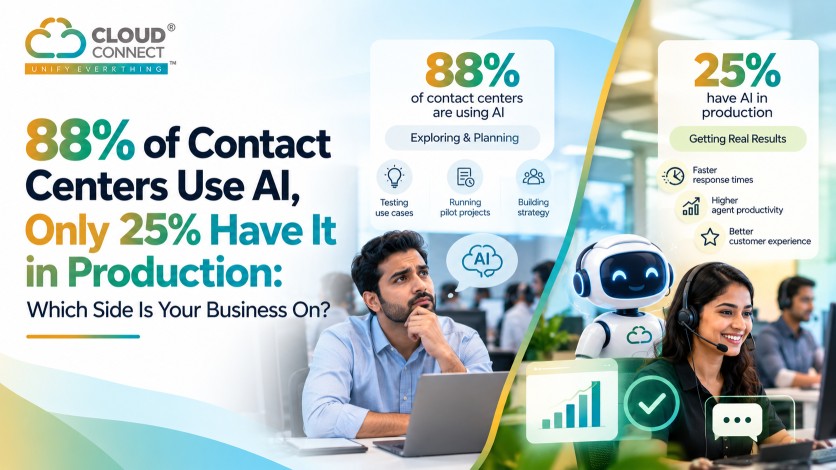
Your contact center probably "has AI". But is it actually answering calls, resolving queries and saving money, or is it still a pilot that nobody talks about?
AI in customer service has moved from experiment to expectation. Almost every contact center now has some AI tool in place: a chatbot, a transcription engine, a voice bot trial, a smart IVR. Yet only a small share have built it into the daily work of handling customers. The gap between buying AI and running it is where most budgets, and most of the promised savings, get stuck.
Here is what the latest data shows:
|
Data point |
What it tells you |
|
88% of contact centers use some form of AI, but only 25% have fully integrated AI automation into daily workflows (AmplifAI, widely cited in 2026) |
Adoption is nearly universal; execution is not |
|
91% of customer service leaders say they are under executive pressure to implement AI (Gartner survey, October 2025) |
The push is coming from the top, often faster than operations can absorb |
|
The average contact center runs 3.9 separate technologies; only 3% operate on a single unified platform (Puzzel, State of Contact Centres 2026) |
Fragmented systems leave AI without the data it needs |
|
Only 30% of contact centers use AI to generate operational insights (Verint survey of 500 contact center leaders) |
Most AI is used narrowly, not across operations |
|
Only 10% of organisations have reached mature AI deployment in customer service (Intercom, 2026) |
True production maturity is still rare |
|
Gartner predicts over 40% of agentic AI projects will be canceled by the end of 2027, due to rising costs, unclear value or weak risk controls |
Pilots without a clear business case are at real risk |
The good news: the 25% aren't using secret technology. They're making a handful of practical decisions differently. Here's how to tell which side you're on, and how to cross over.
1. Diagnose Where You Stand: Pilot or Production?
Start with an honest self-assessment. Most businesses recognise themselves quickly in one of these two columns.
|
Stuck in pilot |
Running in production |
|
AI is tested on a small slice of traffic, with no plan to expand |
AI handles a defined share of live calls every day |
|
Success is described as "promising" |
Success is measured in containment, resolution and cost per contact |
|
The bot can't see order, account or CRM data |
The bot reads and writes to core systems in real time |
|
Escalations to humans lose context |
Agents receive the full conversation and customer history |
|
Nobody owns AI performance after launch |
A named owner reviews and tunes it every week |
|
Compliance is checked after deployment |
Compliance is designed in from day one |
If most of your answers sit in the left column, you're in the majority. The next four steps are about moving right.
2. Pick Use Cases That Can Actually Go Live
The fastest route to production is not the most ambitious use case. It's the highest-volume, most repeatable one, where answers are predictable and success is easy to measure.
|
Use case |
Why it's production-ready |
How to measure it |
|
Order and delivery status |
High volume, simple data lookup |
Containment rate, repeat calls |
|
EMI and payment reminders |
Scripted, scheduled, outbound |
Payment rate after call |
|
Appointment confirmations |
Clear yes/no outcomes |
Confirmation and no-show rates |
|
Lead qualification |
Structured questions, CRM handoff |
Qualified leads per day |
|
Smart routing and intent detection |
Improves every call, low risk |
Transfers per call, first-call resolution |
|
Call summaries for agents |
Saves after-call work immediately |
Handle time and wrap-up time |
Choose one or two, prove value within weeks, then expand. As Gartner warns, use cases with unclear business value are the ones most likely to be canceled.
3. Fix the Foundation: Integrate Telephony, CRM and Data
This is where most AI pilots quietly fail. A voice bot that can't check an order, see a payment or update a ticket can only say "let me transfer you". With the average contact center running nearly four separate systems, the AI simply can't see enough of the business to be useful.
Production-ready AI needs:
• A unified cloud telephony layer, covering calls, IVR, routing and recording, in one place.
• Real-time CRM and backend integration, so AI can look up and update customer records.
• Shared conversation history, so a handover to a human agent keeps the full context.
• Clean call data, including recordings, dispositions and outcomes, to measure and train on.
Get this right and the same AI tool that struggled in a pilot can start resolving queries instead of deflecting them.
4. Design for Humans and Compliance From Day One
The contact centers that succeed treat AI as part of a team, not a replacement for it. Every bot needs a clear path to a human, and every deployment needs to fit the rules of the market it operates in.
• Clear escalation rules: hand over on frustration, complex queries, disputes or high-value customers.
• Regional languages: for Indian customers, AI that works in Hindi and regional languages reaches far more people.
• Regulatory fit: in India, TRAI's Third Amendment Regulations, 2026 require automated (A2P) calls to be declared in advance, and service calls belong on the right number series: 1600 for BFSI and government, 1601 for logistics and utilities.
• Data protection: recordings and customer data should be stored securely, ideally in Indian data centres.
Building these in upfront avoids the costly rework that stalls many projects after launch.
5. Measure What Matters, Then Scale
Production AI is managed like any other part of operations: with clear metrics, an owner and a review rhythm.
|
KPI |
What it shows |
|
Containment or resolution rate |
Share of interactions AI completes without a human |
|
Escalation rate and reasons |
Where AI falls short and needs tuning |
|
Cost per contact |
Whether AI is delivering real savings |
|
Customer satisfaction (CSAT) after AI interactions |
Whether customers are happy with the experience |
|
Agent handle time |
Whether AI support is helping human agents too |
A simple rollout rhythm helps: prove one use case in 30 days, integrate and tune it by 60, and expand to the next by 90. Each step builds on data from the last.
|
Why Choose CloudConnect? • One unified platform: Cloud Call Center, Cloud PBX, IVR, SIP trunking and AI Voice Bots, which reduces the fragmentation that stalls AI. • Integration-ready: connect calling and AI with your CRM, so bots and agents share context. • Built for India: regional-language voice bots and compliance-ready calling for 1600 (BFSI and government) and 1601 (logistics and utilities). • India's first DOT-licensed B2B VNO: licensed, compliant cloud telephony. • ISO 9001 and ISO 27001 certified, 100% Indian data centres, 99.9% uptime SLA: secure and reliable. • 450+ enterprise clients, GeM Registered Seller: and software, not staffing. See it live: Book My Demo |
Conclusion
Having AI is no longer what sets a contact center apart; nearly everyone does. Running it in production is. The businesses in the 25% start with high-volume, measurable use cases, build on a unified and integrated telephony foundation, design for human handover and compliance from day one, and manage AI with clear metrics. If your AI is still a pilot, you're not behind. You're simply one well-chosen use case and one solid integration away from crossing to the other side.
Frequently Asked Questions
1. What does it mean to have AI "in production" in a contact center?
It means AI handles a defined share of live customer interactions every day, connected to real systems, with measurable results and an owner responsible for performance, rather than running only as a limited trial.
2. Why do so many contact center AI projects stay stuck in pilot?
Common reasons include fragmented systems that keep data out of reach, unclear business cases, weak integration with CRMs and backends, poor handover to human agents, and compliance issues found late.
3. Which AI use cases should we start with?
High-volume, repeatable tasks with predictable answers, such as order status, payment reminders, appointment confirmations, lead qualification, smart routing and call summaries.
4. Will AI voice bots replace our agents?
In most contact centers, AI handles routine volume while human agents focus on complex, sensitive and high-value conversations. Clear escalation paths are essential.
5. How long does it take to move an AI use case into production?
With an integrated cloud telephony platform and a well-defined use case, many teams can prove value within weeks. Complex, multi-system use cases take longer.
6. Do AI voice bot calls need special compliance in India?
Under TRAI's Third Amendment Regulations, 2026, automated (A2P) calls must be declared to your operator in advance, and service or transactional calls should use the appropriate designated series.
7. How do we measure AI success in our contact center?
Track containment or resolution rate, escalation rate and reasons, cost per contact, customer satisfaction after AI interactions and agent handle time.
About CloudConnect
CloudConnect helps businesses build reliable and scalable communication infrastructure with advanced voice and business communication solutions. As leading cloud telephony providers in Indiaand experienced SIP trunk providers, we offer powerful PBX solutions, cloud telephony, IVR, and call center solutions to streamline business communication.
Related Reading
Toll-Free Numbers in India: Features, Pricing & Best Providers
How to Get a DID Mobile Number in India for Your Business
Best Cloud Telephony Providers in India: Features, Pros & Cons
UCaaS vs. CCaaS: Understanding the Difference Between Two Cloud Communication Platforms
References
1. AmplifAI, customer service statistics 2026: https://www.amplifai.com/blog/customer-service-statistics
2. CMSWire, call center statistics on the AI integration gap: https://www.cmswire.com/contact-center/16-important-call-center-statistics-to-know-about/
3. ICTBroadcast, summary of Puzzel State of Contact Centres 2026: https://www.ictbroadcast.com/call-center-ai-adoption-gap-integration-2026/
4. Neomanex, AI customer service statistics including Intercom 2026: https://neomanex.com/blog/ai-customer-service-statistics
5. Gartner, over 40% of agentic AI projects will be canceled by end of 2027: https://www.gartner.com/en/newsroom/press-releases/2025-06-25-gartner-predicts-over-40-percent-of-agentic-ai-projects-will-be-canceled-by-end-of-2027
6. PIB, TRAI Third Amendment Regulations, 2026: https://www.pib.gov.in/PressReleseDetailm.aspx?PRID=2311989&lang=1®=3
.