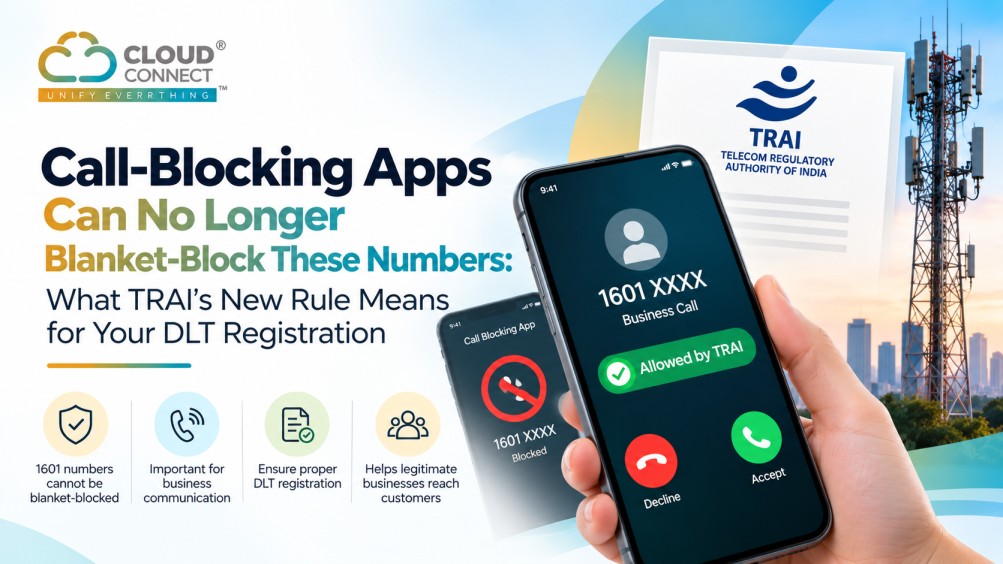
If a caller-ID app has been quietly labelling your service calls as "spam", what happens now that TRAI says it can't?
Among the most consequential changes in TRAI's Telecom Commercial Communications Customer Preference (Third Amendment) Regulations, 2026, notified on 18 September 2026, is a new limit on Call Management Applications (CMAs), the caller-ID and call-blocking apps on millions of Indian smartphones. They can no longer blanket-block, filter or spam-tag calls from TRAI's designated commercial number series.
But there's a catch. That protection applies only to calls from those designated series, and getting there depends on clean, complete registration with your operator and on the DLT (Distributed Ledger Technology) platform. Here's the context:
|
Data point |
Why it matters |
|
Caller-ID app data cited by MediaNama: users ignore 81% of 140-series and 79% of 1600-series calls |
Even regulated calls struggle to get answered |
|
Users block about 4 lakh 140-series and 1.25 lakh 1600-series calls a day, and manual blocking of 1600 has tripled since October 2025 (MediaNama) |
Blocking pressure on legitimate series was rising fast |
|
The DLT ecosystem holds roughly 2.5 lakh registered principal entities, 6 lakh headers and 55 million+ content templates (Telerivet, early 2026) |
DLT is already the backbone of commercial communication |
|
1.085 million UCC complaints in Q1 FY27, 89% filed via the TRAI DND app (TRAI quarterly highlights) |
Complaint data is increasingly centralised |
|
2,873 SMS headers blocked and 263 senders blacklisted in the same quarter |
Registration records are actively enforced |
So what exactly has changed, and what should you check in your DLT setup? Let's walk through it.
1. What the New Rule Actually Says
Under the amendment, CMAs are prohibited from blanket blocking, filtering or spam-tagging calls from number series designated by TRAI or the Central Government for commercial communication. TRAI's reasoning is that such tagging, without the safeguards built into the regulatory framework, risks mislabelling genuine commercial and government calls that customers actually need.
|
What changes |
Allowed? |
|
A CMA blanket-blocking all 1600xx or 1601xx service calls |
No |
|
A CMA spam-tagging all 140xx regulated promotional calls |
No |
|
Operators flagging designated-series calls as suspected spam to recipients |
No |
|
An individual user blocking a specific number on their own phone |
Yes |
|
"Block Promo" blocking promotional calls |
Yes, but not transactional, service or government calls |
|
A CMA offering a "report spam" option without sending reports to the DLT platform |
No |
In short: the regulated series can no longer be written off wholesale. Individual customer choice remains.
2. Protection Follows the Number Series, Not the Business
This is the part many businesses miss. The rule protects calls from designated series. Calls from ordinary 10-digit numbers get no such protection, even if your business is fully registered. To benefit, your calls need to come from the right series for the right purpose:
|
Series |
Purpose |
Who uses it |
|
140xx |
Regulated promotional calls |
Any registered sender, for promotions |
|
1600xx |
Service and transactional calls |
BFSI and government entities |
|
1601xx |
Service and transactional calls |
Utilities, courier and logistics entities (Phase I) |
Under the 1601 direction, numbers are allocated directly to eligible entities after operator verification, not to intermediaries or aggregators, and the entity gives an undertaking to use them only for service and transactional calls. Misusing a protected series for promotions puts that allocation at risk.
3. Spam Reports Now Flow Into DLT, So Your Records Become the Evidence
The amendment also says that no CMA may let users report UCC under any label, such as spam or junk, unless the app sends that report to the DLT platform maintained by operators. Combined with the new enforcement rules, this matters:
• Operators now corroborate consumer complaints with their own AI/ML detection; action can begin at 3 unique complaints in 10 days if the number is also AI-flagged.
• If 5 or more of a sender's numbers are flagged within 10 days, investigation and graded action follow, including KYC re-verification and, for repeat violations, disconnection.
• Consumers can now appeal complaint outcomes within 15 days.
When a complaint arrives, your DLT records, registered CLIs, headers, templates and consents, are what show whether a call or message was legitimate. Gaps in those records become your risk.
4. Your DLT Registration Checklist
Use this checklist to make sure your registration supports, rather than undermines, the new protections:
|
Check |
What to confirm |
|
Principal Entity details |
Legal name, PAN and KYC are current; each legal entity is registered separately |
|
SMS headers |
Registered under the right category with the correct suffix (-P, -S, -T, -G, required since 6 May 2025) |
|
Voice CLIs |
All calling numbers used for commercial communication are registered against your entity |
|
Content templates |
Every message variant is approved under the correct category |
|
Consent records |
Consents are digital, verifiable and registered; legacy consents must be registered on the operator's digital platform to count |
|
Inquiry records |
Customer inquiries are kept in verifiable form; inquiry-based messaging is allowed for 7 days only |
|
Telemarketer chain |
Your Principal Entity-to-telemarketer chain is defined and current |
|
A2P declaration |
Automated calling, and the CLIs used for it, are declared to your operator in advance |
5. Guard Your Headers and Templates, and Still Earn the Pickup
The amendment also strengthens action against misuse of headers and content templates. When misuse is identified, the originating operator must suspend the affected header or template within six hours and notify the sender, who must then take remedial steps and file a complaint with law enforcement. If a telemarketer is responsible, all its telecom resources across operators are disconnected for a year, with blacklisting.
Practical safeguards:
• Review active headers and templates quarterly, and retire unused ones.
• Limit who in your organisation and partner network can use each header.
• Monitor complaint and delivery data to catch misuse early.
Finally, remember that protection from blanket tagging is not the same as being answered. With most regulated-series calls still ignored, calling at expected moments, sending an SMS heads-up from a registered header and stating the purpose immediately all help your calls get picked up.
|
Why Choose CloudConnect? • India's first DOT-licensed B2B VNO: a licensed Access Provider within TRAI's commercial communication framework. • Series-ready voice: calling built for 140 (promotional), 1600 (BFSI and government) and 1601 (logistics and utilities). • Compliant automation: AI Voice Bots, Voice Broadcasting and Cloud Call Center set up for declared A2P calling. • ISO 9001 and ISO 27001 certified, 100% Indian data centres: secure, data-resident telephony. • 99.9% uptime SLA, 450+ enterprise clients, GeM Registered Seller: trusted at scale. • Software, not staffing: the platform and compliance support; your team owns the conversations. See it live: Book My Demo |
Conclusion
TRAI's new limit on call-blocking apps is good news for legitimate businesses, but only for those calling from the right number series with clean DLT records behind them. Spam reports from these apps must now flow into DLT, complaints are corroborated with operator AI, and misuse of headers or templates is acted on within hours. The businesses that benefit most will audit their DLT registration now, match every call to the correct series and treat their consent and CLI records as the compliance evidence they have become.
Frequently Asked Questions
1. Can Truecaller or other apps still block my business calls?
Call management apps can no longer blanket-block, filter or spam-tag calls from TRAI-designated series such as 140xx, 1600xx and 1601xx. Calls from ordinary numbers are not covered, and individual users can still block any number themselves.
2. Does DLT registration alone protect my calls from spam tags?
No. The protection applies to calls from designated number series. DLT registration supports compliance, but your calls also need to come from the correct series for their purpose.
3. Which series should my business use?
140xx for regulated promotional calls, 1600xx for service and transactional calls by BFSI and government entities, and 1601xx for service and transactional calls by utilities, courier and logistics entities.
4. What happens to spam reports made through caller-ID apps?
Under the amendment, apps may offer UCC reporting only if they send those reports to the operators' DLT platform, where they can feed into complaint-based enforcement.
5. Do old customer consents still count?
Legacy consents count only if they were obtained through verifiable means and are registered on the operator's digital platform.
6. What happens if our SMS header is misused?
The originating operator must suspend the misused header or template within six hours and notify you. You must take remedial measures and file a complaint with the appropriate law enforcement agency.
7. Does "Block Promo" block our service calls?
No. Block Promo blocks only promotional communications, not transactional, service or government communications.
About CloudConnect
CloudConnect helps businesses build reliable and scalable communication infrastructure with advanced voice and business communication solutions. As leading cloud telephony providers in Indiaand experienced SIP trunk providers, we offer powerful PBX solutions, cloud telephony, IVR, and call center solutions to streamline business communication.
Related Reading
Toll-Free Numbers in India: Features, Pricing & Best Providers
How to Get a DID Mobile Number in India for Your Business
Best Cloud Telephony Providers in India: Features, Pros & Cons
UCaaS vs. CCaaS: Understanding the Difference Between Two Cloud Communication Platforms
References
1. PIB, TRAI Third Amendment Regulations, 2026 (18 September 2026): https://www.pib.gov.in/PressReleseDetailm.aspx?PRID=2311989&lang=1®=3
2. The Pioneer, TRAI directs telcos to act against spam callers: https://dailypioneer.com/news/slug-lite/trai-directs-telcos-to-act-against-spam-callers?year=2026
3. MediaNama, TRAI 1601 series and caller-ID app data: https://www.medianama.com/2026/08/223-trai-1601-series-logistics-courier-services/
4. Orissa Diary, key provisions of the TRAI 1601-series direction: https://orissadiary.com/trai-initiates-phase-wise-implementation-of-1601-series-for-service-and-transactional-calls-by-utilities-courier-and-logistics-sectors-entities/
5. Telerivet, India SMS compliance and DLT ecosystem figures: https://www.telerivet.com/blog/india-sms-compliance-trai-dlt-registration-and-tcccpr-guide
6. SMSHorizon, DLT header category suffix requirement: https://www.smshorizon.in/blog/trai-dlt-registration-for-bulk-sms
7. Communications Today, TRAI Q1 FY27 enforcement figures: https://www.communicationstoday.co.in/trai-cracks-down-on-spam-bars-1-84-lakh-telecom-resources-in-q1/
8. CloudConnect: https://cloudconnect.in/public/Cloud-Call-Center-Solutions/