Contact Center Automation: A Smarter Way to Deliver Better Customer Service
Customer expectations have changed dramatically over the last few years. Today, people expect businesses to answer quickly, resolve issues on the first call, and provide support across multiple channels such as phone, email, chat, WhatsApp, and social media.
At the same time, businesses are under pressure to manage growing customer inquiries without continuously increasing staff or operational costs.
The numbers clearly show why contact center automation has become a business priority:
-
73% of customers say customer experience is one of the most important factors when choosing a brand.
-
61% of customers prefer using self-service options before speaking with a customer support agent.
-
Businesses using AI-powered customer service have reported up to 30% lower operational costs and significantly faster response times.
-
According to Gartner, conversational AI is expected to save businesses billions of dollars in customer service costs over the coming years.
These trends show one thing—businesses can no longer rely on manual customer support alone.
This is where Contact Center Automation helps. It automates repetitive tasks, improves agent productivity, reduces waiting times, and delivers a better customer experience.
What is Contact Center Automation?
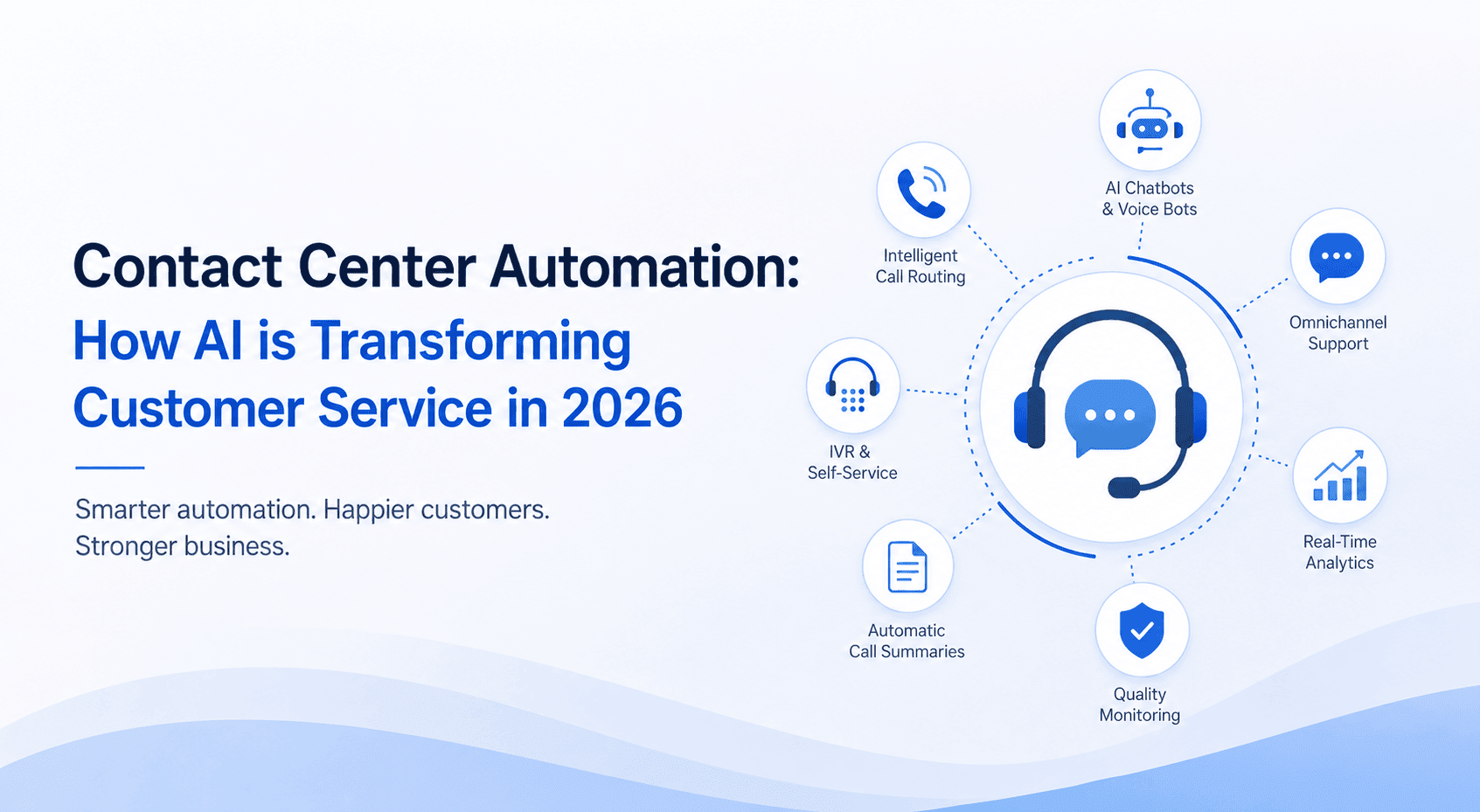
Contact Center Automation is the use of Artificial Intelligence (AI), automation software, and cloud communication technologies to handle repetitive customer service tasks with minimal human intervention.
Instead of making agents perform every task manually, automation helps with:
-
Intelligent call routing
-
AI chatbots and voice bots
-
Automatic call summaries
-
CRM updates
-
Quality monitoring
-
Call recording
-
Customer feedback collection
This allows human agents to focus on conversations that need empathy, decision-making, or technical expertise.
Unlike traditional call center automation, contact center automation works across multiple communication channels, including:
-
Voice Calls
-
Live Chat
-
Email
-
WhatsApp
-
SMS
-
Social Media
Everything is managed from a single platform.
Why Businesses Need Contact Center Automation
Customer support teams today receive thousands of interactions every day.
Without automation, agents spend a large part of their time on repetitive work instead of solving customer problems.
Common challenges include:
-
Long waiting times
-
Manual call transfers
-
Repeating customer information
-
Updating CRM after every call
-
Managing multiple communication channels
-
High operational costs
Automation solves these challenges by making every interaction faster and more efficient.
According to industry research, businesses that automate customer support often experience:
-
Up to 40% faster response times
-
Higher First Call Resolution (FCR)
-
Lower Average Handle Time (AHT)
-
Better Customer Satisfaction (CSAT)
-
Improved employee productivity
Top Types of Contact Center Automation
1. Intelligent Call Routing
Customers become frustrated when they are transferred multiple times before reaching the right person.
AI-powered routing automatically understands the customer's query and connects them with the most suitable agent.
Benefits include:
-
Faster resolutions
-
Fewer call transfers
-
Better customer satisfaction
-
Reduced handling time
2. Self-Service Through IVR and AI Voice Bots
Many customer questions are simple and repetitive.
Examples include:
-
Order status
-
Appointment booking
-
Account balance
-
Delivery tracking
-
Payment information
-
FAQs
Instead of waiting for an agent, customers can get instant answers using:
-
IVR Systems
-
Chatbots
Research shows that over 60% of customers prefer solving simple issues themselves before speaking with an agent.
3. Automatic Call Summaries
After every customer interaction, agents usually spend time writing notes and updating CRM systems.
This process is known as After Call Work (ACW).
Depending on the business, this may take 30–90 seconds per interaction.
AI automatically creates:
-
Call summaries
-
Customer notes
-
Disposition codes
-
CRM updates
This allows agents to move immediately to the next customer.
4. Quality Monitoring
Traditional quality monitoring checks only a small sample of customer interactions.
Modern AI systems can analyze 100% of calls and conversations.
This helps businesses:
-
Identify training opportunities
-
Improve compliance
-
Measure customer sentiment
-
Detect recurring issues
-
Improve agent performance
Managers receive real-time insights instead of waiting for weekly reports.
Benefits of Contact Center Automation
Faster Customer Service
Customers receive answers immediately through intelligent routing and self-service.
This reduces waiting time and improves customer satisfaction.
Lower Operating Costs
Automation handles routine interactions, allowing businesses to serve more customers without significantly increasing staff.
Industry studies show that AI-driven customer service can reduce operational costs by 20–30%.
Higher Agent Productivity
Instead of performing repetitive work, agents spend more time solving complex customer problems.
This improves both productivity and employee satisfaction.
Better Customer Experience
Automation creates a consistent customer journey across every communication channel.
Customers no longer have to repeat their information every time they switch between voice, email, or chat.
Improved Business Insights
Modern contact center platforms provide detailed analytics such as:
-
Call volumes
-
Peak hours
-
Customer sentiment
-
Agent performance
-
Resolution rates
-
Customer satisfaction scores
These insights help businesses continuously improve their customer service.
Best Practices for Implementing Contact Center Automation
Start Small
Begin by automating repetitive, high-volume tasks such as:
-
FAQs
-
Appointment booking
-
Call routing
-
CRM updates
Once successful, gradually automate more complex workflows.
Integrate with Existing Systems
Automation delivers the best results when connected with:
-
ERP
-
Helpdesk software
-
Ticketing systems
-
Customer databases
This ensures every interaction has complete customer context.
Measure Performance
Track important KPIs before and after implementation.
Important metrics include:
-
First Call Resolution (FCR)
-
Average Handle Time (AHT)
-
Customer Satisfaction (CSAT)
-
Average Speed of Answer (ASA)
-
Call Abandonment Rate
Monitoring these KPIs helps measure the actual business impact.
Challenges Businesses May Face
While automation offers many benefits, successful implementation requires proper planning.
Some common challenges include:
-
Poor CRM integration
-
Incorrect IVR flows
-
Limited agent training
-
Lack of customer journey mapping
-
Incomplete knowledge base
Choosing the right technology partner helps businesses avoid these issues.
The Future of Contact Center Automation
Artificial Intelligence is changing customer service faster than ever before.
Future contact centers will increasingly use:
-
Conversational AI
-
Predictive Analytics
-
Real-Time Sentiment Analysis
-
Intelligent Workforce Management
-
Hyper-Personalized Customer Experiences
Rather than replacing human agents, AI will work alongside them—handling routine tasks while people focus on building stronger customer relationships.
Businesses that invest in automation today will be better prepared to meet the growing expectations of tomorrow's customers.
Conclusion
Contact Center Automation is no longer just a technology upgrade—it has become a business necessity.
By automating repetitive tasks, improving customer interactions, and giving agents better tools, businesses can deliver faster service, reduce costs, and improve customer satisfaction.
Whether you're managing a small customer support team or a large enterprise contact center, automation helps create a smarter, more efficient, and scalable customer service operation.
Organizations that begin their automation journey today will be better positioned to compete in an increasingly digital and customer-focused world.
About CloudConnect
CloudConnect is India's 1st DOT-Licensed B2B Digital Telco (VNO), helping businesses modernize customer communication through AI-powered cloud telephony and contact center solutions.
Our platform offers everything businesses need to deliver exceptional customer experiences, including:
-
AI-Powered Cloud Contact Center
-
Omnichannel Communication
-
AI Voice Bots
-
Automatic Call Distribution (ACD)
-
Real-Time Analytics & Reporting
-
Workforce Management
Trusted by 450+ businesses across India, CloudConnect enables organizations to improve customer experience, increase agent productivity, and scale communication effortlessly.
To learn more, visit www.cloudconnect.in.
Frequently Asked Questions (FAQs)
1. What is Contact Center Automation?
Contact Center Automation uses AI and cloud technology to automate customer service tasks such as call routing, IVR, chatbots, CRM updates, call summaries, and quality monitoring.
2. How is Contact Center Automation different from Call Center Automation?
Call Center Automation focuses only on voice calls, while Contact Center Automation manages customer interactions across voice, email, chat, SMS, WhatsApp, and social media.
3. What are the biggest benefits of Contact Center Automation?
The main benefits include lower operating costs, faster response times, improved customer satisfaction, higher agent productivity, and better business insights.
4. Can AI replace customer service agents?
No. AI handles repetitive tasks, while human agents continue to manage complex conversations that require empathy, negotiation, and problem-solving.
5. Is Contact Center Automation suitable for small businesses?
Yes. Cloud-based automation solutions are scalable and can support startups, SMEs, and large enterprises alike.
6. Which industries benefit the most from Contact Center Automation?
Industries such as healthcare, banking, insurance, education, retail, logistics, e-commerce, travel, and telecom benefit significantly from automation.
7. How long does it take to implement Contact Center Automation?
Cloud-based solutions can often be deployed within days or weeks, depending on the business size and integration requirements.
References
-
Gartner – Future of Conversational AI and Customer Service Research.
-
Salesforce – State of Service Report.
-
IBM Institute for Business Value – AI in Customer Service Research.
-
McKinsey & Company – The State of AI Report.
-
Deloitte – Global Contact Center Survey.
-
Microsoft Work Trend Index – AI and Workforce Productivity.
-
Customer service automation research and operational insights adapted from the uploaded reference document.