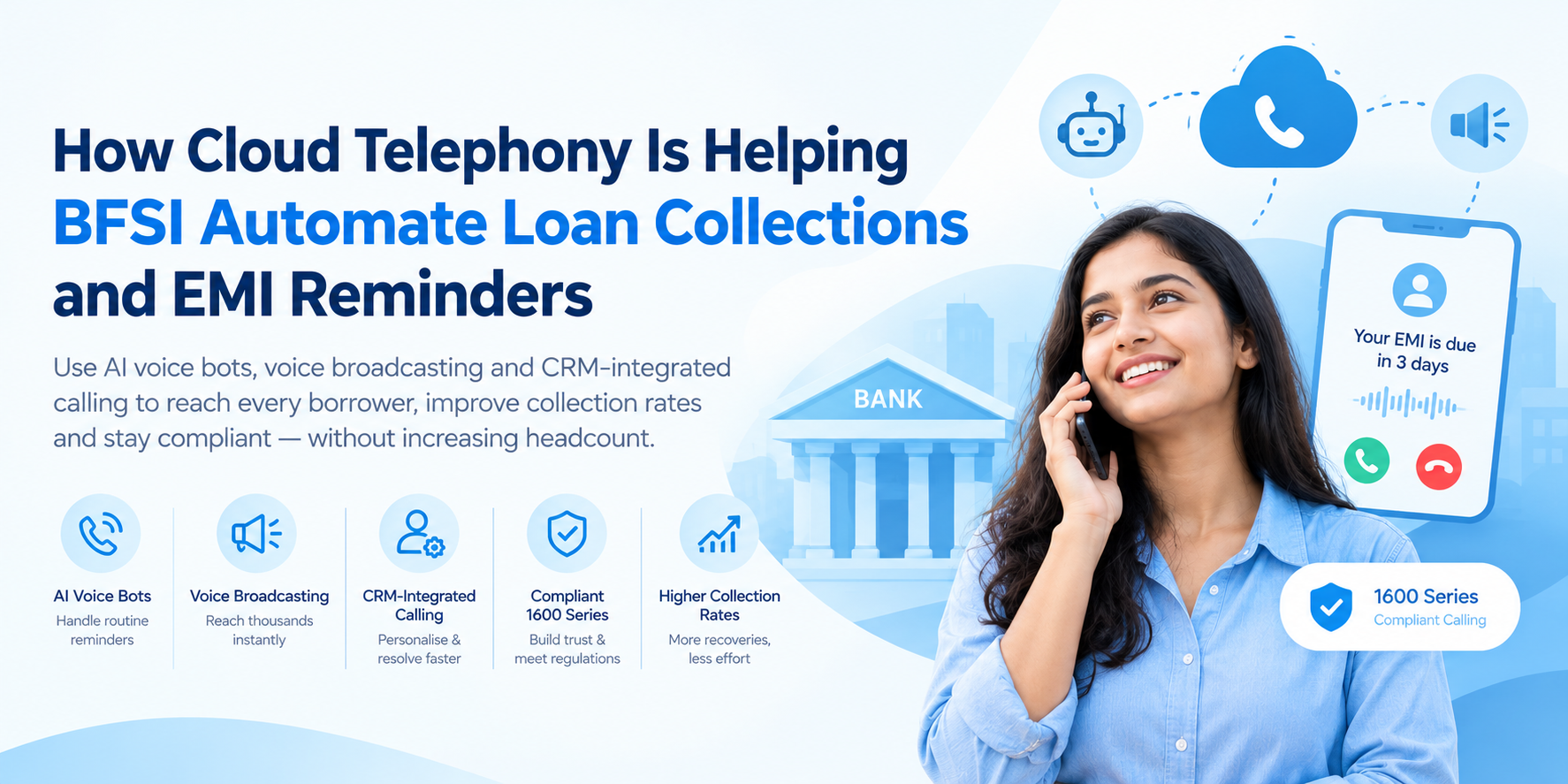
For most banks and NBFCs, EMI reminders still rely on a familiar formula: a team of callers, a spreadsheet of due dates and a lot of manual dialling. That works at a few thousand accounts. It breaks at a few lakh. Calls go unmade, reminders arrive too late, and agents spend their day on routine "your EMI is due" calls instead of the conversations that actually recover money.
Manual EMI reminders don't scale with a growing loan book. Here's the context every BFSI collections leader is working in:
|
Data point |
What it means for collections teams |
|
Household debt reached 45.5% of GDP by September 2025 (RBI Financial Stability Report, June 2026) |
More borrowers, more EMIs and more reminders every month |
|
Non-housing retail loans made up 58.4% of household borrowings as of March 2026 (RBI FSR, June 2026) |
A growing share of loans depends on borrowers' regular income, not collateral |
|
Gross NPAs were 0.7% for secured and 1.7% for unsecured retail loans in March 2026; RBI says these segments need close monitoring (RBI FSR, June 2026) |
Asset quality is healthy today, but early engagement keeps it that way |
|
TRAI's November 2025 direction requires RBI-, SEBI- and PFRDA-regulated entities to use the 1600 series for service and transactional calls, with deadlines phased from January to March 2026 |
EMI reminder calls must come from compliant 1600-series numbers |
|
RBI's August 2022 instructions bar recovery calls to borrowers before 8 am or after 7 pm |
Every automated campaign must respect the calling window |
|
India recorded roughly 147 million complaints about spam calls and messages in 2024 (EY, via Business Standard) |
Borrowers are wary of unknown callers, so trusted caller identity matters |
The answer isn't a bigger calling floor. It's a smarter communication stack. Here's how banks and NBFCs are using AI Voice Bots, Voice Broadcasting and CRM-integrated calling to automate reminders and improve collection rates, without adding headcount.
1. Match the Right Channel to Each Stage of the Loan
Not every borrower needs a human call. Most will pay on time with a timely, clear reminder. The key is to segment your book by repayment stage and let automation handle the high-volume, low-complexity end.
|
Stage |
Best-fit channel |
Goal |
|
Pre-due (3-7 days before EMI) |
Voice broadcast with SMS payment link |
Friendly reminder at scale |
|
Due date |
Voice broadcast or AI voice bot |
Nudge payment on the day |
|
Early delinquency (1-30 days past due) |
AI voice bot with promise-to-pay capture |
Understand the reason and secure a commitment |
|
Later buckets or broken promises |
CRM-integrated agent calling |
Personal negotiation and restructuring options |
|
Post-payment |
Automated confirmation call or SMS |
Build trust and reduce disputes |
Consider an illustrative example. An NBFC with one lakh EMIs due each month, where one agent can make around 150 manual calls a day, would need a large team working flat out just to place a single reminder per borrower. Automate the pre-due and due-date stages, and those same agents can focus on the smaller set of accounts that genuinely need a human conversation.
2. Voice Broadcasting: Reach Every Borrower, On Time
Voice broadcasting sends pre-recorded or dynamically generated voice messages to thousands of borrowers simultaneously. For EMI reminders, it delivers what manual calling can't: every borrower reached, on schedule, every month.
-
Personalised messages: text-to-speech inserts the borrower's name, EMI amount and due date into each call.
-
Regional languages: reminders in Hindi, Tamil, Kannada, Marathi, Bengali and more improve understanding and response.
-
Interactive options: "Press 1 to receive a payment link by SMS, press 2 to speak to an executive."
-
Scheduled delivery: campaigns run automatically at set intervals before the due date, within permitted hours.
Every call outcome, answered, unanswered or keypress, feeds back into your system, so the next action is triggered automatically.
3. AI Voice Bots: Two-Way Conversations at Scale
Broadcasts inform. AI voice bots converse. When a borrower misses an EMI, a voice bot can call, confirm identity, explain the overdue amount, ask when they plan to pay and record a promise-to-pay date, all in natural, polite language.
|
Task |
AI voice bot |
Human agent |
|
EMI due and overdue reminders |
Yes, at scale and around the clock within permitted hours |
Not needed for most accounts |
|
Capturing promise-to-pay dates |
Yes, logged automatically |
Only for complex cases |
|
Sharing payment links and account details |
Yes, via SMS during the call |
Rarely |
|
Hardship, disputes and restructuring |
Hands over to a human |
Yes, with empathy and judgement |
|
Follow-up on broken promises |
First attempt |
Escalation |
The bot handles the routine volume consistently and without fatigue. Your collections officers step in where empathy, negotiation and judgement make the difference.
4. CRM-Integrated Calling: Give Agents Full Context
For accounts that need a human call, integration with your CRM or loan management system (LMS) makes each call faster and more effective.
-
Screen pops show loan details, payment history, previous promises and bot interactions before the agent speaks.
-
Auto and predictive dialling removes manual dialling and idle time between calls.
-
Call dispositions, promise-to-pay dates and notes update the record automatically.
-
Call recordings are stored against the account for quality checks, audits and dispute resolution.
-
Priority queues route high-risk or high-value accounts to your most experienced officers.
Agents stop switching between screens and start having better conversations, with every interaction documented.
5. Build Compliance Into Every Call
In BFSI, how you collect matters as much as what you collect. Automation, done right, makes compliance more consistent, not less.
|
Requirement |
How cloud telephony supports it |
|
1600-series numbers for service and transactional calls (TRAI) |
Reminders and collection calls go out from compliant 1600-series numbers |
|
No recovery calls before 8 am or after 7 pm (RBI) |
Campaign schedulers block calls outside the permitted window |
|
No harassment or intimidation (RBI Fair Practices Code) |
Standardised, approved bot scripts and recorded agent calls |
|
Audit trail and grievance handling |
Call recordings, logs and dispositions stored per account |
|
Data security and residency |
ISO 27001-certified platforms with Indian data centres |
With the 1600-series deadlines now in force, a telephony partner that can provision these numbers and integrate them with your dialler, IVR and bots is no longer optional.
|
Why Choose CloudConnect?
See it live: Book My Demo |
Conclusion
A growing loan book doesn't have to mean a growing collections floor. By matching each repayment stage to the right channel, using voice broadcasting for reminders at scale, deploying AI voice bots for routine follow-ups and giving agents CRM-integrated context for the calls that need a human touch, banks and NBFCs can reach every borrower on time. Add built-in compliance with TRAI's 1600-series rules and RBI's calling-hour limits, and automation becomes the safer way to collect.
Frequently Asked Questions
1. How does cloud telephony automate EMI reminders?
It uses voice broadcasting and AI voice bots to call borrowers automatically before and on the due date, with personalised details such as name, amount and due date, and triggers SMS payment links based on the borrower's response.
2. What is the difference between voice broadcasting and an AI voice bot?
Voice broadcasting delivers a one-way message, sometimes with keypress options, to many borrowers at once. An AI voice bot holds a two-way conversation, answers questions and captures promise-to-pay dates.
3. Do banks and NBFCs need 1600-series numbers for EMI reminder calls?
TRAI requires RBI-, SEBI- and PFRDA-regulated entities to use the 1600 series for service and transactional calls, with deadlines phased between January and March 2026 depending on entity type. EMI reminders generally fall in this category; confirm specifics with your compliance team.
4. What calling hours apply to loan recovery calls?
RBI's instructions bar recovery calls to borrowers before 8 am or after 7 pm. Automated campaigns should be scheduled within this window.
5. Can AI voice bots speak regional languages?
Yes. Voice bots and broadcasts can be configured in multiple Indian languages, which helps borrowers understand the message and respond.
6. Will automation replace our collections team?
No. Automation handles high-volume, routine reminders so your officers can focus on complex cases such as hardship, disputes and restructuring.
7. Can the system integrate with our loan management system?
Yes. Cloud telephony platforms can integrate with CRMs and LMS platforms to pull due dates and borrower details, and to push back call outcomes, promise-to-pay dates and recordings.
References
-
Business Standard, RBI Financial Stability Report June 2026 coverage: https://www.business-standard.com/amp/finance/news/rbi-flags-nascent-stress-in-micro-enterprises-retail-loans-need-monitoring-126063001396_1.html
-
RMA India, summary of RBI Financial Stability Report June 2026: https://rmaindia.org/reserve-bank-of-india-rbi-releases-financial-stability-report-june-2026/
-
Business Standard, TRAI directs BFSI entities to use 1600 series from 2026: https://www.business-standard.com/industry/news/trai-directs-bfsi-use-1600-number-series-2026-125111900941_1.html
-
Mondaq, TRAI 1600-series mandate for BFSI: https://www.mondaq.com/india/telecoms-mobile-cable-communications/1764274/trais-1600-series-mandate-for-bfsi-regulatory-data-protection-and-customer-communication-risks
-
Business Standard, RBI directs recovery agents not to call before 8 am or after 7 pm (2022): https://www.business-standard.com/amp/article/finance/rbi-directs-loan-recovery-agents-not-to-intimidate-borrowers-no-calling-before-8am-after-7pm-122081201144_1.html
-
CloudConnect: https://cloudconnect.in/public/Cloud-Call-Center-Solutions/