What makes a customer stay loyal to a brand — the product itself, or how quickly and easily their problems get solved?
For most businesses today, the answer is clear. Products can be copied. Prices can be matched. But the experience a customer has when they call, chat, or email your business is hard to replicate — and it is fast becoming the biggest reason customers stay or leave.
This is where AI contact centers are changing the game. According to Gartner, conversational AI is expected to reduce contact center agent labour costs by around USD 80 billion by 2026, while handling a growing share of routine customer interactions. McKinsey research also shows that companies using AI in customer care improve both service quality and cost efficiency at the same time — something that was very difficult to achieve with traditional call centers.
Here is a quick look at why businesses across industries are moving to AI-powered contact centers:
| Metric | Data Point | Source | ||
| Agent labour cost savings from conversational AI | ~USD 80 billion by 2026 | Gartner | ||
|
|
Gartner | ||
|
Nearly 80% | Deloitte Contact Center Survey | ||
|
Up to 15–20% | McKinsey | ||
| India's cloud telephony and CPaaS growth | Strong double-digit annual growth | Nasscom / TRAI industry data |
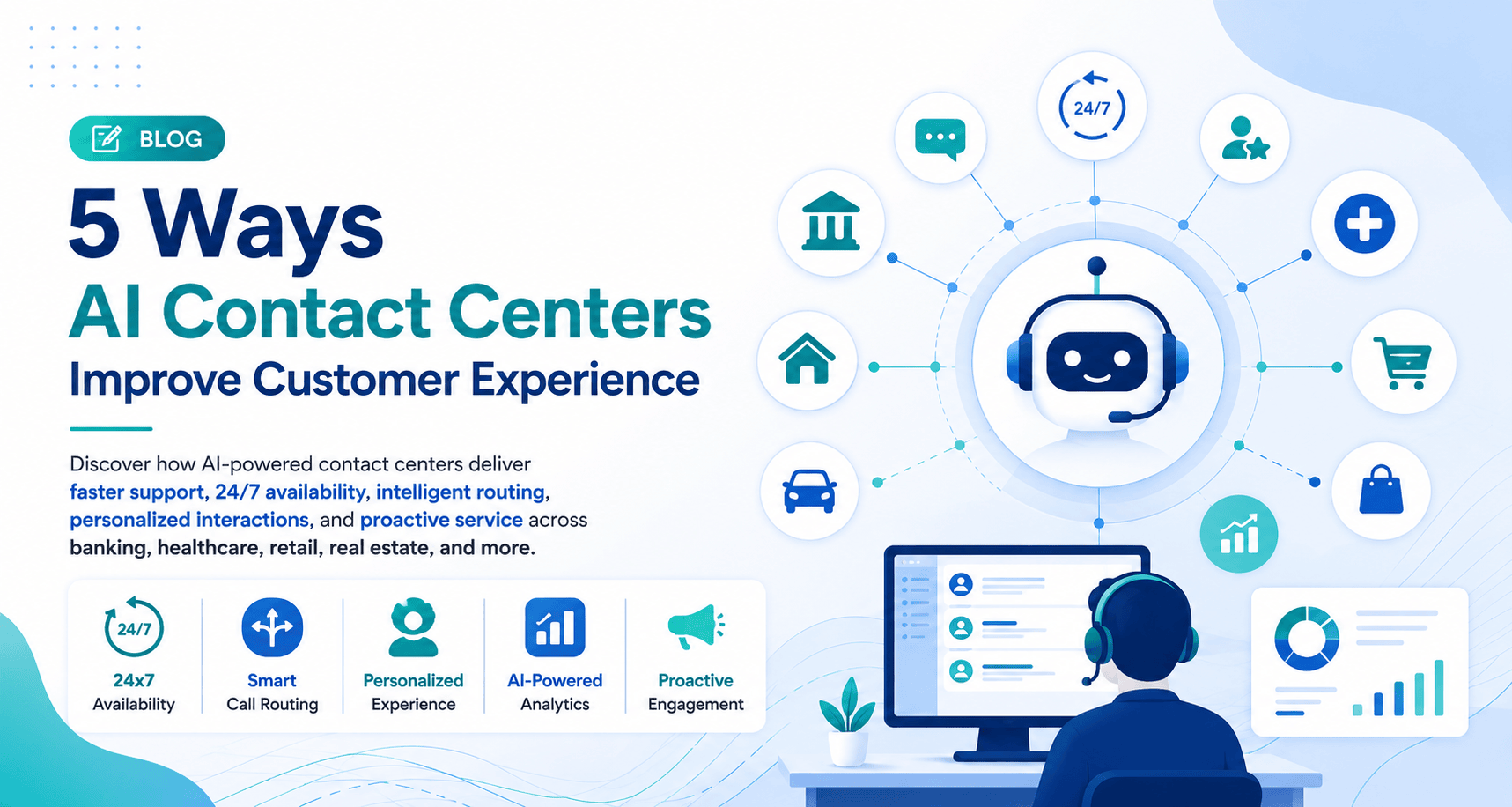
In this article, we look at five practical ways AI contact centers improve customer experience — and how these benefits play out across industries like banking, real estate, healthcare, automotive, and e-commerce.
1. 24x7 Availability Without Long Wait Times
Customers do not stop having questions at 6 PM. A home buyer may want project details late at night. A bank customer may need to block a card on a Sunday. Traditional contact centers either miss these calls or make customers wait in long queues.
AI voice bots and chatbots answer instantly, at any hour, in multiple languages. They handle routine queries — account balance, order status, appointment booking, site visit scheduling — on their own, and pass complex cases to human agents during working hours with full context. The result is simple: no missed calls, no long hold music, and no frustrated customers.
2. Faster Resolutions with Smart Call Routing
One of the biggest complaints customers have is being transferred from one department to another and repeating the same story each time. AI contact centers fix this with intelligent routing.
The system understands why the customer is calling — using speech recognition and intent detection — and connects them directly to the right team or the right agent. It also shows the agent the customer's history, past tickets, and previous conversations on one screen. First-call resolution goes up, average handling time comes down, and customers feel the business actually knows them.
3. Personalisation at Scale
A human agent can personalise a conversation for one customer at a time. AI can do it for thousands of customers at once. By connecting the contact center with the CRM, AI systems greet customers by name, know what they bought or enquired about, and tailor responses accordingly.
For example, an auto dealership's AI bot can remind a customer that their car service is due and book a slot in the same call. A bank's system can recognise a premium customer and route them to a dedicated relationship desk. This level of personalisation used to need large teams — now it runs automatically in the background.
4. Consistent Quality Through AI-Powered Agent Assist and Analytics
Customer experience often depends on which agent picks up the call. AI removes that lottery. Real-time agent assist tools listen to live calls and prompt agents with suggested answers, compliance reminders, and next-best actions. After the call, AI-based speech analytics reviews 100% of conversations — not just a random 2–3% sample — to flag quality issues, compliance gaps, and unhappy customers.
Managers get clear dashboards showing sentiment trends, common complaint themes, and agent performance. Training becomes targeted instead of generic, and service quality stays consistent across every shift and every location.
5. Proactive Service Instead of Reactive Support
The best customer experience is solving a problem before the customer has to call. AI contact centers make this possible. Automated outbound voice bots and messages can confirm deliveries, remind customers about payments or renewals, alert them about service disruptions, and follow up after a purchase or site visit.
This shift — from waiting for complaints to reaching out first — reduces inbound call volumes and makes customers feel cared for. Deloitte's research on service organisations consistently shows that proactive engagement is one of the strongest drivers of customer loyalty.
How These Benefits Play Out Across Industries
|
Industry |
Common Use Case |
Customer Experience Impact |
|
Banking & Financial Services (BFSI) |
AI voice bots for balance checks, card blocking, EMI reminders |
Instant service, better compliance, secure interactions |
|
Real Estate |
Automated site visit scheduling, lead qualification, follow-ups |
No missed leads, faster response to enquiries |
|
Automotive Dealers |
Service reminders, test drive bookings, feedback calls |
Higher service bookings, stronger customer retention |
|
Healthcare |
Appointment booking, report status, follow-up reminders |
Reduced waiting, timely care coordination |
|
E-commerce & Retail |
Order status, returns, delivery confirmation |
Fewer 'where is my order' calls, faster resolutions |
Conclusion: Better Experience, Lower Costs — You No Longer Have to Choose
For years, businesses believed that improving customer experience meant spending more — more agents, more shifts, more infrastructure. AI contact centers have broken that trade-off. With 24x7 availability, smart routing, personalisation, consistent quality, and proactive outreach, businesses can serve customers better while actually reducing costs.
Why CloudConnect for AI Contact Centers?
CloudConnect is India's first DOT-licensed B2B Virtual Network Operator (VNO), trusted by 450+ enterprise customers. Our AI-powered cloud contact center solutions come with a 99.9% uptime SLA, ISO 9001 and ISO 27001 certification, and 100% Indian data centers — so your customer data stays secure and fully compliant. Whether you run a bank, a dealership network, or a growing e-commerce business, we can help you deliver the customer experience your competitors cannot match. Visit cloudconnect.in to book a free demo.
Frequently Asked Questions (FAQs)
1. What is an AI contact center?
An AI contact center is a cloud-based customer service platform that uses artificial intelligence — voice bots, chatbots, smart routing, and speech analytics — alongside human agents to handle customer interactions faster and more efficiently.
2. Will AI replace human agents completely?
No. AI handles routine, repetitive queries so human agents can focus on complex and emotional conversations. The best results come from AI and humans working together.
3. Can AI contact centers work in Indian languages?
Yes. Modern AI voice bots support Hindi, English, and multiple regional languages, which is essential for serving customers across India.
4. Is customer data safe with an AI contact center?
It depends on the provider. With CloudConnect, all data is hosted in 100% Indian data centers with ISO 27001-certified security practices and full compliance with DOT regulations.
5. How quickly can a business set up an AI contact center?
Since the solution is cloud-based, most businesses can go live within days — not months. No heavy hardware or on-premise infrastructure is required.
6. Is an AI contact center only for large enterprises?
Not at all. Cloud-based pricing makes AI contact centers affordable for small and mid-sized businesses too. You pay for what you use and scale as you grow.
References
• Gartner — Forecasts on conversational AI and contact center agent labour cost reduction (gartner.com)
• McKinsey & Company — Research on AI-enabled customer care and service transformation (mckinsey.com)
• Deloitte — Global Contact Center Survey (deloitte.com)
• Nasscom — Reports on AI adoption and India's technology industry (nasscom.in)
• TRAI — Telecom and industry performance data (trai.gov.in)