If your bank's contact center hardware crashed tomorrow, how long would your customers wait before they could reach you again? A few years ago, this was a real fear for most banks, NBFCs, and insurance companies in India. Their customer service ran on physical EPABX systems, on-premise dialers, and servers sitting in one office. One outage, one flood, one lockdown — and thousands of customer calls simply went unanswered.
That is why the industry moved to the cloud. Deloitte's Global Contact Center Survey shows that a large majority of contact centers have either moved to the cloud or are in the process of moving, and BFSI is at the front of this shift. The reasons go beyond safety. McKinsey's work on banking operations shows that institutions which modernise customer engagement reduce cost-to-serve while improving satisfaction — and Gartner expects conversational AI, especially voice bots, to save contact centers around USD 80 billion in agent labour costs by 2026. In India, TRAI data shows call and data usage climbing every year, so query volumes will only grow.
Here is a quick look at the numbers behind this shift:
|
Metric |
Data Point |
Source |
|
Contact centers moved or moving to cloud |
Large majority, BFSI leading |
Deloitte Global Contact Center Survey |
|
Labour cost savings from voice bots and conversational AI |
~USD 80 billion by 2026 |
Gartner |
|
Routine banking calls that can be automated |
60–70% of inbound volume |
McKinsey / industry estimates |
|
Time to set up a cloud contact center |
Days to weeks (vs months for on-premise) |
Industry benchmarks |
|
Growth in India's digital banking users |
Rising year on year |
TRAI / Nasscom |
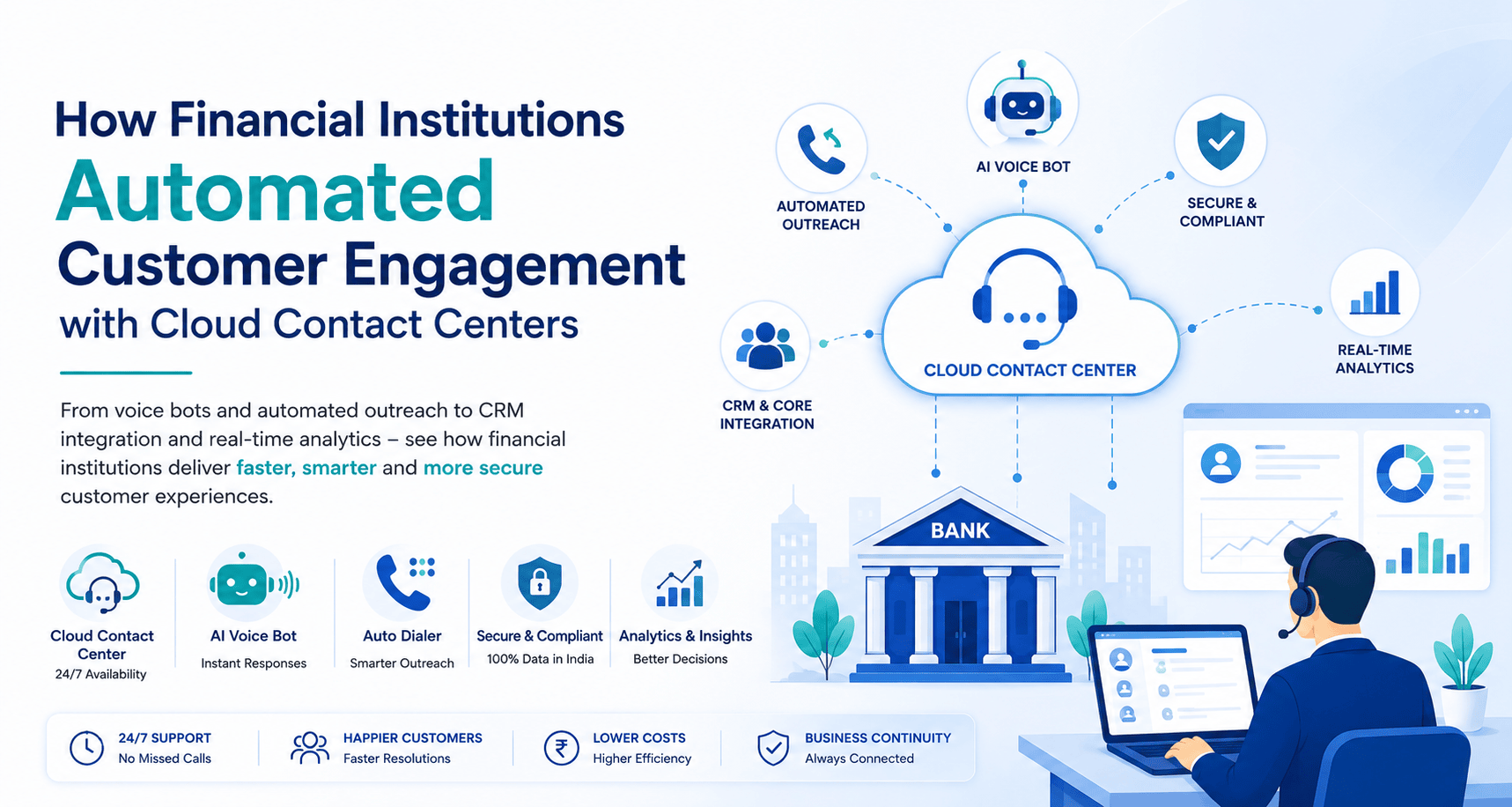
So what did this journey actually look like? Here are the five steps most financial institutions followed to automate customer engagement with a cloud contact center.
1. They Moved Customer Calling from Hardware to the Cloud
The first step was the simplest but the most important — replacing the physical phone system with a cloud platform. No EPABX boxes, no server rooms, no wires. Agents just need a laptop, a headset, and an internet connection.
This one change solved several problems at once. Agents could work from any branch, office, or home. Adding 50 agents during a festival season took hours, not weeks. And because the platform runs from secure data centers with high uptime guarantees, customer calling no longer depended on one office staying operational. For an industry where a missed call can mean a lost loan customer, this reliability changed everything.
2. They Put Voice Bots on the Front Line
Once calling moved to the cloud, adding intelligence became easy. The biggest step was deploying AI voice bots to answer calls first. Most calls to a bank are routine — balance enquiry, blocking a lost card, EMI due date, loan application status, branch timings. A voice bot handles all of these on its own, in Hindi, English, and regional languages, at any hour of the day.
The customer speaks normally, the bot verifies their identity, completes the task, and sends a confirmation on SMS or WhatsApp. If the query is complex or sensitive, the bot transfers the call to a human agent — along with the full context, so the customer never repeats their story. In most institutions, voice bots now handle 60–70% of inbound calls, and customers get answers in seconds instead of waiting in a queue.
3. They Automated Outbound Engagement — Reminders, Renewals, and Collections
Financial institutions do not just receive calls, they make them — payment reminders, policy renewals, lead follow-ups, EMI collections, KYC document requests. Earlier this needed large tele-calling teams dialling numbers manually all day.
Cloud contact centers automated this completely. Auto-dialers and outbound voice bots now make these calls at the right time, follow the approved script every single time, and log every response back into the system. A customer who asks for a call-back gets one, automatically routed to the right officer. Collections improved because reminders became consistent and polite, and sales teams stopped losing leads because no follow-up ever slips through.
4. They Connected the Contact Center with CRM and Core Systems
Automation only works well when systems talk to each other. So institutions connected their cloud contact center with their CRM, core banking, and loan management systems. Now, when a call lands, the agent's screen already shows who the customer is, their products, recent transactions, past complaints, and what the voice bot has already done on the call.
This is what customers actually feel as 'good service' — not repeating their account number three times, not explaining an old complaint again, and getting an answer on the first call. For the institution, it means shorter calls, higher first-call resolution, and agents who can focus on solving problems instead of searching for information.
5. They Used Call Recording and Analytics to Stay Compliant and Improve
RBI and IRDAI expect strict controls — call recording, data protection, and proof that customers were given correct information. On old systems, compliance teams could only sample 2–3% of calls manually. On a cloud contact center, every call is recorded and stored securely, and speech analytics can review 100% of conversations for mis-selling, missing disclosures, or angry customers.
Managers get simple dashboards showing call volumes, wait times, common complaint themes, and agent performance. Training became targeted, audits became painless, and the quality of customer conversations kept improving month after month.
The Change at a Glance
|
Area |
Old On-Premise Setup |
Cloud Contact Center |
|
Infrastructure |
EPABX, servers, wiring in office |
Fully cloud-based, no hardware |
|
First response |
IVR menus and hold queues |
Voice bot answers instantly, 24x7 |
|
Scaling up |
Weeks of procurement and setup |
New agents added in hours |
|
Outbound calling |
Manual dialling by tele-callers |
Auto-dialers and outbound voice bots |
|
Compliance checks |
2–3% of calls sampled manually |
100% of calls recorded and analysed |
|
Business continuity |
Depends on one office location |
Agents work from anywhere |
Conclusion: The Cloud Made Automation Possible — Voice Bots Made It Powerful
The move to cloud contact centers was not just an IT upgrade for financial institutions. It was the foundation that made everything else possible — voice bots on the front line, automated outbound engagement, connected customer data, and complete compliance visibility. Institutions that made this shift now serve customers faster, at lower cost, with far fewer missed opportunities. The ones still running on old hardware are not just spending more — they are falling behind on the experience their customers now expect.
Why Financial Institutions Choose CloudConnect ?
CloudConnect is India's first DOT-licensed B2B Virtual Network Operator (VNO), trusted by 350+ enterprise customers. Our cloud contact center platform — with AI voice bots, auto-dialers, CRM integration, and full call analytics — is built for the security and compliance needs of banks, NBFCs, and insurers. With a 99.9% uptime SLA, ISO 9001 and ISO 27001 certification, and 100% Indian data centers, your customer data stays in India and your customer engagement never goes down. Visit cloudconnect.in to book a free demo.
Frequently Asked Questions
1. What is a cloud contact center?
It is a customer calling platform hosted in secure data centers instead of physical hardware in your office. Agents log in from anywhere with just a laptop and internet, and features like voice bots, auto-dialers, and call recording are built in.
2. What role does a voice bot play in a cloud contact center?
The voice bot is the first responder. It answers calls instantly, handles routine queries like balance checks, card blocking, and EMI reminders in multiple languages, and transfers complex calls to human agents with full context.
3. Is a cloud contact center safe enough for banking data?
Yes, if the provider is right. CloudConnect hosts all data in 100% Indian data centers with ISO 27001-certified security and operates under a DOT VNO license, which supports RBI's data localisation expectations.
4. Do we need to remove our existing phone numbers or IVR ?
No. Your existing numbers can be moved to the cloud platform, and your IVR can be upgraded to a voice bot gradually — customers only notice that service got faster.
5. How long does migration from an on-premise system take ?
Most institutions go live in a few weeks, including CRM and core system integrations. Basic cloud calling can start in days.
6. Is this affordable for smaller NBFCs and cooperative banks?
Yes. Cloud contact centers work on a pay-as-you-use model with no hardware investment, so smaller institutions get the same technology as large banks at a cost that fits their size.
References
• Deloitte — Global Contact Center Survey (deloitte.com)
• Gartner — Forecasts on conversational AI and voice bot cost savings (gartner.com)
• McKinsey & Company — Banking operations and customer engagement research (mckinsey.com)
• TRAI — Indian Telecom Services Performance Indicators (trai.gov.in)
• Nasscom — Technology adoption in Indian BFSI (nasscom.in)