What if the follow-up call your sales team makes today never reaches your customer's ear — not because they rejected it, but because an AI spam filter silently blocked it before the first ring? That scenario is no longer hypothetical. As India's Telecom Regulatory Authority tightens its grip on unsolicited commercial communication in 2026, the line between ‘legitimate business outreach’ and ‘spam’ is being redrawn — and every business that picks up a phone to call a customer needs to know exactly where that line now sits.
The numbers explain the urgency. Here's the shape of the problem TRAI is responding to, and the compliance reality it has created for outbound calling in 2026.
|
What's Changed |
The Number |
|
Spam calls received by Indian mobile users (past year) |
4,168 crore (2025 India Insights Report) |
|
Consumer complaint window (extended, Feb 2025 amendment) |
3 days → 7 days |
|
Penalty for first UCC violation |
₹2 lakh |
|
Penalty for second violation |
₹5 lakh |
|
Penalty from third violation onward |
₹10 lakh per instance |
|
Maximum blacklisting period for repeat/unregistered offenders |
Up to 2 years |
|
Typical answer rate — unregistered/generic promotional numbers |
8%–20% |
|
Typical answer rate — verified 160-series / brand-recognised numbers |
45%–65% |
|
Sectors moving to the Digital Consent dashboard by August 2026 |
Banks (first), then fintech, insurance, e-commerce |
1. Why TRAI Is Tightening the Net in 2026
India's spam problem has scaled well beyond nuisance calls. Voice-cloning tools, automated dialers, and robo-calling have let bad actors impersonate legitimate businesses and government bodies at a volume regulation has struggled to keep pace with. TRAI's response has been built up in stages rather than a single sweeping rule change.
● 2018 — The Telecom Commercial Communications Customer Preference Regulations (TCCCPR) establish the original framework governing unsolicited commercial communication (UCC).
● October 2024 — Telemarketing calls on the 140 series are migrated onto the DLT (Distributed Ledger Technology) platform for blockchain-based tracking and monitoring.
● August 2024 — TRAI issues directions enabling disconnection of telecom resources and blacklisting of up to two years for entities violating promotional-calling rules.
● February 2025 — The TCCCPR Second Amendment tightens consent rules, extends the consumer complaint window from 3 to 7 days, and sets the current tiered penalty structure.
● March 2026 — A draft Third Amendment proposes advance declaration of automated A2P voice calls, a possible termination charge to discourage bulk robo-dialling, mandatory AI/ML-based spam detection, and KYC re-verification for callers. Public consultation closed in April 2026, with a final rule expected later in the year.
The direction of travel is unmistakable: more automated detection, faster enforcement, and less tolerance for ambiguity between ‘promotional’ and ‘necessary’ business communication.
2. The New Rules Every Business Needs to Know
For a business making outbound calls in 2026 — whether for sales, collections, service updates, or appointment reminders — five mechanics of the framework matter most.
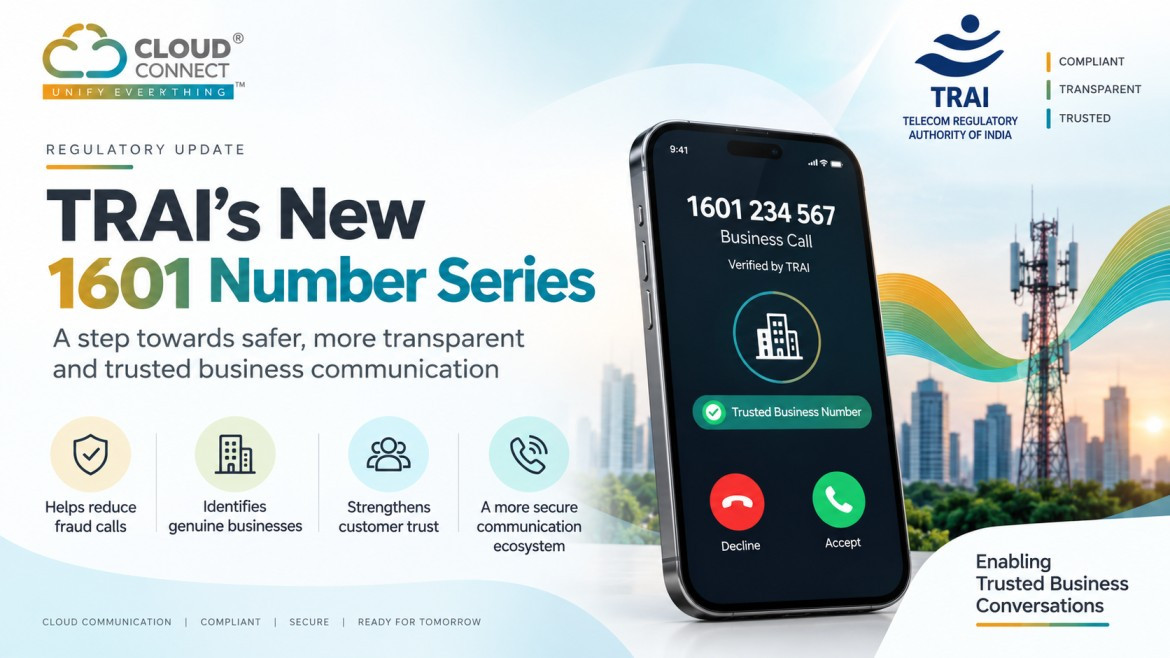
● Number series discipline: Promotional calls must originate from 140-series numbers; transactional and service calls use the 160 series (1600 for government entities). Mixing the two isn't a technicality — it's classified as an Unregistered Telemarketer violation.
● DLT registration: Every Principal Entity (the business) and its Telemarketer must be registered on a TRAI-approved DLT platform, with headers and message templates pre-approved, before any calling campaign begins.
● Consent management: Inferred consent now holds only for the duration of the underlying contractual relationship; explicit consent for a transaction is valid for just 7 days from when it was captured, tracked through the Digital Consent Acquisition (DCA) framework.
● Calling hours: Outbound commercial calls are restricted to 9 AM–9 PM, with violations outside this window treated the same as other UCC breaches.
● Caller identity integrity: Under Section 42 of the Telecommunications Act, 2023, and the Calling Name Presentation (CNAP) regime, tampering with or masking the originating number is a criminal offence — not just a regulatory infraction.
3. What Happens If You Don't Comply
The penalty structure under the TCCCPR Second Amendment is deliberately escalating: ₹2 lakh for a first violation, ₹5 lakh for a second, and ₹10 lakh per instance from the third onward. But fines are only part of the exposure.
● Disconnection: Telecom resources belonging to an unregistered or repeat-offending sender can be disconnected entirely by the primary service provider.
● Blacklisting: Offenders can be blacklisted for up to two years, during which no access provider is permitted to allocate them new telecom resources.
● Cross-network propagation: Once a sender is blacklisted, that status is shared with every other access provider on the DLT platform within 24 hours — and each provider must disconnect that sender's resources within the following 24 hours. There is no single-operator workaround.
● Low complaint thresholds: Enforcement action can be triggered by a small number of consumer complaints, well before volumes that would suggest deliberate spam.
The ambiguity cuts both ways, too. Regulation 25's complaint-driven enforcement doesn't formally distinguish genuine B2B outreach from consumer spam — a gap serious enough that platforms like IndiaMart have challenged it in the Delhi High Court on constitutional grounds, with the matter listed for hearing in 2026. Until that's resolved, businesses relying on outbound B2B calling can't assume they're outside the scope of these rules simply because their recipients are other businesses.
4. The Business Case for Compliance Goes Beyond Avoiding Fines
Compliance isn't purely defensive — it directly affects whether your calls get answered at all. As AI-based spam filters get better at pattern-matching, the gap between compliant and non-compliant calling is widening into a deliverability problem, not just a legal one.
● Numbers seen as generic or unregistered promotional lines are converging on 8%–20% answer rates as consumers and carrier-side AI filters both learn to screen them out.
● Verified 160-series and brand-recognised numbers are seeing 45%–65% answer rates — the prefix itself signals legitimacy before a word is spoken.
● As telecom operators roll out mandatory AI/ML spam detection under the proposed Third Amendment, the businesses with clean DLT registration, correct number series, and documented consent will be the ones AI filters learn to trust — and everyone else will face declining reach regardless of call quality or offer.
In short: the compliance discipline TRAI is enforcing is converging with what good outbound practice already looked like. Businesses that treat this as a deliverability strategy, not just a legal checkbox, will out-perform competitors who don't.
5. How to Future-Proof Your Outbound Calling Now
● Register your Principal Entity and Telemarketer on a TRAI-approved DLT platform before your next campaign, not during it — registration can take days to weeks.
● Audit every outbound number against its actual use — promotional traffic on 140, transactional/service traffic on 160 — and correct any mismatches.
● Build real-time DND/NCPR scrubbing into your dialling workflow rather than relying on periodic list cleaning.
● Log consent artefacts per call — source, timestamp, and validity window — so they're retrievable in an audit, not just recorded in a spreadsheet.
● If using AI voice calling, build in clear AI disclosure at call start and pre-declare auto-dialer usage, anticipating the KYC re-verification requirements proposed in the draft Third Amendment.
● Work with a DOT-licensed, DLT-integrated telecom partner rather than assembling compliance in-house across multiple vendors — the coordination overhead of consent, number series, and audit logging is easy to get wrong piecemeal.
140 Series vs. 160/1600 Series: At a Glance
|
|
140 Series |
160 / 1600 Series |
|
Purpose |
Promotional / telemarketing calls |
Transactional & service calls |
|
Who uses it |
All businesses running marketing/sales outreach |
BFSI (160) and government entities (1600) for service calls |
|
Registration |
DLT: Principal Entity + Telemarketer + header/template |
DLT registration + sector-specific allocation |
|
DND / consent scrubbing |
Mandatory before every call |
Not required for genuine transactional use, but consent trail still expected |
|
Typical answer rate |
8%–20% |
45%–65% |
|
Risk if misused |
Blacklisting, disconnection, ₹2–10 lakh penalties |
Criminal liability under Section 42 if masked or misused for promotions |
|
Why Choose CloudConnect? |
|
● India's first DOT-licensed B2B Virtual Network Operator (VNO) — built to operate inside TRAI's regulatory framework, not around it ● DLT-integrated calling infrastructure, so Principal Entity and telemarketer registration, header/template approval, and consent scrubbing are handled as part of the platform, not bolted on afterward ● 100% Indian data centers, supporting the data residency expectations under the DPDP Act, 2023 for call recordings and consent records ● ISO 9001 and ISO 27001 certified, giving BFSI, real estate, auto dealer, and D2C compliance teams an audit-ready paper trail ● 99.9% uptime SLA, so compliance-driven call windows (9 AM–9 PM) and time-boxed campaigns don't lose reach to downtime ● 450+ enterprise brands already routing voice and SIP traffic through infrastructure designed for correct number-series allocation and CNAP-compliant caller identity |
Conclusion
TRAI's anti-fraud push isn't a temporary crackdown — it's a structural shift in how outbound calling is expected to work in India, moving toward the same discipline that email and SMS marketing went through a decade earlier: registration, consent, and traceability as the price of reach. For BFSI, real estate, auto dealer, and D2C businesses that depend on outbound calling to convert leads and retain customers, the choice isn't between compliance and growth. Getting the DLT registration, number series, and consent framework right now is what protects the growth.
Frequently Asked Questions
1. What's the real difference between the 140 series and the 160/1600 series?
The 140 series is reserved for promotional and telemarketing calls and must be registered on the DLT platform with DND scrubbing before every call. The 160 series (and 1600 for government) is reserved for transactional and service calls — things like OTPs, delivery updates, or account alerts — and carries a much higher consumer trust and answer rate. Using a 140 number for service calls, or a 160 number for sales pitches, is itself a compliance violation, regardless of content.
2. Do B2B outreach calls also fall under TRAI's spam regulations?
This is genuinely unsettled. TRAI's Regulation 25 enforcement system doesn't formally distinguish business-to-business outreach from consumer spam, which is exactly what platforms like IndiaMart have challenged in the Delhi High Court. Until that matter is resolved, the safest approach for any business making outbound B2B calls is to treat them with the same DLT registration and consent discipline as B2C calls.
3. What is DLT registration and how long does it take?
DLT (Distributed Ledger Technology) is the blockchain-based platform where every Principal Entity (business) and Telemarketer must register before making commercial calls, along with approved headers and message templates. Registration on any one TRAI-approved DLT platform is recognised across all telecom operators. It typically takes anywhere from a few days to a few weeks depending on documentation readiness, so it needs to happen well before a campaign launch, not during one.
4. Can AI voice bots legally be used for outbound calling in 2026?
Yes, but with conditions. Current guidance requires clear disclosure at the start of the call that an AI or automated system is being used, pre-declaration of auto-dialer usage, and DND/consent verification before every call attempt. TRAI's draft Third Amendment (under consultation in 2026) proposes going further, with mandatory AI/ML-based spam detection and KYC re-verification for callers — so AI calling programmes should be built for tighter rules ahead, not just today's baseline.
5. What actually happens if a customer complains about our calls?
Complaints trigger a graduated penalty structure under the TCCCPR Second Amendment: ₹2 lakh for a first violation, ₹5 lakh for a second, and ₹10 lakh per instance from the third onward. Beyond fines, repeat or unregistered offenders can have all telecom resources disconnected and be blacklisted for up to two years — and that blacklist status is shared across all access providers within 24 hours, so it isn't limited to a single operator.
6. Are WhatsApp and other OTT messaging channels covered by these rules?
No — this is one of the most common misconceptions. WhatsApp Business operates under Meta's own Business Messaging Policy, outside TRAI's DLT framework entirely. That doesn't mean it's unregulated (the DPDP Act still applies to data handling), but WhatsApp-specific spam rules and DLT registration requirements don't carry over from voice and SMS.
7. How do we know if our current outbound calling setup is actually compliant?
At minimum, check five things: your Principal Entity and telemarketer are registered on DLT; you're calling from the correct number series for the call's purpose; every number is scrubbed against the DND/NCPR registry in real time before dialling; consent records are logged and retrievable per call; and calls stay within the 9 AM–9 PM window. If any of these are missing or manual, it's worth a compliance audit before your next campaign, not after a complaint.
About CloudConnect
CloudConnect helps businesses build reliable and scalable communication infrastructure with advanced voice and business communication solutions. As leading cloud telephony providers in India and experienced SIP trunk providers, we offer powerful PBX solutions, cloud telephony, IVR, and call center solutions to streamline business communication.
References
TRAI's Crackdown on Spam Calls and AI-Driven Telemarketing — Bar and Bench
TRAI's Crackdown on Spam Calls and AI-Driven Telemarketing — S.S. Rana & Co.
TRAI Compliance for Outbound Calls & Business Messaging in India: 2026 Checklist — Express IVR
160 Series Numbers for Government Entities in India: TRAI's Outreach Mandate Explained — FreJun
TRAI Compliance for Call Centers India: 2026 Guide — FreJun
Related Reading
Toll-Free Numbers in India: Features, Pricing & Best Providers
How to Get a DID Mobile Number in India for Your Business
Best Cloud Telephony Providers in India: Features, Pros & Cons
UCaaS vs. CCaaS: Understanding the Difference Between Two Cloud Communication Platforms