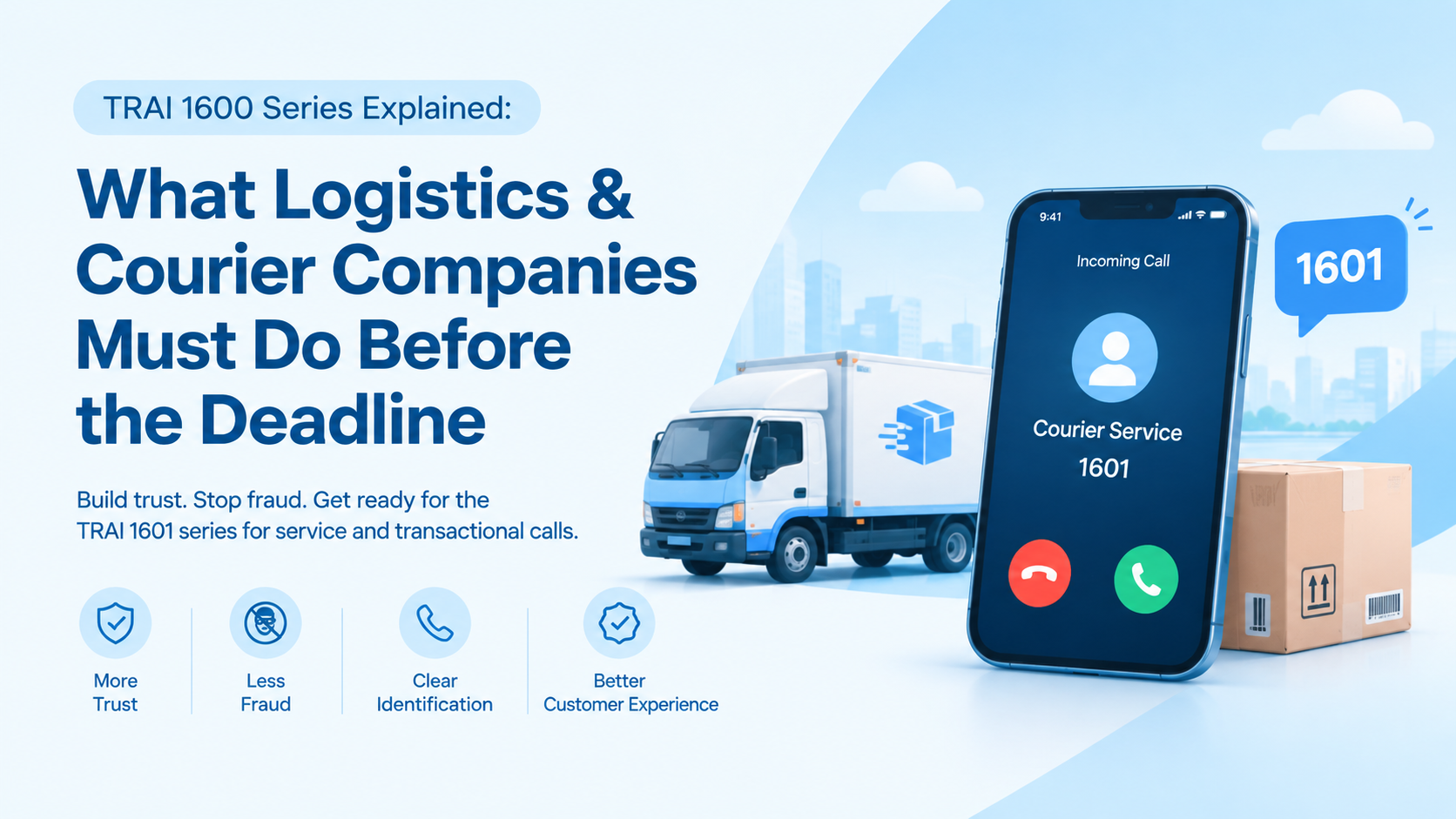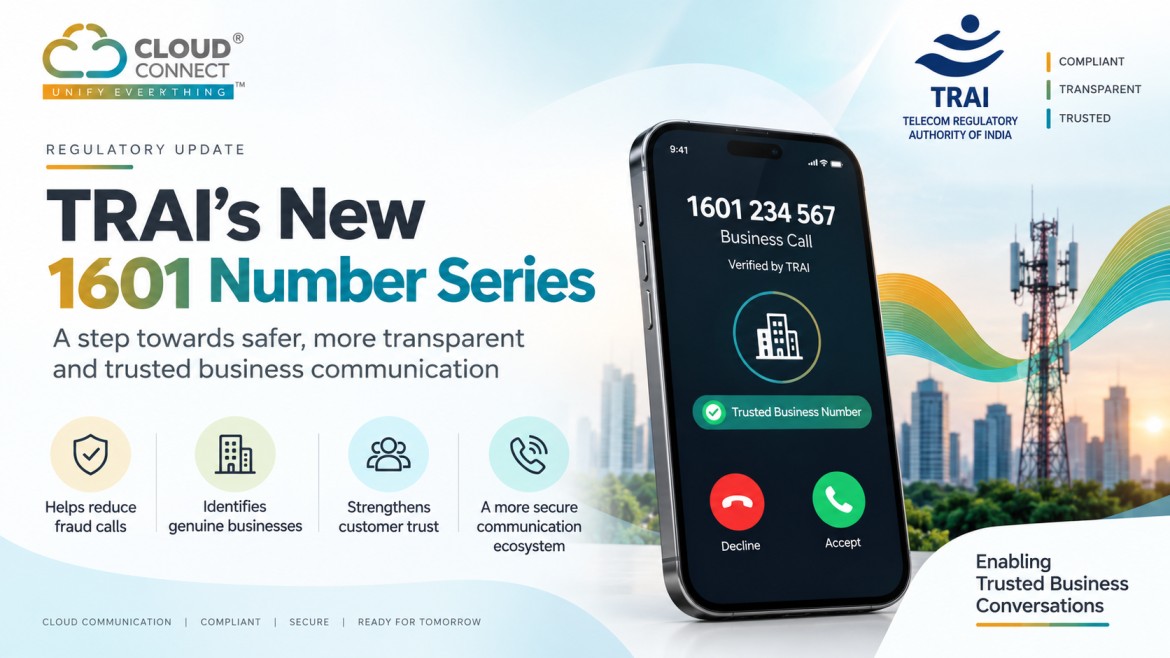
What if your customers could tell, the instant their phone rings, that it's genuinely your delivery rider, your electricity board, or your gas distributor calling — and not another impersonation scam?
That is precisely the problem the Telecom Regulatory Authority of India (TRAI) set out to solve on 10 August 2026, when it directed telecom service providers (TSPs) to begin allotting a dedicated 1601 number series to eligible entities in the utilities and courier & logistics sectors. For an industry that places hundreds of crores of service and transactional calls every month, this is not a minor numbering tweak — it is a fundamental shift in how customers will learn to trust (or distrust) a call from your business.
The Scale of the Trust Problem — By the Numbers
Before looking at what the 1601-series direction requires, it helps to see why TRAI felt compelled to act. The data paints a stark picture of a voice ecosystem under siege — and of what's at stake for legitimate businesses trying to reach their own customers.
|
Metric |
Data Point |
|
Spam/scam calls received by Indian users (2025) |
~40 billion (4,000 crore) — Truecaller India Insights Report |
|
Share of unknown calls flagged as spam or fraud |
66% — India ranked 5th most spam-hit market globally |
|
Fraud calls specifically (2025) |
~7.7 billion, incl. 18% financial-services impersonation, 12% scams |
|
Fraudulent mobile numbers disconnected (trailing 12 months, late 2025) |
~2.1 million numbers; 100,000+ entities blacklisted |
|
Penalties on TSPs for failing to curb spam (early 2026) |
₹150 crore (₹1.5 billion) |
|
Sectors covered under 1601 Phase-I |
Utilities + Courier & Logistics |
|
TSP migration/onboarding deadline |
90 days from the order date (i.e., by ~8 November 2026) |
Note: Figures above are drawn from Truecaller's India Insights Report, TRAI/DoT public statements, and contemporaneous news coverage (Aug 2026). Spam-volume and enforcement figures update frequently and should be reverified against the original source before external publication.
1. What TRAI's 1601-Series Direction Actually Says
Until now, the 1600-series was reserved almost exclusively for BFSI (banking, financial services, insurance) and government entities. TRAI's new order extends the same 'trusted numbering' logic to two sectors that generate an enormous volume of everyday service calls — utilities and courier & logistics — under a distinct 1601 series, so these calls are never mixed up with sensitive financial communications.
Phase-I Eligible Categories
|
Sector |
Eligible Entities |
|
Utilities |
Electricity distribution companies; water utility service providers; City Gas Distribution (CGD) companies; LPG distribution entities; other eligible utility service providers |
|
Courier & Logistics |
Courier companies; express logistics companies; parcel delivery service providers; freight and logistics service providers engaged in delivery of consignments |
Key provisions to note:
● 1601-series numbers go directly to eligible entities — never to intermediaries or aggregators.
● TSPs must independently verify entity eligibility before allocating a 1601 number.
● Entities must submit an undertaking for exclusive use of 1601 numbers for service and transactional voice calls only.
● The 1601-series is strictly prohibited from use in promotional voice calls.
● TSPs must complete migration/onboarding of all eligible Phase-I entities within 90 days of the order.
2. Why This Matters Now: The Trust Deficit in Voice Calls
Fraudsters routinely spoof ordinary 10-digit mobile numbers to impersonate banks, delivery agents, and utility providers — a tactic behind everything from fake 'your parcel is on hold' scams to impersonated electricity-disconnection threats. Truecaller's analysis of unwanted calls shows just how commercially exploited this trust gap has become:
|
Category of Unwanted/Fraud Calls |
Approx. Share |
|
Sales & telemarketing |
36% |
|
Financial-services impersonation |
18% |
|
Outright scams (incl. impersonation, 'digital arrest') |
12% |
|
Other spam categories |
34% |
The consequence for legitimate service providers is direct: when customers can't distinguish a real delivery-confirmation call or an electricity-billing call from a scam attempt, answer rates fall — and so does the effectiveness of your entire customer communication funnel. A dedicated, verified 1601 prefix is designed to reverse that.
Worth flagging for balance: caller-ID platforms like Truecaller have publicly contested how well number-series-based trust signals work in practice, citing high manual block rates on the existing 1600-series. TRAI and industry are still refining enforcement — which makes early, compliant adoption (rather than a wait-and-see approach) the safer commercial bet.
3. Utilities Sector: The Data Behind the Urgency
India's utilities sector — especially power distribution — is both call-heavy and reputationally exposed to impersonation fraud (fake disconnection notices, fake bill-payment links). The scale of the sector explains why it was prioritized in Phase-I:
|
Metric |
Data Point |
|
Number of electricity DISCOMs in India |
72 (state-owned, private, and power-department entities) |
|
Aggregate Technical & Commercial (AT&C) losses, FY2024 |
16.37% (down from a third higher a decade ago) |
|
Transmission & Distribution losses, FY2023-24 |
17.63% |
|
Average discom dependence on tariff subsidies, FY2025 |
~21% of revenue (up from 17% in FY2021) |
|
Electricity access |
100% household electrification |
For water utilities, CGD players, and LPG distributors, the operational logic is the same: high call volumes for billing, outage alerts, safety notices, and service confirmations — all now eligible to move onto a number customers can learn to trust on sight.
4. Courier & Logistics: A Market Racing Ahead of Trust
India's courier, express & parcel (CEP) and e-commerce logistics markets are among the fastest-growing in the world — which also means fraudulent 'delivery' calls and messages are growing in lockstep. The commercial upside of a trusted number is just as large as the fraud risk it addresses:
|
Metric |
Data Point |
|
India CEP market size, 2025 |
USD 9.57 billion |
|
India CEP market size, 2026 (est.) |
USD 10.58 billion, growing at ~10.58% CAGR to 2031 |
|
India e-commerce logistics market, 2025 |
USD 6.65 billion |
|
India e-commerce logistics market, 2026 (est.) |
USD 7.25 billion, projected to reach USD 11.14 billion by 2031 (8.98% CAGR) |
|
Road transport share of freight tonnage |
56.10%–69.97% depending on segment |
|
Express delivery growth rate |
~11.02% CAGR (2026–2031) |
Every one of those parcel movements typically triggers multiple service calls or IVR interactions — dispatch confirmation, out-for-delivery alerts, delivery-failure follow-ups, COD confirmations. At this scale, a verified 1601 identity isn't a compliance checkbox; it's a direct lever on delivery-call answer rates and, ultimately, customer satisfaction and repeat orders.
Note: Market-size estimates vary meaningfully across research providers (Mordor Intelligence, Grand View Research, Expert Market Research); figures above are from Mordor Intelligence and should be cross-checked against the latest release before use in external-facing materials.
5. The 90-Day Countdown: What Eligible Entities Must Do Now
With TSPs directed to complete migration within 90 days of the order, the practical window for utilities and courier/logistics brands to act is already closing. Here's the compliance checklist:
|
Requirement |
What It Means for You |
|
Confirm eligibility |
Verify your entity falls under one of the Phase-I categories (utilities or courier/logistics — not an aggregator or intermediary) |
|
Prepare verification documentation |
TSPs must independently verify eligibility before allocation — have licenses/registrations ready |
|
Submit an exclusive-use undertaking |
Formal commitment that 1601 numbers will be used only for service/transactional voice calls |
|
Segregate promotional traffic |
Promotional voice calls must continue on the appropriate series (e.g., 140-series) — never on 1601 |
|
Plan for migration within the window |
TSPs must onboard all eligible entities within 90 days of the order date — early movers avoid last-mile bottlenecks |
Now is the moment to start engaging every existing and target customer in these two categories — not after competitors have already migrated and captured the 'verified caller' advantage.
|
Why Choose CloudConnect? ● India's first DOT-licensed B2B Virtual Network Operator (VNO) — built for regulated, enterprise-grade voice communication. ● ISO 9001 and ISO 27001 certified, with 99.9% uptime SLA across all voice and cloud communication services. ● 100% Indian data centers — full data residency and compliance alignment for TRAI-regulated numbering series. ● 450+ enterprise clients already trust CloudConnect's Cloud Telephony, Cloud PBX, SIP Trunking, and Cloud Call Center platforms. ● Hands-on support for 1601-series eligibility verification, documentation, and 90-day migration — so you're compliant without disrupting customer-facing operations. Get migration-ready today at cloudconnect.in. |
Conclusion
The 1601-series is more than a regulatory formality — it's TRAI's attempt to rebuild trust in a voice channel that fraud has steadily eroded, and it directly benefits any utility, courier, or logistics business willing to move early. With a hard 90-day migration window already running, eligible entities that verify, document, and onboard now will be the ones customers learn to answer without hesitation — while those that wait risk being lost in the noise of a still-unverified 10-digit number.
Frequently Asked Questions
What is the 1601 number series?
It's a new TRAI-mandated numbering series for service and transactional voice calls made by eligible entities in the utilities and courier & logistics sectors, introduced to help customers instantly identify legitimate business calls and reduce impersonation fraud.
Which businesses are eligible for 1601 numbers in Phase-I?
Electricity distribution companies, water utility providers, City Gas Distribution (CGD) companies, LPG distribution entities, and other utility service providers; plus courier companies, express logistics firms, parcel delivery service providers, and freight/logistics operators engaged in consignment delivery.
Can aggregators, marketplaces, or platform intermediaries get a 1601 number?
No. TRAI has explicitly directed that 1601-series numbers be allocated directly to eligible entities only — not to intermediaries or aggregators that operate a platform on their behalf.
Can 1601 numbers be used for promotional or marketing calls?
No. The 1601-series is strictly reserved for service and transactional voice calls. Promotional voice calls must continue to use the appropriate designated series (such as 140-series) and are prohibited on 1601.
What is the deadline for migrating to the 1601 series?
TSPs have been directed to complete migration/onboarding of all eligible Phase-I entities within 90 days from the date the order was issued (10 August 2026), putting the effective deadline around early November 2026.
How is the 1601-series different from the existing 1600-series?
The 1600-series is reserved for BFSI (banking, financial services, insurance) and government entities. The 1601-series was created as a distinct series specifically for utilities and courier/logistics, so their service calls are never mixed with sensitive financial communications.
How can CloudConnect help my business migrate to the 1601 series?
As a DOT-licensed B2B Virtual Network Operator with ISO 9001/27001 certification and 100% Indian data centers, CloudConnect can guide eligibility verification, prepare the required documentation and exclusive-use undertaking, and manage the end-to-end migration of your service and transactional voice traffic onto the 1601 series — well within the 90-day compliance window.
About CloudConnect
CloudConnect helps businesses build reliable and scalable communication infrastructure with advanced voice and business communication solutions. As leading cloud telephony providers in India and experienced SIP trunk providers, we offer powerful PBX solutions, cloud telephony, IVR, and call center solutions to streamline business communication.
References
Business Standard — TRAI directs utilities, courier and logistics providers to use 1601 series: https://www.business-standard.com/industry/news/trai-directs-utilities-courier-and-logistics-providers-to-use-1601-series-126081001287_1.html
Medianama — TRAI issues 1601 series for utilities, logistics and courier services: https://www.medianama.com/2026/08/223-trai-1601-series-logistics-courier-services/
Trak.in — TRAI Rolls Out 1601 Number Series For Utility, Courier And Logistics Calls: https://trak.in/stories/trai-rolls-out-1601-number-series-for-utility-courier-and-logistics-calls/
WION News — 41.68 billion spam calls in India: Truecaller data: https://www.wionews.com/trending/41-68-billion-spam-calls-in-india-66-per-cent-of-unknown-numbers-on-truecaller-were-spam-whatever-happened-to-do-not-disturb-1778144364126
Voice&Data — India is fifth most spam-hit market globally, Truecaller report 2025: https://www.voicendata.com/telecom/india-fifth-most-spam-hit-market-globally-66-calls-flagged-11802470
Related Reading
Toll-Free Numbers in India: Features, Pricing & Best Providers
How to Get a DID Mobile Number in India for Your Business
Best Cloud Telephony Providers in India: Features, Pros & Cons
UCaaS vs. CCaaS: Understanding the Difference Between Two Cloud Communication Platforms