Cloud telephony has become the backbone of modern customer communication—powering sales, support, and engagement across industries like fintech, edtech, healthcare, and eCommerce.
While multiple platforms exist, choosing the right one depends on performance, pricing transparency, scalability, and integration capability.
This guide compares CloudConnect with leading cloud telephony platforms
1. Platform Overview
|
Feature |
CloudConnect |
Other Platforms |
|
Core Offering |
Unified Cloud Communication Suite (CC + CPBX) |
Mostly fragmented (IVR, CPBX, APIs separately) |
|
Target Market |
SMB to Enterprise (India-first optimization) |
Mixed (SMB to Enterprise, often global-first) |
|
Deployment |
Fast onboarding (1–3 days) |
3–10 days typical |
|
Customization |
High (use-case driven) |
Limited in SMB plans |
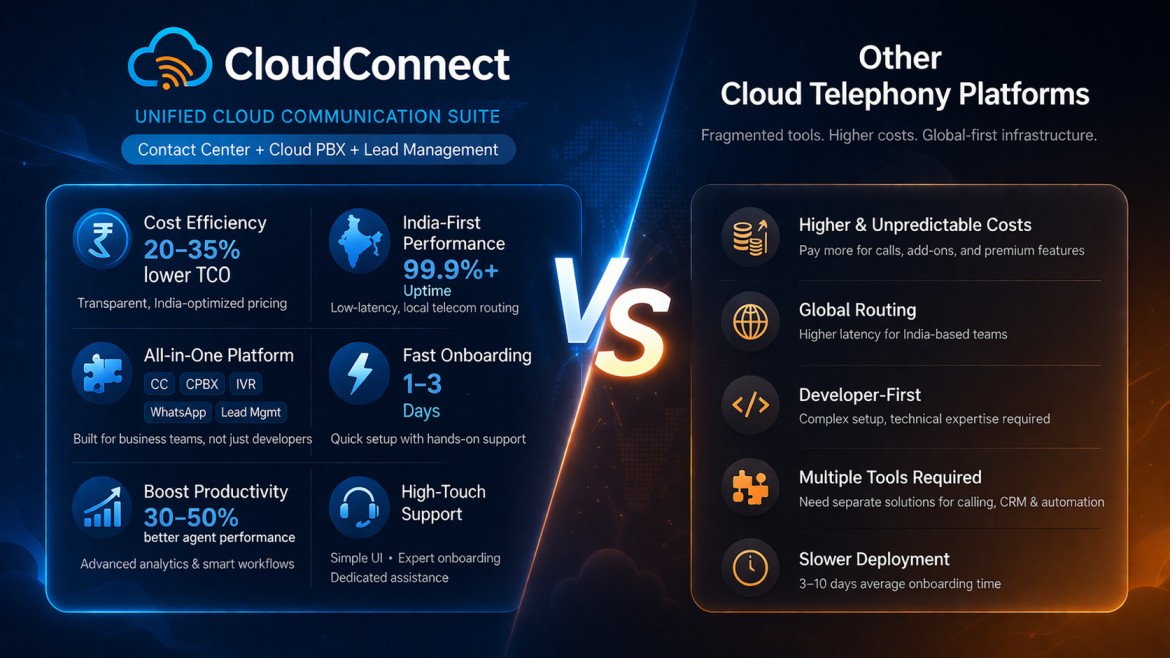
👉 Insight: CloudConnect positions itself as a solution-oriented platform, while others often remain feature-oriented.
2. Pricing & Cost Efficiency
|
Metric |
CloudConnect |
Competitors |
|
Setup Cost |
Low / Flexible |
Medium to High |
|
Per Minute Calling |
Competitive (India optimized routes) |
Often higher for India |
|
Hidden Costs |
Minimal |
Add-ons (recording, APIs, reports) |
|
Scalability Cost |
Linear |
Often exponential |
👉 Data Insight:
-
Businesses using cloud telephony report 20–35% cost savings when switching to optimized routing providers.
-
CloudConnect focuses heavily on cost predictability, a major pain point in platforms like Twilio.
3. Call Quality & Infrastructure
|
Factor |
CloudConnect |
Others |
|
Latency |
Low (India optimized infra) |
Varies |
|
Uptime |
99.9%+ |
99–99.9% |
|
Call Routing |
Smart routing |
Standard routing |
|
Local Connectivity |
Strong |
Depends on vendor |
👉 Key Advantage:
CloudConnect prioritizes India-first telecom infrastructure, reducing call drops and latency—especially compared to global platforms.
4. Features & Capabilities
Core Features Comparison
|
Feature |
CloudConnect |
Others |
|
IVR |
Advanced, customizable |
Available |
|
Call Recording |
Included |
Often paid add-on |
|
CRM Integration |
Native + API |
API-based |
|
WhatsApp Integration |
Available |
Limited / extra cost |
|
Real-time Analytics |
Advanced dashboards |
Basic to advanced |
|
Lead Management |
Built-in |
External CRM needed |
👉 Insight:
Platforms like Exotel and Knowlarity offer strong APIs, but CloudConnect combines communication + lead workflows in one system.
5. Contact Center (CC) Capabilities
|
Capability |
CloudConnect |
Competitors |
|
Omnichannel |
Voice + WhatsApp + SMS |
Limited in basic plans |
|
Agent Monitoring |
Real-time |
Available |
|
Auto Dialer |
Smart predictive |
Standard |
|
Call Routing Logic |
Advanced |
Moderate |
|
Reporting |
Deep analytics |
Varies |
👉 Data Insight:
Companies using advanced contact center features see:
-
30–50% improvement in agent productivity
-
20–40% faster response times
6. Cloud PBX (CPBX) Comparison
|
Feature |
CloudConnect CPBX |
Others |
|
Virtual Number |
Yes |
Yes |
|
Multi-location Support |
Strong |
Moderate |
|
Call Transfer |
Seamless |
Available |
|
Mobile App |
Available |
Available |
|
Remote Teams |
Optimized |
Varies |
👉 Use Case Fit:
CloudConnect is highly suited for:
-
Distributed teams
-
Sales-heavy organizations
-
Multi-branch operations
7. Integration Ecosystem
|
Integration |
CloudConnect |
Others |
|
CRM (Zoho, HubSpot, Salesforce) |
Native + API |
API-heavy |
|
Marketing Tools |
Supported |
Limited |
|
Custom APIs |
Yes |
Yes |
|
Automation (n8n, Zapier) |
Easy |
Moderate |
👉 Insight:
CloudConnect reduces dependency on multiple tools by offering built-in workflows, unlike platforms like Ozonetel which rely heavily on integrations.
8. Ease of Use & Support
|
Factor |
CloudConnect |
Others |
|
UI/UX |
Simple, business-friendly |
Technical |
|
Onboarding Support |
High-touch |
Standard |
|
Training |
Included |
Paid / limited |
|
Support |
Dedicated |
Ticket-based |
👉 Key Difference:
CloudConnect focuses on non-technical teams, while many competitors are developer-first platforms.
9. Industry Use Cases
|
Industry |
CloudConnect Advantage |
|
EdTech |
Lead tracking + counseling calls |
|
Healthcare |
Appointment reminders + patient support |
|
eCommerce |
Order confirmation + COD verification |
|
FinTech |
KYC calls + onboarding |
|
Real Estate |
High-volume lead handling |
10. When to Choose CloudConnect vs Others
Choose CloudConnect if:
-
You want cost efficiency + bundled features
-
You need India-first performance
-
You want lead + communication in one platform
-
You prefer hands-on support
Choose competitors like Twilio if:
-
You need deep developer APIs
-
You operate globally
-
You want custom-built communication systems
Conclusion
Cloud telephony is no longer just about calling—it’s about driving business outcomes.
CloudConnect differentiates itself by:
-
Offering a unified communication ecosystem
-
Focusing on cost predictability
-
Delivering India-optimized performance
-
Enabling non-technical teams to operate efficiently
While competitors like Exotel, Knowlarity, and Twilio excel in specific areas, CloudConnect provides a balanced, business-first solution.
Frequently Asked Questions (FAQs)
1. What makes CloudConnect different from other cloud telephony platforms?
CloudConnect combines contact center, cloud PBX, and lead management into a single platform, reducing the need for multiple tools.
2. Is CloudConnect suitable for small businesses?
Yes, it is designed for SMBs to enterprises, with scalable pricing and minimal setup complexity.
3. How does CloudConnect ensure better call quality?
It uses India-optimized telecom routing, reducing latency and improving connection stability.
4. Can CloudConnect integrate with CRM tools?
Yes, it supports native integrations and APIs for platforms like Zoho, HubSpot, and Salesforce.
5. Is CloudConnect cheaper than platforms like Twilio?
In most India-based use cases, CloudConnect is more cost-efficient due to localized pricing and fewer hidden charges compared to Twilio.
6. Does CloudConnect support remote teams?
Yes, it offers mobile apps, virtual numbers, and remote call handling, making it ideal for distributed teams.
7. What industries benefit the most from CloudConnect?
Industries like EdTech, Healthcare, eCommerce, FinTech, and Real Estate see the highest ROI due to high call volumes and lead management needs.
References
-
Gartner (Cloud Communications Platforms):
https://www.gartner.com/en/market-insights/cloud-communications -
IDC (Cloud Communications & Contact Center):
https://www.idc.com/getdoc.jsp?containerId=prUS -
Deloitte Digital (Customer Experience & Contact Centers):
https://www2.deloitte.com/global/en/pages/technology/articles/digital-contact-center.html