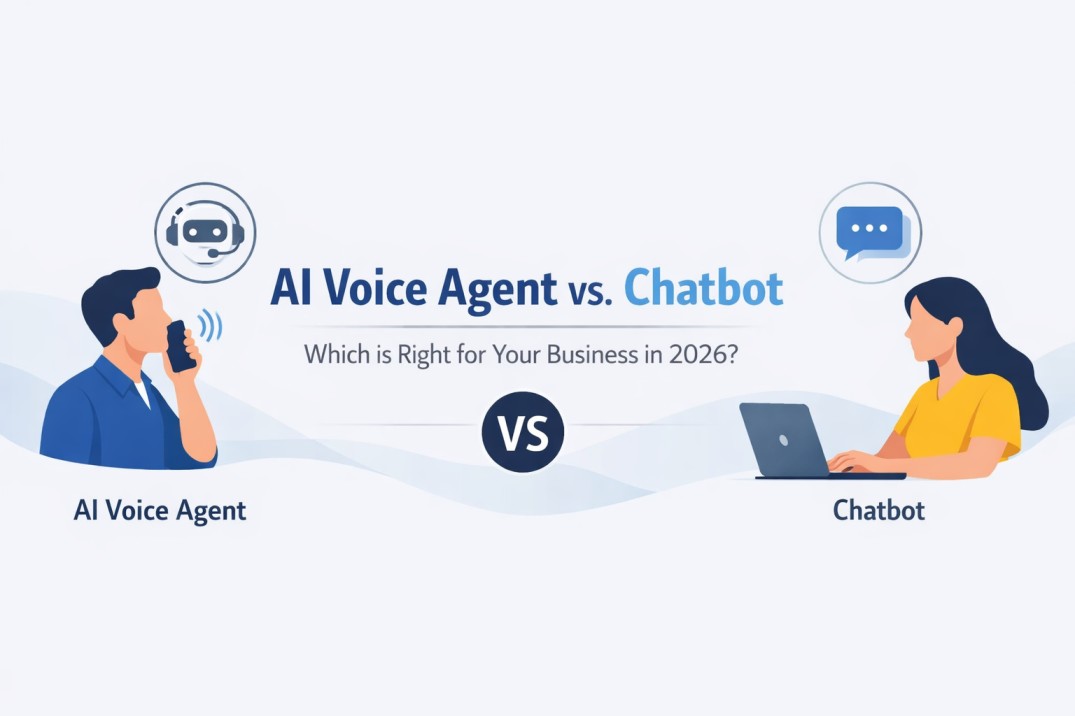
Customer communication is rapidly evolving. Businesses are no longer relying only on traditional chatbots—they are adopting more advanced AI voice agents to meet rising customer expectations.
According to the Agentic AI Report 2026:
-
14% of organizations currently prefer voice-based AI interactions
-
This number is expected to grow to 23% within the next two years
-
Companies using AI-driven communication report faster resolution times and higher customer satisfaction
At the same time:
-
Over 70% of customers expect instant responses from businesses
-
Nearly 60% prefer human-like interactions over automated text replies
-
Businesses using conversational AI see up to 30% cost reduction in customer support
👉 This clearly shows that the future is shifting toward more natural, voice-first communication experiences.
What is an AI Voice Agent?
An AI voice agent is an advanced system that can handle real-time phone conversations using artificial intelligence.
How AI Voice Agents Work
They combine multiple technologies:
-
Speech-to-text (understanding spoken words)
-
Natural Language Processing (understanding intent)
-
AI decision-making (generating responses)
-
Text-to-speech (replying in a human-like voice)
Key Capabilities
-
Detects tone (frustration, urgency, satisfaction)
-
Handles multi-step conversations
-
Remembers previous context
-
Works 24/7 without breaks
-
Follows business rules and compliance
Business Use Cases
-
Customer support calls
-
Appointment scheduling
-
Sales and lead qualification
-
Intelligent call routing
👉 Example: A customer calls about a refund, and the AI resolves the issue without human intervention.
What is a Chatbot?
A chatbot is a text-based AI system that interacts through messages.
How Chatbots Work
-
Accept text input
-
Match with predefined patterns
-
Deliver structured responses
Key Capabilities
-
Answer FAQs
-
Provide quick information
-
Capture leads
-
Redirect users to pages
Common Platforms
-
Websites
-
Mobile apps
-
WhatsApp, Messenger
👉 Example: A chatbot helping users track an order.
AI Voice Agents vs Chatbots: Detailed Comparison
1. Interaction Method
-
Voice AI: Natural conversation (hands-free)
-
Chatbot: Requires typing
👉 Voice is better for accessibility and multitasking.
2. Speed & Efficiency
-
Voice conversations are 3–4x faster for complex queries
-
Chatbots are efficient only for simple questions
👉 Voice reduces average handling time significantly.
3. Understanding & Context
-
Voice AI understands tone, pauses, and urgency
-
Chatbots only process text
👉 Voice delivers deeper intent recognition.
4. Customer Experience
-
Voice builds emotional connection
-
Chatbots feel transactional
👉 Businesses using voice AI report higher CSAT scores (10–20% increase).
5. Complexity Handling
-
Voice AI handles complex, multi-step workflows
-
Chatbots work best for repetitive queries
6. Accuracy & First Call Resolution
-
Voice AI improves first-call resolution rates
-
Chatbots often require escalation
7. Deployment Channels
-
Voice AI: Phone systems, IVR, contact centers
-
Chatbots: Websites, apps, messaging platforms
Why Voice AI is Becoming the Preferred Choice
The growing adoption of voice AI is driven by both technology and psychology.
Key Reasons:
1. Human-Like Interaction
People naturally prefer speaking over typing.
2. Faster Problem Solving
Voice allows real-time clarification and faster communication.
3. Emotional Intelligence
Voice AI detects:
-
Frustration
-
Urgency
-
Satisfaction
👉 This improves personalization and outcomes.
4. Trust & Engagement
Voice creates:
-
Stronger emotional connection
-
Higher trust levels
-
Better customer retention
👉 This explains the projected growth from 14% to 23% adoption.
When Should Businesses Use AI Voice Agents?
AI voice agents are ideal when:
-
You receive high call volumes daily
-
Queries are complex or multi-step
-
Customer experience is critical
-
You want to increase conversions via calls
-
Your audience prefers phone communication
Industry Examples:
-
Healthcare → appointment booking
-
Finance → account queries & fraud alerts
-
EdTech → student support
-
E-commerce → order and return queries
When Should Businesses Use Chatbots?
Chatbots are suitable when:
-
Queries are repetitive
-
You need instant FAQ responses
-
You want to capture leads
-
Customers are already on digital platforms
Best Strategy: Combine Voice AI + Chatbots
Top-performing companies use a hybrid approach:
-
Voice AI → customer calls & complex interactions
-
Chatbots → website queries & lead capture
👉 This improves efficiency and reduces cost while enhancing experience.
Future Trends in AI Communication
In the next 2–3 years:
-
Voice AI will become standard in enterprises
-
AI will handle voice + chat + visual interactions
-
Conversations will become near-human level
👉 Businesses that adopt early will gain a competitive advantage.
Conclusion
-
Chatbots are effective for simple, repetitive tasks
-
AI voice agents are powerful for complex, high-value interactions
👉 If customer experience drives your business, AI voice agents are the future.
FAQs
1. What is the biggest advantage of AI voice agents?
They provide human-like conversations, faster resolutions, and better customer satisfaction.
2. Are chatbots becoming obsolete?
No, but they are limited to simple use cases. Voice AI is expanding into more complex areas.
3. How much cost can AI reduce?
Businesses can reduce customer support costs by 20–30% using AI automation.
4. Can AI voice agents handle all customer queries?
They can handle 70–80% of queries, with the rest escalated to humans.
5. Which is better for conversions?
Voice AI performs better in sales and high-intent conversations, while chatbots are better for initial lead capture.
6. Is voice AI suitable for small businesses?
Yes, especially those with high customer interaction needs.
7. What is the future of conversational AI?
The future is voice-first, multimodal AI, combining voice, chat, and automation.
References
-
Gartner Customer Service Trends (Conversational AI Adoption)
-
McKinsey Report on AI in Customer Experience (Cost Reduction & Efficiency)
-
Salesforce State of Service Report (Customer Expectations & Preferences)
-
IBM AI Customer Service Study (Automation & ROI Insights