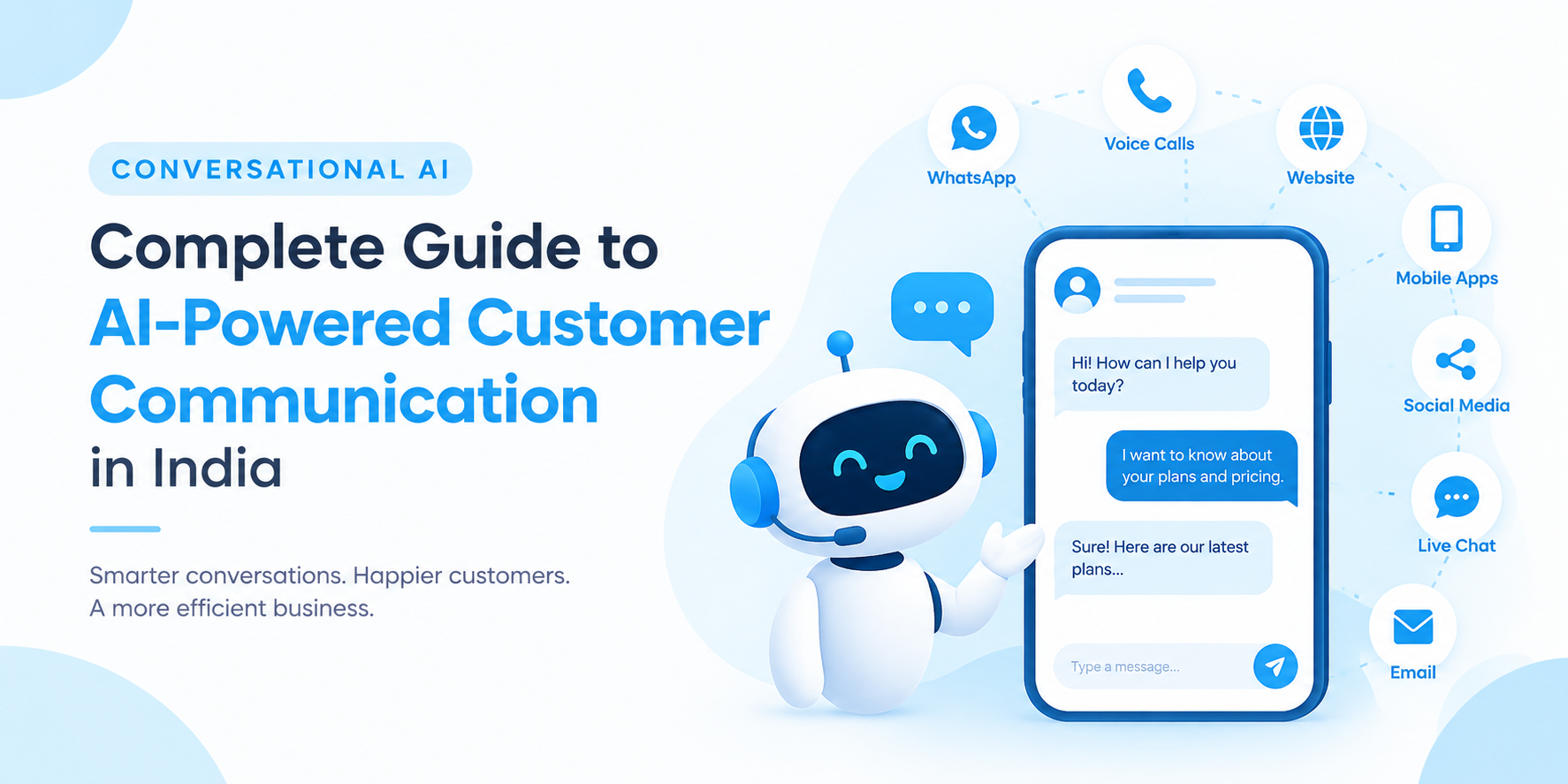
Conversational AI is transforming how businesses communicate with customers. From answering customer queries and qualifying leads to booking appointments and providing 24/7 support, AI-powered conversations are helping businesses reduce response time, improve customer experience and increase operational efficiency.
With the rapid adoption of smartphones, messaging platforms, cloud telephony and generative AI, Indian businesses are increasingly moving from traditional customer support systems to intelligent conversational solutions.
What Is Conversational AI?
Conversational AI refers to technologies that enable computers to communicate with people through natural language. It uses Artificial Intelligence, Natural Language Processing, Machine Learning and speech technologies to understand customer queries and provide relevant responses.
Conversational AI can work through multiple channels, including:
-
Voice calls
-
Websites
-
WhatsApp
-
Mobile applications
-
Social media
-
Live chat
-
Email and messaging platforms
Unlike traditional rule-based chatbots, modern Conversational AI systems can understand context, identify customer intent, respond naturally and connect with business systems such as CRM, helpdesk and payment platforms.
How Does Conversational AI Work?
A typical Conversational AI solution follows these steps:
-
Customer Interaction: The customer asks a question through voice or chat.
-
Speech or Text Recognition: The system converts voice into text or processes the written message.
-
Intent Detection: AI identifies what the customer wants.
-
Context Understanding: The system analyses previous messages, customer details and conversation history.
-
Response Generation: AI creates a relevant response using business information.
-
Action or Integration: The system may update the CRM, create a ticket, schedule an appointment or transfer the conversation to a human agent.
For voice-based interactions, technologies such as speech-to-text, text-to-speech and voice AI are used to create a more natural calling experience.
Types of Conversational AI
1. AI Chatbots
AI chatbots communicate with customers through websites, apps and messaging platforms. They can answer FAQs, explain products, collect customer details and assist customers before and after a purchase.
2. AI Voice Bots
AI voice bots handle customer conversations over phone calls. They can answer inbound calls, make outbound calls, qualify leads, confirm appointments, send reminders and provide customer support.
3. WhatsApp AI Assistants
WhatsApp-based AI assistants help businesses manage customer conversations on one of India’s most widely used messaging platforms. They can share product information, collect enquiries, send updates and support transactional conversations.
4. Virtual Customer Support Agents
Virtual agents can resolve common support requests without requiring a human agent for every interaction. More complex issues can be transferred to the appropriate support executive.
5. AI Sales Assistants
AI sales assistants can engage prospects, ask qualifying questions, recommend products and schedule meetings for sales teams.
Key Benefits of Conversational AI for Businesses
1. 24/7 Customer Availability
Customers can receive assistance even outside business hours. This is particularly useful for e-commerce, healthcare, education, travel, real estate and financial services.
2. Faster Response Time
AI can respond to customer queries instantly, reducing waiting time and improving the overall customer experience.
3. Reduced Support Costs
Businesses can automate repetitive questions and routine tasks, allowing human agents to focus on complex and high-value interactions.
4. Better Lead Qualification
Conversational AI can ask qualifying questions, identify customer requirements and pass high-intent leads to the sales team.
5. Higher Productivity
AI can manage multiple conversations simultaneously. This reduces the workload on support teams and improves operational efficiency.
6. Consistent Customer Experience
AI assistants can follow approved business processes and provide consistent information across different customer interactions.
7. CRM Integration
When connected with CRM platforms, Conversational AI can capture leads, update customer records, create tickets and track follow-ups automatically.
8. Multilingual Communication
AI-powered systems can support multiple languages and regional communication preferences, helping Indian businesses serve a wider audience.
Conversational AI for Different Industries
E-commerce and D2C
Conversational AI can help customers discover products, check order status, understand return policies and receive delivery updates.
Common use cases include:
-
Product recommendations
-
Order tracking
-
Cart recovery
-
Customer support
-
Post-purchase communication
-
Lead generation
Education and EdTech
Educational institutions can use Conversational AI to respond to admission enquiries, explain courses, schedule counselling calls and send reminders.
AI can help manage questions related to:
-
Course details
-
Fees and eligibility
-
Admission deadlines
-
Demo classes
-
Counselling appointments
-
Student support
Real Estate
Real estate companies receive a large number of enquiries through websites, advertisements and property portals. Conversational AI can instantly ask about budget, location, property type and purchase timeline.
It can then qualify the lead and schedule a meeting with a sales advisor.
Healthcare
Healthcare providers can use Conversational AI for appointment booking, reminders, basic service information and patient communication.
Sensitive medical decisions should still be handled by qualified healthcare professionals.
Banking and Financial Services
Conversational AI can assist with service requests, account-related information, FAQs, appointment scheduling and customer support. Strong security, authentication and regulatory compliance are essential for financial use cases.
Travel and Hospitality
AI assistants can help customers with booking enquiries, itinerary information, hotel details, cancellation policies and travel updates.
Conversational AI vs Traditional Chatbots
|
Parameter |
Traditional Chatbot |
Conversational AI |
|
Technology |
Rule-based flows |
AI, NLP and Machine Learning |
|
Understanding |
Limited keywords |
Understands natural language and intent |
|
Conversation |
Mostly predefined |
More flexible and contextual |
|
Personalisation |
Limited |
Can use customer and CRM data |
|
Complex Queries |
Often struggles |
Can handle broader conversations |
|
Voice Support |
Usually limited |
Can support AI voice conversations |
|
Learning |
Requires manual updates |
Can improve through training and feedback |
|
Integration |
Basic integrations |
CRM, helpdesk, ERP and business integrations |
|
Customer Experience |
Menu-driven |
More natural and human-like |
CloudConnect Conversational AI
CloudConnect brings Conversational AI and business communication together through an AI-first communication ecosystem.
With CloudConnect, businesses can explore AI-powered voice and communication solutions for customer support, sales, lead qualification and business operations.
Key CloudConnect Capabilities
-
AI Voice Bots
-
Inbound and outbound calling
-
Cloud Call Center
-
IVR and call routing
-
CRM integration
-
Call recording
-
Lead qualification
-
Automated customer follow-ups
-
Voice and communication workflows
-
Business analytics
-
Mobile and cloud-based access
-
Scalable communication infrastructure
CloudConnect can help businesses connect AI conversations with their existing communication and sales processes. Instead of using separate tools for calling, customer support and lead management, businesses can build a more connected communication workflow.
For example, a real estate company can run advertisements, receive customer calls, use an AI voice bot to qualify enquiries, record the conversation and send the lead details to the CRM.
Important Features to Consider Before Choosing a Conversational AI Provider
AI Accuracy
The system should understand different accents, natural language, incomplete sentences and common customer questions.
Voice Quality
For voice bots, clear audio, natural speech and low latency are essential for a smooth customer experience.
Human Handover
The AI should be able to transfer a conversation to a human agent whenever the query is complex, sensitive or outside its knowledge.
CRM and Business Integrations
Check whether the platform integrates with tools such as Salesforce, Microsoft Dynamics, Zoho, Freshdesk, LeadSquared, Bitrix24 or other business applications.
Knowledge Base Management
Businesses should be able to update product information, FAQs, policies and service details without rebuilding the entire system.
Analytics and Reporting
The platform should provide information about call volumes, response quality, resolution rates, lead qualification and customer interactions.
Data Security
Businesses should evaluate data protection, access controls, call recording policies, authentication and compliance requirements before deployment.
Scalability
The solution should support increasing call volumes, more users, additional languages and multiple communication channels.
How to Implement Conversational AI in Your Business
A successful Conversational AI implementation should begin with a clearly defined business objective.
Step 1: Identify the Use Case
Start with one practical use case such as lead qualification, appointment booking, order tracking or customer support.
Step 2: Map the Customer Journey
Identify what customers ask, where they face delays and which conversations can be automated.
Step 3: Prepare Business Information
Create a reliable knowledge base containing product details, FAQs, pricing, policies and escalation rules.
Step 4: Connect Business Systems
Integrate the AI solution with CRM, helpdesk, telephony, calendars and other required systems.
Step 5: Test Real Conversations
Test different accents, customer questions, interruptions, incomplete information and unexpected scenarios.
Step 6: Launch and Optimise
Monitor conversations, identify gaps and continuously improve the AI responses and workflows.
Conclusion
Conversational AI is becoming an important part of modern customer communication. It helps businesses respond faster, automate repetitive tasks, qualify leads, improve customer support and provide assistance across voice and digital channels.
However, successful Conversational AI is not only about using an AI chatbot. Businesses need accurate information, strong integrations, reliable communication infrastructure, human handover and continuous optimisation.
For Indian businesses looking to combine AI-powered conversations with cloud telephony, IVR, cloud call center and CRM integration, CloudConnect offers an AI-first communication approach. It can be evaluated for use cases such as sales automation, customer support, lead qualification, appointment reminders and outbound voice campaigns.
The right solution will depend on the business’s industry, customer volume, communication channels, integration requirements, data security needs and automation goals.
Frequently Asked Questions
1. What is Conversational AI?
Conversational AI is a technology that enables computers to communicate with people through natural language using voice or text.
2. What is the difference between Conversational AI and a chatbot?
A chatbot is one type of Conversational AI. Traditional chatbots usually follow predefined rules, while modern Conversational AI can understand context, intent and natural language more flexibly.
3. Can Conversational AI make phone calls?
Yes. AI voice bots can make outbound calls, answer inbound calls, qualify leads, send reminders and handle routine customer conversations.
4. Can Conversational AI work on WhatsApp?
Yes. Conversational AI can be integrated with WhatsApp Business solutions to answer questions, collect enquiries, share information and support customer communication.
5. Can Conversational AI replace human agents?
Conversational AI can automate repetitive conversations, but human agents remain important for complex, sensitive and high-value customer interactions. A human handover process is recommended.
6. Is Conversational AI useful for sales?
Yes. It can engage prospects, ask qualifying questions, capture customer information, recommend next steps and schedule meetings.
7. Can Conversational AI integrate with a CRM?
Yes. Depending on the provider, Conversational AI can integrate with CRM and helpdesk platforms to capture leads, update records, create tickets and track follow-ups.
8. What industries can use Conversational AI?
Industries such as e-commerce, education, real estate, healthcare, banking, insurance, travel, hospitality and customer service can use Conversational AI.
9. What is an AI voice bot?
An AI voice bot is a voice-based Conversational AI system that communicates with customers through telephone calls using speech recognition and AI-generated responses.
10. How can CloudConnect help with Conversational AI?
CloudConnect combines AI-first communication with cloud telephony, IVR, cloud call center, voice bots and CRM integration. Businesses can explore it for customer support, lead qualification, sales automation and business communication.
References
-
CloudConnect – https://cloudconnect.in/
-
IBM – Conversational AI – https://www.ibm.com/think/topics/conversational-ai
-
Google Cloud – Conversational AI – https://cloud.google.com/conversational-ai
-
Microsoft – Conversational AI – https://www.microsoft.com/en-us/ai
-
AWS – Conversational AI – https://aws.amazon.com/what-is/conversational-ai/
-
NASSCOM – https://nasscom.in/
-
Ministry of Electronics and Information Technology, Government of India – https://www.meity.gov.in/
Note: AI capabilities, integrations, pricing and regulatory requirements may vary by provider and should be verified before implementation.

