What happens to the parent who calls your admissions desk at 8:40 pm, the day NEET results are out, and hears nothing but a ringing phone?
In most cases, they simply call the next institute on their list. And they are not alone. Admission season compresses a year's worth of interest into a few frantic weeks, and the scale behind that rush is enormous. India's higher education system has grown to nearly 4.33 crore students, spread across more than 58,000 universities, colleges and standalone institutions. Every one of those seats starts with a question: fees, eligibility, deadlines, hostel, placements.
At the same time, the research on enquiry response is brutally clear. Speed decides who wins the student, and most institutions are far slower than they think.
|
Data point |
What it tells admissions teams |
|
~4.33 crore students enrolled in Indian higher education (AISHE 2021-22), up from 3.42 crore in 2014-15 |
Demand keeps growing year on year, so each season's enquiry peak tends to be bigger than the last |
|
1,168 universities, 45,473 colleges and 12,002 standalone institutions registered (AISHE 2021-22) |
Competition for every enquiry is intense; parents shortlist several options at once |
|
22.79 lakh candidates registered for NEET-UG 2026 |
A single results day can trigger lakhs of simultaneous counselling and college enquiries |
|
Firms contacting a lead within an hour were ~7x more likely to qualify it; waiting 24+ hours made it ~60x less likely (HBR, 2011) |
The first hour after an enquiry is where admissions are won or lost |
|
Contacting within 5 minutes vs 30 minutes: ~100x higher contact odds, ~21x higher qualification odds (Lead Response Management Study, 2007) |
Minutes matter, not just hours |
|
Average first response among audited firms: 42 hours; 23% never responded (HBR audit of 2,241 firms) |
Most competitors are slow, which is an opportunity for the one who answers first |
So here is the real question: how do you answer every enquiry within minutes, during the busiest weeks of the year, without hiring and training a temporary army of counsellors who will be idle by August? Let's walk through it.
1. Understand the Shape of Your Surge
Admission enquiries don't arrive evenly. They spike around predictable triggers: board results, entrance exam results, counselling rounds, scholarship deadlines and the final week before fee payment closes. Within those days, calls cluster in the evenings and on weekends, exactly when parents are home and your office is closed.
Here's why that matters. Consider an illustrative example: ten counsellors, each averaging six minutes per call, can handle about 100 calls an hour. If results day brings 400 calls in that hour, 300 families hear a busy tone or ring-no-answer. Hiring 30 more people for three weeks is expensive, slow to train and hard to manage. The smarter move is to change how calls are handled, not how many people handle them.
Start by pulling last season's call logs. Which dates peaked? Which hours? How many calls went unanswered? That baseline tells you where automation will pay off first.
2. Never Let a Call Go Unanswered: Smart IVR and Intelligent Routing
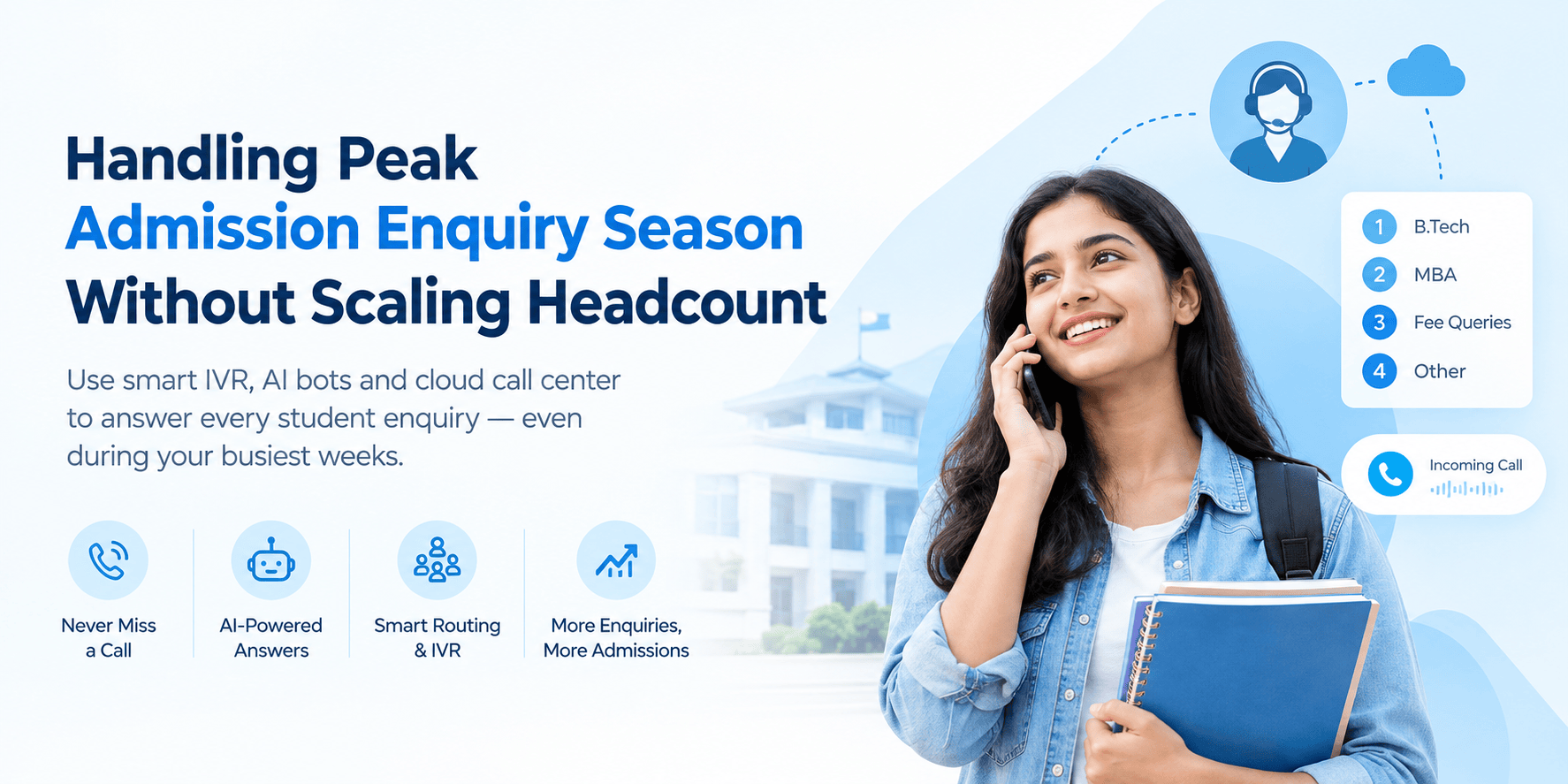
A cloud call center puts a structured front door on your admissions line. A multilevel IVR lets callers self-select ("Press 1 for B.Tech, 2 for MBA, 3 for fee queries") so each call lands with the right counsellor on the first attempt, not after two transfers.
Intelligent routing does the rest:
-
Skill-based routing sends programme-specific calls to counsellors who know that programme.
-
Overflow rules push excess calls to a queue, a callback option or an AI voice bot instead of a busy tone.
-
Remote agent login lets faculty coordinators or trained alumni take calls from home during peak evenings, with no extra desks or phone lines.
-
Missed-call capture logs every unanswered number automatically, so nobody falls through the cracks.
Because it all runs in the cloud, you can add or remove agent seats for the season in minutes rather than installing new hardware.
3. Let AI Voice Bots Handle the Repetitive Questions
Talk to any admissions team and they'll tell you the same thing: a large share of calls ask the same handful of questions. What's the fee? Am I eligible with this score? When is the last date? Is there a hostel? These answers are fixed, and a well-trained AI voice bot can deliver them instantly, around the clock, in English and regional languages.
|
Enquiry type |
Best handled by |
Why |
|
Fees, deadlines, documents required |
AI voice bot |
Standard answers, high volume, needed 24x7 |
|
Eligibility check by score or stream |
AI voice bot with rules |
Quick, consistent answers based on published criteria |
|
Course comparison and career guidance |
Human counsellor |
Needs empathy, judgement and persuasion |
|
Scholarship or fee negotiation |
Senior counsellor |
High-value, sensitive conversation |
|
Application status updates |
Automated outbound call / SMS |
Proactive, reduces inbound call load |
The result? Your counsellors stop reading out fee structures for the hundredth time and spend their hours on the conversations that actually convert: the anxious parent, the undecided student, the high-merit applicant weighing three offers.
4. Win on Speed: Automated Callbacks and Follow-Ups
Remember the research: contact within five minutes is dramatically more effective than contact at thirty. During peak season, humans alone can't hit that consistently. Automation can.
-
Instant callback on web forms: when a student submits an enquiry form, the system can dial them back within seconds and connect the call to a free counsellor.
-
Missed-call-to-callback: every missed call is queued for an automatic return call as soon as capacity frees up.
-
CRM integration: call details, recordings and outcomes are logged against the student record, so the next counsellor knows the full history.
-
Scheduled outbound reminders: automated calls for document submission, counselling slots and fee deadlines reduce drop-offs between enquiry and enrolment.
Think of it as a safety net. Even on the busiest evening, every enquiry gets a response while interest is still high.
5. Measure, Coach and Improve in Real Time
You can't fix what you can't see. Real-time dashboards show live queue length, answer rates and agent availability, so supervisors can reassign staff before a backlog forms. Call recordings help you coach new counsellors quickly and identify which conversations convert best.
|
KPI to track |
Why it matters in peak season |
|
Answer rate (% of calls answered) |
The simplest measure of lost opportunities |
|
Average speed to answer / callback |
Tracks how close you are to the five-minute window |
|
Bot containment rate |
Shows how much repetitive load automation is absorbing |
|
Enquiry-to-application conversion |
Connects call handling to actual admissions outcomes |
|
Counsellor talk time vs idle time |
Reveals whether you truly need more people, or better routing |
After the season, this data becomes your blueprint for the next one.
|
Why Choose CloudConnect?
See it live: Book My Demo |
Conclusion
Peak admission season will keep getting busier, but your headcount doesn't have to grow with it. When you map the surge, route calls intelligently, let AI voice bots absorb repetitive questions, automate callbacks and track the right metrics, the same team can respond to every family within minutes. In a market where the first institute to respond often wins the conversation, that speed becomes your most reliable admissions advantage.
Frequently Asked Questions
1. How can an institute handle peak admission calls without hiring temporary staff?
By combining a cloud call center with IVR, intelligent routing, AI voice bots and automated callbacks. Automation absorbs repetitive and overflow calls, while your existing counsellors focus on high-value conversations.
2. What kinds of admission queries can an AI voice bot answer?
Standard, fact-based questions such as fees, deadlines, eligibility criteria, required documents, hostel availability and application status. Complex guidance and negotiations are best routed to human counsellors.
3. How quickly should we respond to an admission enquiry?
As fast as possible. Research from HBR and the Lead Response Management Study shows qualification odds fall sharply after the first five minutes and continue to decline through the first hour.
4. Can counsellors take admission calls from home?
Yes. With a cloud call center, agents can log in from anywhere with an internet connection, using a softphone or mobile app, while calls, recordings and reports stay centralised.
5. What happens to calls that come in after office hours?
They can be answered by an AI voice bot, sent to a callback queue or captured as missed calls with automatic follow-up the next morning, so no enquiry is lost.
6. Will the system integrate with our existing CRM or ERP?
Most cloud telephony platforms, including CloudConnect, support integration with popular CRMs so call logs, recordings and outcomes attach to each student's record.
7. How long does it take to set up before admission season?
Cloud telephony needs no on-premise hardware, so an institute can typically go live much faster than with a traditional PBX. Plan a few weeks ahead to configure IVR flows, train the voice bot and test routing before results day.
References
-
Ministry of Education (PIB), AISHE 2021-22 release: https://www.pib.gov.in/PressReleasePage.aspx?PRID=1999713®=48&lang=2
-
India TV News, AISHE 2021-22 institution counts and GER: https://www.indiatvnews.com/education/news/enrolment-in-higher-education-increased-to-4-33-crore-in-2021-22-a-hike-of-26-5-pc-since-2014-education-ministry-survey-updates-2024-01-27-913906
-
Careers360, NEET-UG 2026 result highlights and registrations: https://news.careers360.com/neet-ug-2026-result-highlights-absentees-surge-qualifiers-fall-cut-offs-rise-toppers-list
-
Voiso, summary of HBR "The Short Life of Online Sales Leads" (2011) and the Lead Response Management Study (2007): https://voiso.com/articles/lead-response-time-metrics/
-
AInora, primary-source breakdown of HBR, MIT/InsideSales and Drift response-time studies: https://ainora.lt/blog/lead-response-time-5-minutes-study-2026
-
CloudConnect Cloud Call Center Solutions: https://cloudconnect.in/public/Cloud-Call-Center-Solutions/
About CloudConnect
CloudConnect helps businesses build reliable and scalable communication infrastructure with advanced voice and business communication solutions. As leading cloud telephony providers in Indiaand experienced SIP trunk providers, we offer powerful PBX solutions, cloud telephony, IVR, and call center solutions to streamline business communication.
Related Reading
Toll-Free Numbers in India: Features, Pricing & Best Providers
How to Get a DID Mobile Number in India for Your Business
Best Cloud Telephony Providers in India: Features, Pros & Cons
UCaaS vs. CCaaS: Understanding the Difference Between Two Cloud Communication Platforms