A Cloud Telephony & AI Voice Bot Guide for India's D2C Brands
What if 7 out of every 10 customers who add something to their cart on your website never actually paid you? For most D2C brands, that isn't a hypothetical — it's the checkout page, every single day. Cart abandonment is one of e-commerce's oldest problems, and most brands are still trying to solve it with the same email reminder everyone else sends. Cloud telephony and AI Voice Bots offer a different way in — reaching customers directly, in real time, on the channel with the highest response rate of all: a phone call.
The Numbers Behind the Problem
Before looking at what actually recovers lost sales, it's worth understanding just how large — and how addressable — the cart abandonment problem really is.
|
Metric |
Data Point |
|---|---|
|
Global average cart abandonment rate |
~70%, consistent across the last three years (Baymard Institute) |
|
Global revenue lost to cart abandonment annually |
Estimated at USD 18 billion+ across e-commerce |
|
Average recovery rate — email reminders |
6–8% of abandoned carts converted |
|
Average recovery rate — SMS reminders |
Higher open rates than email, but similarly passive |
|
Phone call connection rate vs. email open rate |
70–85% connection on calls vs. 40–45% email open rates |
|
Reported recovery rate — AI voice outreach |
25–35% of abandoned carts, roughly 5x email performance |
|
COD share of Indian e-commerce orders |
60–65%, adding a second confirmation step after checkout |
The pattern is consistent: the channels brands rely on most (email, SMS) recover the least, while the channel almost nobody uses at scale — voice — recovers the most.
1. The Cart Abandonment Problem: Why D2C Brands Lose 7 in 10 Sales
Most abandoned carts aren't lost customers — they're hesitating ones. Unexpected shipping costs at checkout, a need to compare prices, a distraction mid-session, or simple uncertainty about sizing and delivery timelines are the most common reasons shoppers leave without paying. None of these represent a disqualified buyer; they represent intent that stalled at the last step.
For Indian D2C brands, the problem compounds further downstream. Even customers who do complete a Cash on Delivery order haven't fully committed — COD orders still see meaningful cancellation and refusal-at-the-door rates, meaning the 'abandonment' risk doesn't end at checkout. It follows the order all the way to the customer's doorstep.
2. Why Cloud Telephony and Voice Outperform Email and SMS for Recovery
Email and SMS are cheap and scalable, but they're passive. A recovery email competes with dozens of other messages in a crowded inbox, and even a well-designed sequence typically converts only 6–8% of abandoned carts. SMS performs a little better on open rates but suffers the same one-way limitation: it can't handle an objection in real time.
A phone call changes the dynamic entirely. It reaches the customer immediately, gets answered at a far higher rate than an email gets opened, and — critically — allows a live, two-way exchange. If a customer abandoned checkout because of a shipping-cost surprise or a sizing doubt, a voice conversation can resolve it on the spot, something no static message can do. Cloud telephony is what makes this possible at scale: it's the infrastructure layer that lets an AI Voice Bot place thousands of these calls simultaneously, without a large in-house calling team.
3. How Cloud Telephony and AI Voice Bots Recover Abandoned Carts — The Workflow
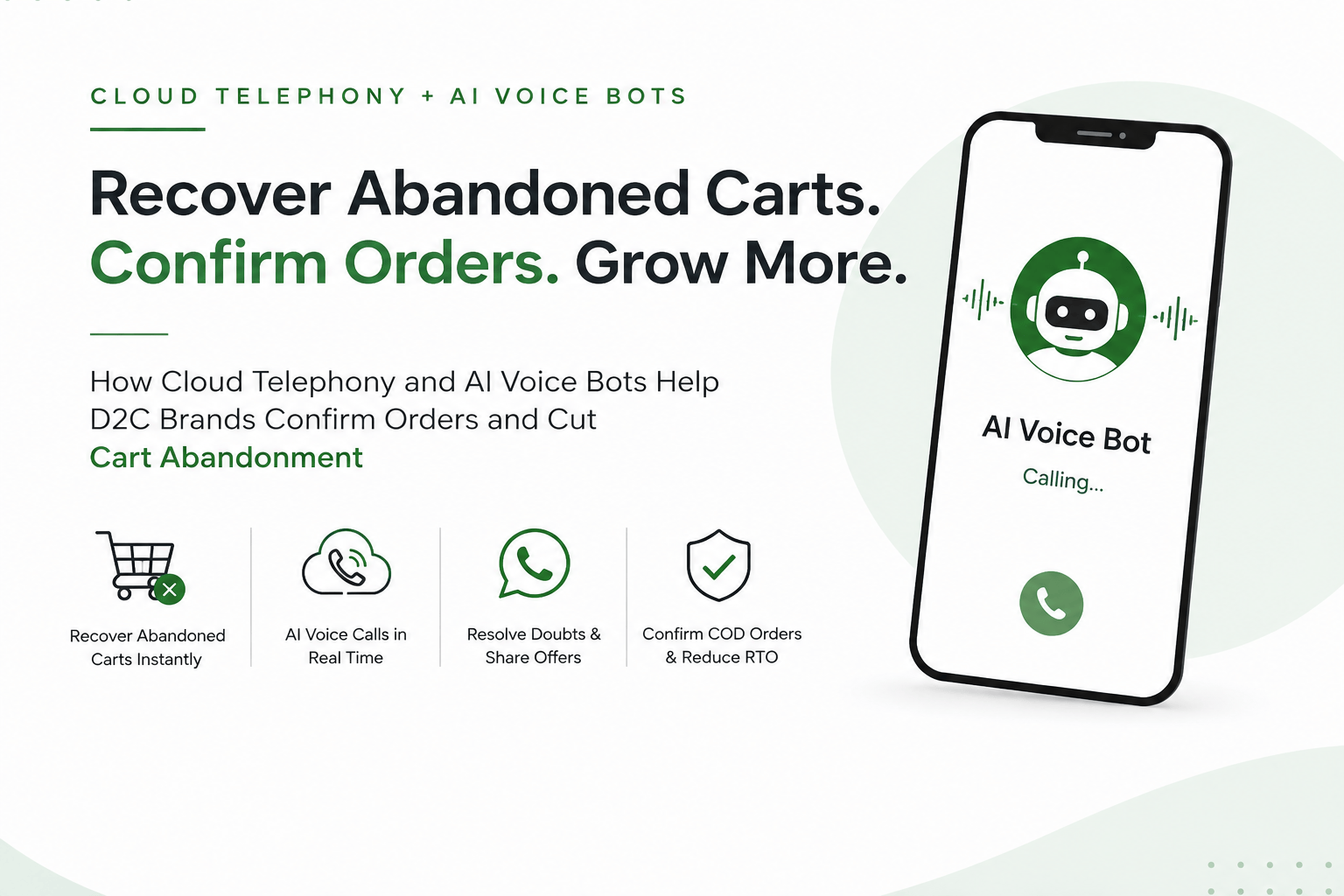
A typical cloud telephony-powered, AI-driven cart recovery flow looks like this:
-
A shopper adds items to cart, begins checkout, and leaves without completing payment.
-
The event is detected in real time and passed to the AI Voice Bot via API/CRM integration.
-
Within minutes, an automated call reaches the customer in their preferred language, referencing the exact items left behind.
-
The bot can answer basic questions, share a discount or free-shipping offer, or send a checkout link over WhatsApp/SMS mid-call.
-
Calls that need a human touch — price negotiation, product doubts — are escalated live to a contact center agent.
-
Every outcome (recovered, not interested, callback requested) is logged back to the CRM for follow-up and reporting.
Because the process is automated, it scales to every abandoned cart, not just the highest-value ones a manual team could realistically call.
4. From Recovered Cart to Confirmed Order: Closing the Loop with COD Verification
For D2C brands running COD, recovery doesn't stop at getting the customer back to checkout. The same AI Voice Bot infrastructure used to recover a cart can confirm the resulting order before dispatch — verifying the delivery address and genuine intent to receive the package. This turns a single technology investment into two wins: more completed checkouts, and fewer of those completed orders coming back as failed deliveries.
In practice, this means a shopper who almost didn't buy can go from an abandoned cart, to a confirmed order, to a successfully delivered package — with the same voice channel touching every step of the journey.
5. The Measurable Impact: Recovery Channel Comparison
|
Recovery Channel |
Typical Response |
Typical Recovery Rate |
|---|---|---|
|
Email reminder |
Passive; competes with inbox clutter |
6–8% |
|
SMS reminder |
Higher open rate than email, still one-way |
Modestly above email |
|
Retargeting ads |
Reaches browser, not always the buyer |
Varies widely by spend |
|
AI voice call |
Immediate, two-way, handles objections live |
25–35% |
These figures are industry-reported benchmarks rather than guarantees — actual recovery rates depend on cart value, product category, and how quickly the call is triggered after abandonment.
Why Choose CloudConnect?
|
For D2C brands looking to recover abandoned carts and confirm orders on one reliable platform, CloudConnect Communications offers:
Explore how CloudConnect can help your D2C brand recover more carts and confirm more orders at cloudconnect.in. |
Conclusion
Cart abandonment isn't a marketing footnote — for most D2C brands, it's the single biggest source of lost revenue on the entire site. Email and SMS will always have a place in the recovery mix, but they're leaving the highest-converting channel largely untouched. Cloud telephony and AI Voice Bots close that gap together: the infrastructure and the intelligence reach customers faster, recover a meaningfully higher share of abandoned carts, and — for COD-heavy brands — carry that same intent verification through to dispatch, cutting failed deliveries downstream as well.
Frequently Asked Questions
1. What counts as cart abandonment, and why is it so common?
Cart abandonment is when a shopper adds items to their cart, starts or nears checkout, and leaves without paying. It happens to roughly 7 in 10 online shoppers, most commonly due to unexpected costs, comparison shopping, or simple hesitation — not a lack of interest in the product.
2. How is an AI voice call different from a recovery email?
An email is a one-way, static reminder that competes with a crowded inbox. An AI voice call reaches the customer directly, gets picked up far more often, and can hold a live conversation to resolve whatever made them hesitate — something a static message can't do.
3. Won't customers find an automated call intrusive?
When timed well (typically within a couple of hours of abandonment) and used for opted-in, high-intent shoppers, voice outreach is generally seen as helpful rather than intrusive — especially when it offers something useful, like resolving a shipping-cost question or sharing a relevant discount.
4. Can AI voice bots operate in regional Indian languages?
Yes. Multilingual AI Voice Bots can run cart-recovery and order-confirmation calls in a customer's preferred language, which meaningfully improves response and conversion rates outside major metro markets.
5. How does this connect to reducing RTO for COD orders?
The same voice infrastructure used to recover an abandoned cart can also confirm the resulting COD order before dispatch, verifying address and intent. That means fewer orders shipped on a whim — and fewer failed deliveries downstream.
6. What kind of recovery rate should a D2C brand realistically expect?
Industry data points to AI voice recovery rates in the 25–35% range, compared to roughly 6–8% for email — but actual results vary by cart value, product category, and how quickly the call reaches the customer after abandonment.
7. Is CloudConnect's platform compliant for outbound calling in India?
Yes. CloudConnect operates as India's first DOT-licensed B2B Virtual Network Operator, with ISO 9001 and ISO 27001 certification and 100% Indian data centers, built for compliant enterprise voice communication at scale.
References
Baymard Institute – Cart Abandonment Rate Statistics
Callsy – How to Reduce Cart Abandonment: 14 Tactics for 2026
FoneSwift – Abandoned Cart Recovery: How to Recover 25% with AI Phone Calls
Ringly.io – Ecommerce Abandoned Cart Recovery Calls
Related Reading
Toll-Free Numbers in India: Features, Pricing & Best Providers
How to Get a DID Mobile Number in India for Your Business
Best Cloud Telephony Providers in India: Features, Pros & Cons
UCaaS vs. CCaaS: Understanding the Difference Between Two Cloud Communication Platforms