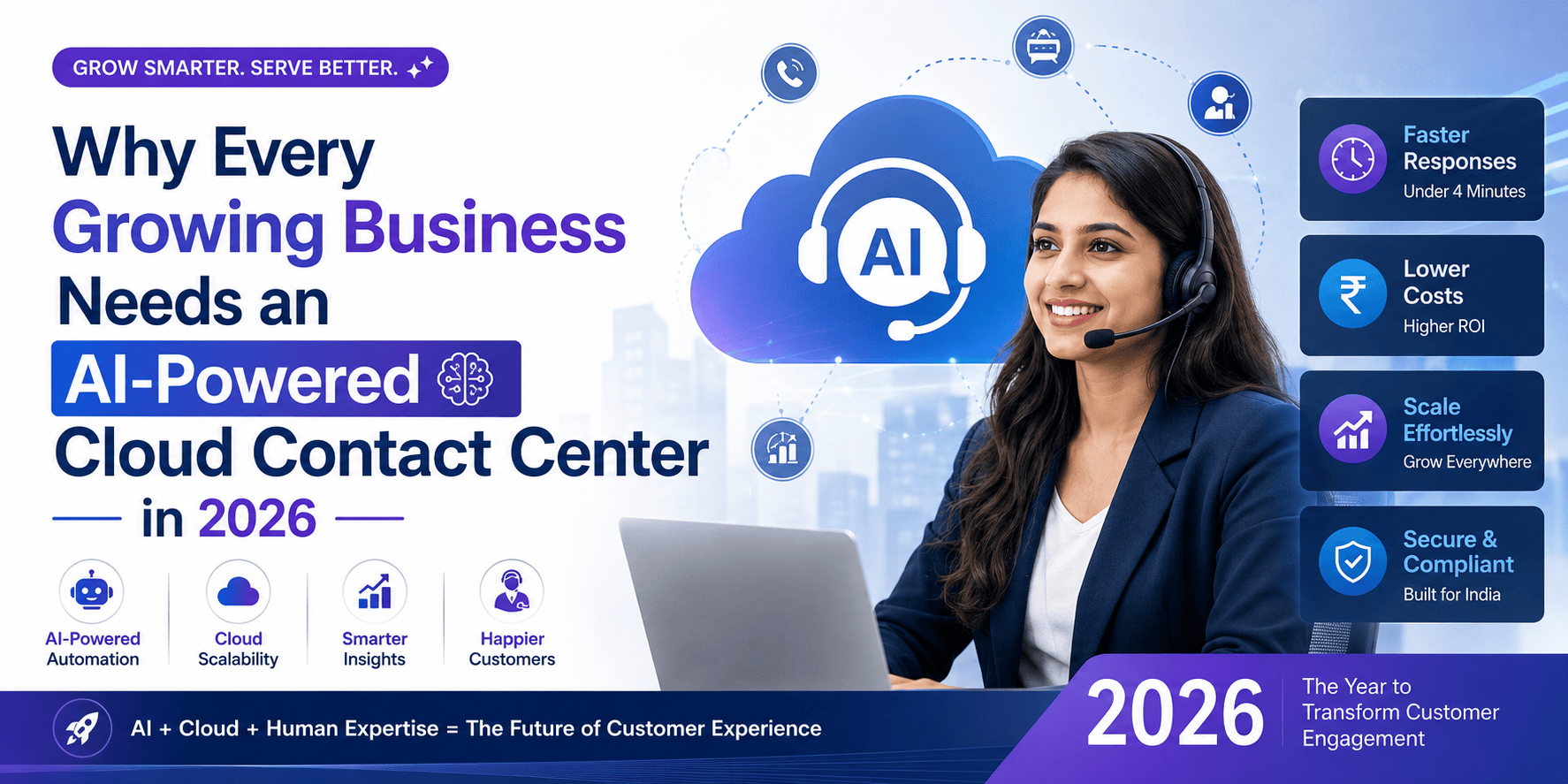
If your business is growing, here is a question worth sitting with: is your customer service infrastructure growing with it?
Most growing businesses add products, hire sales teams, and expand to new markets — but their customer engagement setup stays exactly where it was on day one. A few agents, a basic phone system, and a hope that volumes do not spike too fast. That works until it doesn't. And in 2026, it stops working sooner than ever.
Customer expectations have changed significantly. People who get an instant reply from their bank's voice bot or their e-commerce chatbot will not tolerate a 20-minute hold queue from a growing brand. According to Gartner, conversational AI is on track to reduce contact center agent labour costs by USD 80 billion in 2026 — and that number reflects just how quickly businesses are moving their customer engagement to AI-powered cloud platforms. The global cloud-based contact center market was valued at around USD 32–34 billion in 2025 and is forecast to grow at over 20% annually through the decade, driven by businesses of every size realising that old infrastructure cannot support new growth.
The case is no longer about technology for its own sake. It is about staying competitive. According to a 2026 analysis by Lorikeet, 88% of contact centers now use some form of AI — businesses that have not started this journey are already behind. Here is what the data looks like:
| Metric | Data Point | Source |
| Global cloud contact center market size (2025) | ~USD 32–34 billion | Mordor Intelligence / Research & Markets (2025) |
| Projected market growth rate (2026–2031) | ~20–24% CAGR | Mordor Intelligence (2026) |
| Contact centers using AI in some form | 88% | Lorikeet CX, 2026 |
| Conversational AI labour cost savings by 2026 | ~USD 80 billion | Gartner (2022 forecast) |
| Average ROI on AI customer service investment | USD 3.50 per USD 1 invested | Ringly.io / Gartner cited data (2026) |
| Reduction in cost per interaction with AI | From ~USD 13.50 to ~USD 1.84 (self-service) | Gartner benchmark figures |
| First contact resolution with AI-native platforms | 55–70% | Lorikeet CX, 2026 |
Here are five specific reasons why 2026 is the year every growing business needs to make this move — and what an AI-powered cloud contact center actually does for them.
1. Your Call Volumes Will Outpace Your Team — AI Fills the Gap
Growth is good. But every new customer, every new city you enter, every new product you launch adds more calls, more chats, and more emails. Hiring agents to match that growth is expensive and slow. Training takes weeks. Attrition runs high. And quality varies from one agent to the next.
AI voice bots and chatbots absorb the routine volume — account queries, order status, appointment booking, payment reminders, FAQs — and handle them instantly, at any hour, in multiple languages. A voice bot does not need onboarding. It does not have a bad day. And according to research compiled by Lorikeet in 2026, AI is projected to handle 95% of all customer interactions by end of 2026 across chat, email, and voice. Growing businesses that automate routine interactions can scale their customer service without scaling their headcount at the same rate.
2. The Cost Difference Between Old and New Infrastructure Is No Longer Small
Running a contact center on old hardware is expensive — server maintenance, telecom lines, physical space, large agent teams for peak hours. Cloud contact centers change the economics completely. You pay for what you use, scale up during busy periods, and scale down when volumes drop. No capital expenditure, no idle capacity.
The numbers are clear. Gartner benchmarks show that a self-service or AI-handled contact costs around USD 1.84 per interaction, compared to USD 13.50 for a fully agent-assisted one. Businesses that shift even 50–60% of their volume to AI self-service see a significant drop in cost-to-serve. Research compiled by Ringly.io in 2026 shows companies averaging USD 3.50 in return for every USD 1 invested in AI customer service — with year-three ROI exceeding 124% as the AI learns and improves.
3. Customers Expect Speed — and AI Delivers It Before a Human Even Picks Up
Speed is now the baseline expectation. Research cited by NextPhone in 2026 shows that AI has reduced average first response times across industries from over 6 hours to under 4 minutes, and resolution times from 32 hours to 32 minutes — an 87% improvement. Customers who get fast answers stay. Customers who wait, leave.
An AI voice bot on a cloud contact center answers on the first ring, identifies the caller, understands what they need, and either resolves it or routes them to the right person with full context. For growing businesses in India — where a customer might be calling from Bengaluru, Patna, or Kochi — multilingual voice bots in Hindi, English, and regional languages mean no customer ever feels ignored. And because the platform is cloud-based, every agent — whether in an office or working from home — is connected to the same system, the same customer history, and the same call queue.
4. Data and Compliance Are Built In — Not Bolted On
One of the biggest problems with old contact center setups is that compliance and data management are afterthoughts. Call recordings sit on a local server someone forgot to back up. Quality checks happen on 2–3% of calls because reviewing more is not possible manually. Customer data is scattered across spreadsheets and email threads.
An AI-powered cloud contact center fixes this by default. Every call is recorded and stored securely in the cloud. Speech analytics reviews 100% of conversations — flagging compliance gaps, mis-selling, repeat complaints, or unusual patterns. Dashboards show managers call volumes, wait times, agent performance, and customer sentiment in real time. For growing businesses in India operating under TRAI guidelines and, increasingly, the DPDP Act, having customer data hosted in Indian data centers with proper security certifications is not just good practice — it is becoming a regulatory necessity.
5. It Turns Customer Service from a Cost Into a Growth Tool
Most businesses treat customer service as a cost center — something to keep lean and hope customers do not use too often. AI-powered cloud contact centers flip this entirely. When service is fast, personalised, and proactive, it drives retention, cross-sell, and referrals.
Deloitte Digital's 2026 research found that 43% of service leaders believe AI will help them reduce contact center costs by 30% or more in the next three years. But the same research also highlights that service innovators — the top performers — are using AI not just to cut costs but to generate revenue: proactive outreach, renewal reminders, personalised product recommendations during service calls, and post-interaction follow-ups that drive repeat purchases. A growing business that uses its contact center to sell, retain, and delight customers has a fundamentally different trajectory from one that just uses it to field complaints.
Old Contact Center vs AI-Powered Cloud Contact Center: The Real Difference
|
Area |
Traditional Contact Center |
AI-Powered Cloud Contact Center |
|
Setup |
Months, heavy hardware, large upfront cost |
Days, fully cloud, pay-as-you-use |
|
Scaling |
Hire more agents (weeks to onboard) |
Add capacity instantly on the platform |
|
Cost per interaction |
~USD 13.50 (agent-assisted) |
~USD 1.84 (AI self-service) — Gartner |
|
Availability |
Business hours, long hold times |
24x7, instant answer via voice bot |
|
Languages |
Agents hired per language |
Multilingual AI bots on one platform |
|
Quality monitoring |
2–3% of calls sampled manually |
100% of calls reviewed by AI analytics |
|
Data & compliance |
Local servers, manual audits |
Cloud-hosted, secure, auto-logged |
|
ROI |
Ongoing cost, limited revenue impact |
Avg. USD 3.50 return per USD 1 invested |
Conclusion: In 2026, This Is No Longer Optional for Growing Businesses
The market data, the ROI numbers, and the customer expectation research all point to the same place. AI-powered cloud contact centers are not something growing businesses should consider — they are something growing businesses cannot afford to ignore. The cost advantage is clear, the speed improvement is proven, and the compliance and data benefits are increasingly non-negotiable. Every month a business waits, its competitors are getting faster, cheaper, and closer to their customers.
The good news is that getting started has never been easier. Cloud means no hardware, no long setup, and no large upfront investment. A growing business can launch with a voice bot, a smart IVR, and basic call routing — and expand from there as it grows.
Why Choose CloudConnect?
CloudConnect is India's first DOT-licensed B2B Virtual Network Operator (VNO), trusted by 350+ enterprise customers across BFSI, real estate, automotive, healthcare, and e-commerce. Our AI-powered cloud contact center platform — with voice bots, smart IVR, auto-dialers, CRM integration, omnichannel engagement, and full speech analytics — is built for growing businesses that need enterprise-grade infrastructure without enterprise-grade complexity. With a 99.9% uptime SLA, ISO 9001 and ISO 27001 certification, and 100% Indian data centers, your customer data stays secure, your engagement never goes down, and your team can focus on growth — not downtime. Visit cloudconnect.in to book a free demo.
Frequently Asked Questions (FAQs)
1. What is an AI-powered cloud contact center?
It is a cloud-hosted customer engagement platform that uses AI — voice bots, smart call routing, speech analytics, and automated outbound calling — alongside human agents to handle customer interactions faster and more cost-effectively than a traditional call center.
2. Is an AI-powered cloud contact center only for large companies?
No. Cloud-based pricing means growing businesses pay for what they use, with no hardware investment. Many businesses start with just a voice bot and basic cloud calling, and add features as they scale.
3. How much can a growing business actually save with AI customer service?
Gartner benchmarks show AI-handled interactions cost around USD 1.84 compared to USD 13.50 for fully agent-assisted ones. With an average ROI of USD 3.50 per USD 1 invested, the savings are significant even for mid-sized operations.
4. Will customers accept talking to an AI voice bot?
For routine queries — balance checks, order status, appointment booking, FAQs — yes. Research in 2026 shows 51% of customers prefer a bot over waiting for a human when they need an immediate answer. The key is to always offer a smooth transfer to a human for complex issues.
5. How long does it take to set up a cloud contact center?
Because everything is cloud-based, most businesses can go live in days to a few weeks, including integrations with their CRM or existing phone numbers. There is no hardware procurement or server room setup involved.
6. What about data security and Indian regulations?
Choose a provider that hosts data in Indian data centers and holds relevant certifications. CloudConnect operates under a DOT VNO license with ISO 27001-certified security and 100% Indian data hosting, which aligns with TRAI guidelines and India's emerging DPDP Act requirements.
References
-
https://www.gartner.com/en/newsroom/press-releases/2022-08-31-gartner-predicts-conversational-ai-will-reduce-contac
-
https://www.mordorintelligence.com/industry-reports/global-cloud-based-contact-center-market
-
https://www.deloitte.com/global/en/about/press-room/digital-research-determines-contact-centers-will-become-experience-hubs-for-brands-in-2021-and-beyond.html
-
https://www.trai.gov.in/release-publication/reports