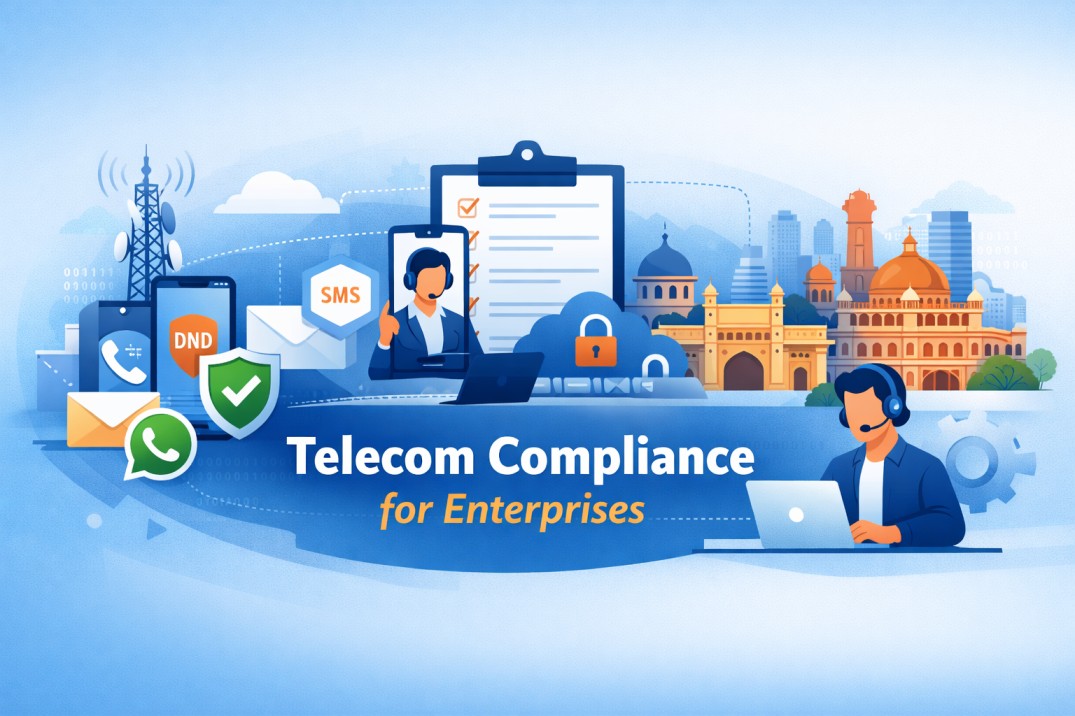
India has one of the largest and most regulated telecom ecosystems in the world, it handles massive scale, driving compliance focus:
-
Total connections: 1.23 billion as of late 2025, up 32% since 2014.
-
Consumer complaints: TRAI gets 10,000+ monthly, often on billing or spam.
-
Spam/fraud actions: 1.94 crore numbers cut via "Not My Number" feedback; 6.21 lakh IMEIs blocked for cyber fraud; 26.35 lakh lost phones traced.
-
Business scale: TSPs run 5.08 lakh 5G stations; taxes hit ₹1.5 lakh crore yearly.
-
60–65% of consumer complaints to telecom regulators are related to:
-
Spam calls
-
Unsolicited SMS
-
Fraudulent communications
-
Over 250 million numbers are registered under DND
📌 What this means for enterprises:
Even one wrong campaign can trigger thousands of complaints in hours.
1. Who Regulates Enterprise Telecom Communication?
Telecom compliance in India is governed by:
-
Telecom Regulatory Authority of India (TRAI)
-
Department of Telecommunications (DoT)
-
Telecom operators (Airtel, Jio, Vodafone Idea, BSNL)
Enterprises become legally accountable once they:
-
Make outbound calls (sales, reminders, verification)
-
Send bulk SMS or OTPs
-
Use WhatsApp Business API
-
Run IVR or auto-dialers
-
Operate contact or call centers
📌 Important:
Even a school, hospital, real estate firm, or edtech company is treated as a telemarketer under law.
2. DLT Registration – The Foundation of Telecom Compliance

DLT (Distributed Ledger Technology) is mandatory for all enterprise SMS communication.
What Enterprises Must Register on DLT
-
Principal Entity (Brand)
-
Your company legal name
-
Sender IDs (Headers)
-
Example: ABCEDU, BANKTX, HOSPIT
-
Message Templates
-
Exact text (even punctuation matters)
-
Consent Type
-
Transactional / Service / Promotional
Real Data
-
30–35% of enterprise SMS failures happen due to:
-
Unregistered headers
-
Template mismatch
-
Using promotional content in service templates
📌 Simple rule:
If even one word differs, the SMS gets blocked.
3. DND (Do Not Disturb) Compliance – The Biggest Risk Area
DND rules control who you can contact and when.
Communication Rules by Type
|
Type |
DND Users |
Time Allowed |
|
Transactional (OTP, alerts) |
✅ Allowed |
24x7 |
|
Service (updates, reminders) |
⚠️ Limited |
8 AM – 9 PM |
|
Promotional (sales, offers) |
❌ Not allowed |
10 AM – 8 PM |
Common Enterprise Mistakes
-
Calling DND numbers for sales
-
Marking promotions as “service”
-
Calling outside allowed hours
-
No call scrubbing before dialing
📊 Impact Data:
Enterprises without DND scrubbing receive 4–6× more complaints.
📌 Penalty:
Repeated violations → number disconnection + blacklisting.
4. Voice Call & Contact Center Compliance

Mandatory Rules for Enterprise Calling
1. Call Scrubbing
Every outbound number must be checked against:
-
DND database
-
Customer consent status
2. Calling Hours
-
Only between 8 AM and 9 PM
-
Even customer-requested calls outside this window can be flagged
3. Purpose Declaration
Each call must be tagged as:
-
Transactional
-
Service
-
Promotional
📊 Industry Data:
Compliant contact centers see 40–60% fewer spam complaints.
5. Call Recording, Storage & Data Protection
Many sectors are legally required to record calls.
Mandatory for:
-
BFSI
-
Insurance
-
Healthcare
-
Large enterprises & regulated services
Compliance Requirements
-
Secure call recording
-
90–180 days retention
-
Restricted internal access
-
Protection under IT Act & privacy norms
📌 Risk:
Unsecured recordings can lead to data breach penalties and lawsuits.
6. WhatsApp Business (WABA) Compliance
WhatsApp is not free-form messaging for businesses.
Key Rules
-
Only opt-in users
-
Approved templates only
-
Clear opt-out option
-
Category-wise usage:
-
Utility
-
Authentication
-
Marketing
Common Reasons for WABA Ban
-
Sending promotions via utility templates
-
Messaging users without consent
-
High user report/block rate
📊 Data Insight:
Verified WABA accounts show 3–5× better delivery than informal WhatsApp usage.
7. Consent Management – The Heart of Compliance
Modern telecom compliance is consent-driven.
Enterprises Must Maintain
-
Where consent was taken (form, IVR, app)
-
Time & purpose of consent
-
Channel-specific permission
-
Easy unsubscribe option
📊 Operational Benefit:
Proper consent logs reduce dispute resolution time by up to 70%.
8. Financial & Business Impact of Non-Compliance
|
Risk |
Business Loss |
|
Number blocking |
Complete campaign stop |
|
Header blacklisting |
SMS delivery failure |
|
WhatsApp ban |
CX breakdown |
|
Legal notices |
Compliance cost |
|
Brand damage |
Trust erosion |
📊 Estimated Cost:
For mid-size enterprises, a blocked number can mean ₹5–25 lakhs/month revenue loss.
9. General Telecom Checklist
Core steps for all enterprises, now tailored for call center scale:
-
Cyber Security: Policy with risk assessments; 6-hour breach reports to DoT; CSO/SOC setup; quarterly audits.
-
Equipment: MTCTE CoC for VoIP gear, PBX, headsets; group testing for variants.
-
Data (DPDP): Consent logs; DPO; DPIAs for customer profiles.
-
Reporting: QoS, financials to TRAI/DoT; DND compliance.
Call Center-Specific Checklist
Focus on outbound/inbound ops to avoid blacklisting:
-
DLT Registration: Register on DLT portal as telemarketer/Principal Entity (PE); get unique headers/senders for SMS; PE guarantees content for agents.
-
Call Series Compliance: Use 140xxx for promotional outbound calls/SMS; 160xxx/1600xxx for service/transactional; no missed calls for promotion.
-
Consent & Records: Log explicit consents with timestamps/opt-outs; retain 3 years; upload monthly to DLT; honor DND instantly.
-
Telemarketer-Header Mapping: Link agents to PEs; report misuse; migrate old numbers to 10-digit by deadlines.
-
Complaint Handling: Resolve UCC issues in 5-7 days; report to TRAI portal; monitor blacklists (e.g., 3.5 lakh headers blocked recently).
-
Audit & Tech: Encrypt calls/data; use AI for spam detection; annual vendor audits; STI (Single Toll-Free) for inbound if applicable.
-
Staff Training: Monthly on UCC/DND; log all calls with timestamps/content.
Key Data & Risks
TRAI blocked 21+ lakh spam numbers, 3.5 lakh SMS headers; complaints fell from 3.12 lakh to 39k post-crackdown. Fines: ₹10 lakh+ per violation; entity blacklisting. Use TRAI's UCC portal for real-time compliance checks.
10. What Telecom Compliance Will Look Like by 2026
By 2026, telecom compliance in India evolves toward smarter, AI-driven enforcement under DoT and TRAI, building on the Telecom Act 2023 and recent reforms to curb spam while easing enterprise burdens.
AI-Based Call Intent Detection
TRAI mandates AI tools to analyze call patterns, content, and metadata in real-time, flagging promotional vs. transactional intent with 95%+ accuracy. Call centers must integrate these into PBX/VoIP systems, reducing false positives; non-compliance risks 50% call volume caps.
Unified Consent Across Channels
Enterprises unify consent via DPDP-integrated platforms linked to TRAI's National Consumer Preference Register, covering calls, SMS, WhatsApp, and email. One-time opt-ins auto-sync across 140/160 series; audits verify 100% logging, with fines up to ₹5 crore for gaps.
Stricter Spam Thresholds
Thresholds tighten: >1% complaint rate per header triggers audits; >5% blocks numbers instantly. Bulk senders face 1,000-call daily limits initially, scaling with clean records; 3-strike policy blacklists repeat offenders for 6 months.
Faster Number Blocking for Repeat Offenders
DoT's UCC portal enables 24-hour blocking post-3 complaints, with AI auto-escalation; 21+ lakh numbers already disconnected as precedent. Enterprises get 2-hour appeals but must swap headers; repeat blocks hit entire PE portfolios.
Mandatory Enterprise Identity Verification
All telemarketers/PEs verify via Aadhaar/DigiLocker on DLT portal by Q1 2026, linking to GST/PAN for traceability. Unverified entities can't register headers; call centers audit chains, facing joint liability for vendor fraud.
Enterprise Readiness Steps
Upgrade to AI-compliant stacks; migrate consents by March 2026; monitor TRAI dashboards daily. These shifts cut complaints 90% (from 3.12 lakh to 39k seen recently), but demand proactive tech investments
About Cloud Connect
Cloud Connect helps enterprises build fully compliant voice, SMS, WhatsApp, and Cloud contact center communication systems.
Cloud Connect works closely with telecom operators and regulatory frameworks to ensure DLT compliance, DND scrubbing, consent management, and audit readiness.
Cloud Connect has supported communication infrastructure for leading enterprises such as 99Acres, Applo Pharmacy, Akash Byjus, Amity University, helping them scale customer communication without risking number blocks or regulatory issues.
Frequently Asked Questions (FAQs)
1. Is telecom compliance mandatory for all enterprises in India?
Yes. Any enterprise making outbound calls, sending SMS, or using WhatsApp for customer communication must follow telecom compliance rules defined by TRAI and telecom operators.
2. What happens if an enterprise does not follow DND or DLT rules?
Non-compliance can lead to number suspension, SMS blocking, WhatsApp bans, and financial losses. In serious cases, enterprises may also face legal notices.
3. Are service and transactional messages exempt from DND rules?
Transactional messages (like OTPs) are allowed 24x7.
Service messages are allowed only during permitted hours and must not contain promotional content.
4. Is WhatsApp Business API safer than using normal WhatsApp for business?
Yes. WABA is compliant, template-based, consent-driven, and more reliable. Normal WhatsApp usage for business often leads to account bans.
5. How can enterprises reduce telecom complaints?
By using DND scrubbing, proper consent management, correct message categorization, and compliant communication platforms.
6. Do small businesses also need to follow telecom compliance?
Yes. Telecom rules apply equally to startups, SMEs, and large enterprises.
References
-
Telecom Regulatory Authority of India (TRAI) – UCC & DND Regulations
-
Department of Telecommunications (DoT), Government of India
-
Telecom Commercial Communication Customer Preference Regulations (TCCCPR)
Disclaimer
This content is intended for general information and awareness purposes only.
Telecom regulations, compliance requirements, and enforcement practices may change over time and can vary based on industry, use case, and telecom operator.
This article does not constitute legal or regulatory advice. Enterprises are advised to consult with their telecom service providers, legal advisors, or compliance experts before making business or communication decisions based on this information.