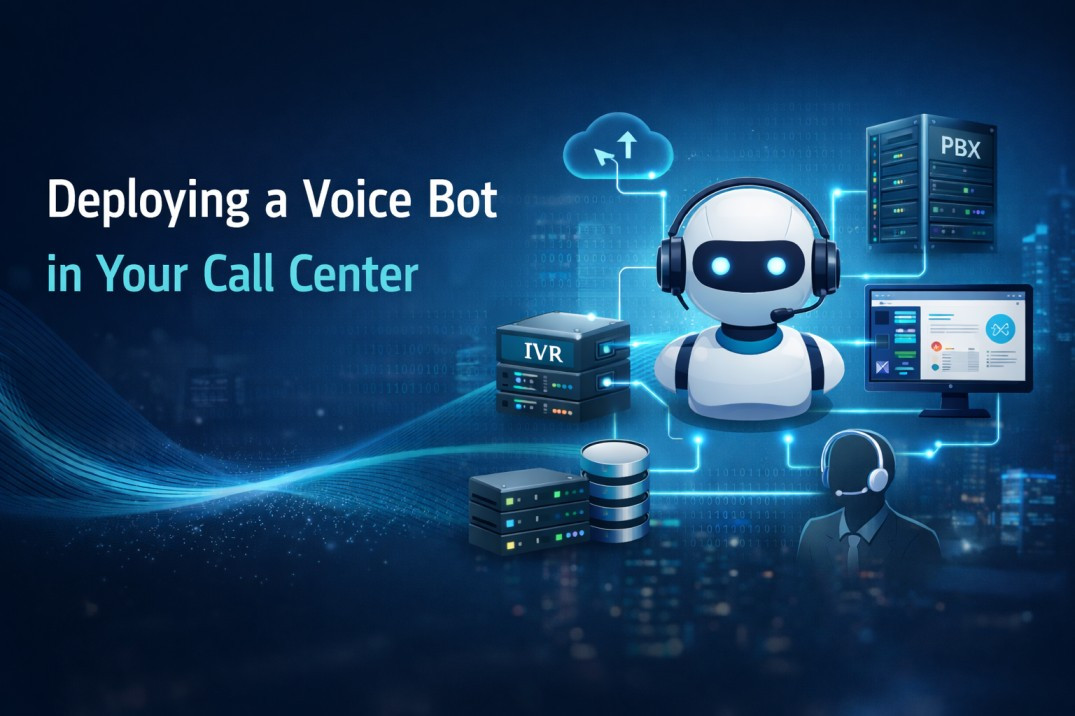
Voice remains the most preferred support channel for urgent and complex issues. According to multiple industry reports:
-
Over 60% of customers still prefer voice support for high-value or time-sensitive issues.
-
Contact centers spend 60–70% of their operational cost on voice operations.
-
AI-powered voice agents can reduce average handling time (AHT) by 20–40%.
-
Intelligent automation can help businesses lower customer service costs by up to 30% while improving CSAT.
-
By 2026, more than 50% of contact centers are expected to integrate conversational AI into voice workflows.
Modern voice agents are no longer IVR trees with “Press 1 for support.” They are AI-powered, context-aware, multilingual, and capable of real-time personalization.
In this guide, we explore the top voice agent platforms helping contact centers improve efficiency, reduce costs, and elevate customer experience (CX).
1. CloudConnect – India’s Licensed Digital Telco (VNO)
Why It Stands Out
CloudConnect is India’s 1st licensed B2B Digital Telco (VNO) delivering enterprise-grade voice infrastructure and AI-powered contact center solutions.
Unlike global-only SaaS providers, CloudConnect combines:
-
Licensed telecom backbone
-
Cloud contact center platform
-
AI-powered voice automation
-
Regulatory compliance support
CloudConnect currently supports 350+ businesses across India, enabling scalable voice operations with reliability and compliance built in.
Key Capabilities
-
AI Voice Agents for inbound automation
-
Smart IVR with conversational AI
-
Call routing & queue intelligence
-
Unified Communications (UCaaS)
-
CRM integration support
-
TRAI & DLT-compliant telecom infrastructure
-
Real-time analytics & reporting
Business Impact
Organizations leveraging AI voice automation through CloudConnect typically achieve:
-
20–35% reduction in repetitive call handling
-
Faster customer response time
-
Improved call routing accuracy
-
Lower telecom infrastructure dependency
-
Better compliance management
Ideal For
-
Indian enterprises requiring licensed telecom infrastructure
-
BFSI, EdTech, Healthcare, E-commerce
-
Growing businesses scaling voice operations
-
Companies needing AI + telecom reliability in one platform
2. Google Cloud Contact Center AI

4
Why It Stands Out
Google’s CCAI combines Dialogflow CX, speech-to-text, text-to-speech, and AI insights into a unified voice AI platform.
Key Features
-
Advanced NLP powered by Google AI
-
Real-time speech recognition
-
Smart IVR replacement
-
Agent assist (live call suggestions)
-
Omnichannel integration
Ideal For
Large enterprises looking for scalable AI with deep analytics and integration flexibility.
3. Amazon Connect

Why It Stands Out
A cloud-native contact center solution integrated with Amazon Lex for AI-powered conversational voice bots.
Key Features
-
Pay-as-you-go pricing
-
AI-driven call routing
-
Real-time sentiment analysis
-
Built-in analytics & dashboards
-
Seamless AWS ecosystem integration
Impact Data
-
Businesses report up to 30% reduction in cost per contact after moving to Amazon Connect.
-
Faster deployment compared to legacy on-prem systems.
Ideal For
Startups to large enterprises already using AWS infrastructure.
4. Genesys (Genesys Cloud CX)
Why It Stands Out
A leader in CX platforms, offering strong AI voice automation capabilities.
Key Features
-
AI-powered predictive routing
-
Conversational AI voice bots
-
Workforce engagement tools
-
Journey orchestration
Impact Data
-
Helps improve first call resolution (FCR) by 15–25%.
-
Reduces agent workload significantly via automation.
Ideal For
Mid-to-large enterprises needing complete CX transformation.
5. Five9

Why It Stands Out
Strong AI-driven intelligent virtual agents (IVAs) for voice automation.
Key Features
-
NLP-powered IVR
-
Intelligent call routing
-
Real-time reporting
-
CRM integrations
Impact Data
-
Companies report 20–35% improvement in operational efficiency.
Ideal For
Enterprises seeking advanced outbound and inbound voice automation.
6. Talkdesk
Why It Stands Out
AI-first contact center platform with automation at its core.
Key Features
-
AI voice agents
-
Real-time reporting
-
No-code automation builder
-
Omnichannel CX
Impact Data
-
Reported up to 30% increase in agent productivity.
-
Faster onboarding with cloud-native infrastructure.
Ideal For
Digital-first businesses and high-growth companies.
How Voice Agents Improve Customer Service
1. 24/7 Availability
AI voice bots handle repetitive queries round the clock.
2. Reduced Wait Times
Automated call deflection reduces queue length by 25–50%.
3. Smart Call Routing
AI identifies intent and routes calls to the right agent.
4. Personalization
Voice AI integrates with CRM to personalize conversations.
5. Cost Optimization
Lower dependency on large agent teams for Tier-1 queries.
Key Metrics to Track
-
Average Handling Time (AHT)
-
First Call Resolution (FCR)
-
Cost Per Contact
-
CSAT & NPS
-
Call Containment Rate
How to Choose the Right Voice Agent Platform
Consider:
-
Scalability & Cloud Architecture
-
AI/NLP Accuracy
-
CRM & API Integrations
-
Pricing Model (per minute, per agent, usage-based)
-
Compliance (PCI-DSS, GDPR, TRAI guidelines in India)
-
Multilingual Support
Why CloudConnect Has a Unique Advantage in India
Most global platforms provide AI software.
CloudConnect delivers:
-
Licensed telecom infrastructure
-
AI automation
-
Compliance-ready voice architecture
-
Enterprise-grade reliability
-
Local support
For Indian enterprises, this reduces dependency on multiple vendors and ensures regulatory alignment.
Frequently Asked Questions (FAQ)
1. What is a voice agent platform in a contact center?
A voice agent platform is an AI-powered system that automates customer phone interactions using technologies like Automatic Speech Recognition (ASR), Natural Language Processing (NLP), and Text-to-Speech (TTS).
Unlike traditional IVR systems, modern platforms such as Google Cloud Contact Center AI or Amazon Connect enable natural, conversational interactions instead of menu-based routing.
They can:
-
Understand caller intent
-
Provide instant answers
-
Route calls intelligently
-
Assist human agents in real time
2. How is a voice agent different from a traditional IVR?
|
Traditional IVR |
AI Voice Agent |
|
Menu-based (“Press 1”) |
Conversational (“How can I help you?”) |
|
Scripted responses |
Context-aware responses |
|
Limited personalization |
CRM-integrated personalization |
|
High drop-off rates |
Higher containment & CSAT |
AI voice agents can reduce call transfers and improve resolution speed by 20–40%, while traditional IVR systems often increase friction.
3. Can AI voice agents completely replace human agents?
No — and they shouldn’t.
Voice AI is best suited for:
-
Tier-1 repetitive queries
-
Order status checks
-
Account balance inquiries
-
Appointment confirmations
-
Basic troubleshooting
Human agents remain critical for:
-
Emotional conversations
-
Escalations
-
High-value sales
-
Complex problem resolution
The most effective model is AI + Human collaboration.
4. How much cost reduction can organizations expect?
Based on industry benchmarks:
-
20–30% reduction in operational cost
-
25–50% reduction in call wait time
-
15–25% improvement in First Call Resolution (FCR)
-
20–40% decrease in Average Handling Time (AHT)
Cost savings depend on:
-
Call volume
-
Automation rate
-
Integration complexity
-
Workforce optimization
5. What industries benefit most from voice agent platforms?
Voice AI delivers strong ROI in:
-
Banking & Financial Services
-
Insurance
-
E-commerce
-
Telecom
-
Healthcare
-
EdTech
-
Travel & Hospitality
High call-volume industries see faster payback periods.
6. Are voice agent platforms suitable for Indian contact centers?
Yes — especially with multilingual support.
Platforms like Genesys and Talkdesk support regional languages including Hindi and other Indian languages.
For India, it is important to consider:
-
TRAI compliance
-
DLT regulations
-
Cloud hosting location
-
Data privacy standards
7. How secure are AI voice agent platforms?
Leading platforms provide:
-
End-to-end encryption
-
Role-based access control
-
PCI-DSS compliance
-
GDPR & regional compliance
-
Secure API integrations
Security depends on deployment architecture and telecom integration quality.
8. How long does implementation take?
Implementation timelines vary:
-
Basic cloud setup: 2–4 weeks
-
CRM integration + custom workflows: 4–8 weeks
-
Enterprise-grade deployment: 8–12 weeks
Cloud-native platforms significantly reduce deployment time compared to legacy systems.
9. What metrics should be tracked after deployment?
Key KPIs include:
-
Call Containment Rate
-
First Call Resolution (FCR)
-
Average Handling Time (AHT)
-
Cost Per Contact
-
Customer Satisfaction (CSAT)
-
Net Promoter Score (NPS)
-
Call Abandonment Rate
Tracking these helps measure ROI and optimization opportunities.
10. How do voice agents improve customer experience (CX)?
Voice agents enhance CX by:
-
Providing 24/7 availability
-
Reducing wait times
-
Offering consistent responses
-
Enabling personalized service
-
Improving routing accuracy
When integrated properly, they create a seamless journey between automation and human support.
11. What is the difference between Agent Assist and Voice Bots?
-
Voice Bots interact directly with customers.
-
Agent Assist works in the background during live calls.
Agent Assist tools can:
-
Suggest responses in real time
-
Provide knowledge base recommendations
-
Generate call summaries
-
Detect sentiment
Platforms like Five9 and Google Cloud Contact Center AI offer advanced agent assist features.
12. What factors should businesses consider before choosing a voice agent platform?
Evaluate:
-
AI/NLP accuracy
-
Multilingual capability
-
Pricing model (per minute vs per agent)
-
Cloud reliability
-
Compliance readiness
-
Scalability for future growth
A pilot program is recommended before full-scale rollout.
13. Is voice AI expensive to maintain?
Cloud-based models operate on:
-
Usage-based pricing
-
Subscription models
-
Hybrid per-agent + per-minute billing
While there is an initial setup cost, long-term operational savings typically outweigh investment within 6–18 months depending on scale.
14. Can voice agents integrate with existing telecom infrastructure?
Yes. Modern platforms integrate with:
-
CRM systems
-
Ticketing tools
-
Workforce management systems
Choosing the right telecom partner ensures stable voice quality and regulatory compliance.
15. What is the future of voice agents in contact centers?
By 2026 and beyond:
-
More than 50% of contact centers are expected to use conversational AI
-
AI-human hybrid models will dominate
-
Hyper-personalization using real-time data will increase
-
Predictive routing powered by AI will become standard
Voice agents will shift from cost-saving tools to strategic CX enablers.
About CloudConnect
CloudConnect is India’s 1st licensed B2B Digital Telco (VNO) delivering enterprise-grade Unified Communications (UCaaS), Cloud Contact Center, AI voice solutions, and business telephony infrastructure.
CloudConnect enables businesses to:
-
Deploy scalable cloud contact centers
-
Integrate AI-powered voice automation
-
Ensure regulatory compliance
-
Improve CX with reliable telecom infrastructure
With enterprise reliability and AI-driven automation, CloudConnect helps organizations transform traditional call centers into modern, intelligent CX hubs.