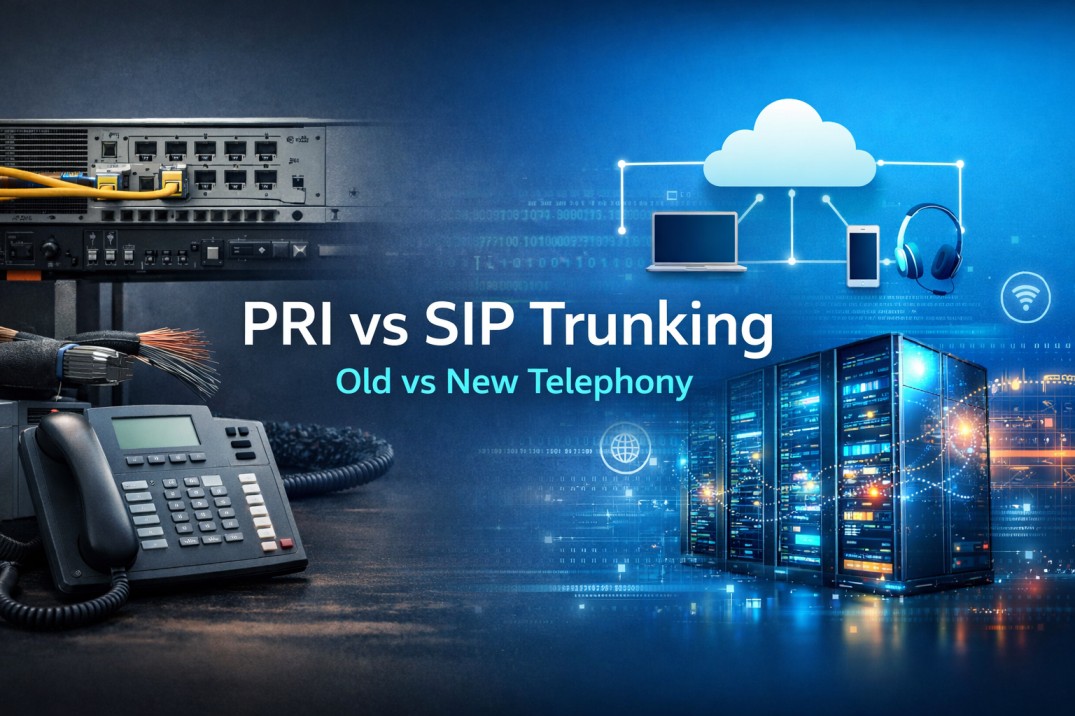
Businesses worldwide are rapidly moving away from Primary Rate Interface (PRI) and adopting Session Initiation Protocol (SIP) trunking—and the shift is backed by clear data, not hype.
According to global telecom market studies, the SIP trunking market is projected to grow from USD 13.87 billion in 2023 to USD 36.74 billion by 2031, registering a compound annual growth rate (CAGR) of nearly 13%. This growth is primarily driven by enterprises replacing legacy PRI and ISDN-based voice systems with IP-based communication.
Cost is a major driver of this transition. Industry reports show that businesses migrating from PRI to SIP achieve 40–60% reduction in telephony costs, mainly by eliminating fixed-capacity circuits, reducing hardware dependency, and leveraging existing internet infrastructure. Even conservative estimates indicate at least 5–10% immediate savings on monthly voice bills post-migration.
Adoption data further reinforces this trend:
-
By 2024, around 65% of enterprises in North America had already adopted SIP trunking
-
Globally, more than 70% of businesses had begun moving away from PRI as early as 2018
-
Telecom operators across regions are actively phasing out ISDN/PRI services, making SIP the default alternative
Beyond cost, SIP aligns better with modern business needs such as cloud PBX, remote work, multi-location operations, disaster recovery, and rapid scalability—areas where PRI struggles due to its rigid, physical architecture.
This shift is not simply a technology upgrade; it represents a structural change in how businesses design, scale, and secure their voice communications.
Below are a few data-backed reasons why SIP is replacing PRI. This article also covers India-specific TRAI and DoT compliance considerations and includes a step-by-step PRI-to-SIP migration checklist.
1. Significant Cost Savings
One of the biggest reasons businesses switch from PRI to SIP is cost reduction.
-
SIP trunking reduces telephony costs by 40–60% compared to PRI
-
No need for physical copper lines or PRI cards
-
Uses existing internet or fiber infrastructure
-
Eliminates expensive per-minute calling charges
Industry insight:
Most businesses report at least a 5% immediate reduction in monthly telecom bills after migrating to SIP—often much more for call centers and multi-location enterprises.
With PRI, companies pay for fixed capacity whether they use it or not. SIP allows businesses to pay only for what they use.

2. Instant Scalability vs Fixed Capacity
PRI comes with rigid limits.
-
One PRI circuit supports 23–30 fixed call channels
-
Adding capacity requires new hardware
-
Provisioning can take weeks
SIP trunking works very differently.
SIP scalability advantages:
-
Channels can be added or removed instantly
-
No physical installation required
-
Scaling happens through software configuration
Market validation:
The global SIP trunking market is expected to grow from $13.87 billion in 2023 to $36.74 billion by 2031, at a 12.9% CAGR—largely driven by businesses demanding flexible, on-demand voice capacity.
3. Rapid Global Adoption
SIP is no longer an emerging technology—it is now mainstream.
Adoption data:
-
Around 65% of North American businesses were using SIP trunking by 2024
-
Over 70% of enterprises globally had already moved away from PRI by 2018
-
Telecom carriers are actively phasing out ISDN/PRI services
Many service providers no longer recommend new PRI installations, as legacy networks are being decommissioned.
4. Better Reliability and Business Continuity
PRI depends on physical infrastructure.
If a PRI line fails due to:
-
Cable damage
-
Hardware failure
-
Local outages
👉 Calls stop completely.
SIP trunking is designed for resilience.
SIP reliability benefits:
-
Automatic call failover to backup locations
-
Disaster recovery across cities or data centers
-
Easy rerouting during outages
Result: Businesses experience far less downtime and higher call availability compared to PRI-based systems.
5. Built for Modern Work Environments
PRI was designed for traditional office setups.
SIP supports:
-
Cloud PBX systems
-
Remote and work-from-home teams
-
CRM and helpdesk integrations
-
Call analytics and monitoring
This makes SIP ideal for BPOs, enterprises, startups, and hybrid teams.
PRI vs SIP: Quick Comparison
|
Feature |
PRI |
SIP |
|
Cost efficiency |
❌ High cost |
✅ 40–60% savings |
|
Scalability |
❌ Fixed channels |
✅ On-demand |
|
Deployment time |
❌ Weeks |
✅ Minutes |
|
Remote work support |
❌ No |
✅ Yes |
|
Disaster recovery |
❌ Limited |
✅ Built-in |
|
Future readiness |
❌ Legacy |
✅ Cloud-ready |
India - TRAI & DoT Compliance Considerations
In India, enterprise voice services—especially SIP trunking—must comply with TRAI (Telecom Regulatory Authority of India) and DoT (Department of Telecommunications) guidelines. Migrating from PRI to SIP is fully permitted, provided compliance norms are followed.
Key Compliance Points for SIP Trunking in India
1. Licensed Service Provider Requirement
-
SIP trunking must be taken only from a DoT-licensed TSP (Access Service / Unified License holder)
-
Enterprises cannot source SIP trunks from unlicensed or overseas providers for PSTN connectivity
✔️ Action: Ensure your SIP provider holds a valid Unified License (UL)
2. KYC & Enterprise Verification
-
Mandatory enterprise KYC including:
-
Certificate of Incorporation
-
GST / PAN
-
Authorized signatory details
-
Verification required before SIP activation
✔️ Action: Keep KYC documents ready to avoid provisioning delays
3. Numbering & CLI Regulations
-
SIP trunks must use TRAI-approved numbering plans
-
CLI masking or spoofing is strictly prohibited
-
Call origin identity must be traceable
✔️ Action: Confirm CLI presentation and numbering compliance with your provider
4. Call Routing & Grey Route Prevention
-
Global calls must route via authorized gateways only
-
Grey routes and bypass mechanisms are illegal
✔️ Action: Ensure all ISD traffic is routed via compliant SIP gateways
5. Call Recording & Data Retention (Where Applicable)
For regulated industries (BFSI, healthcare, BPOs):
-
Call logs and recordings may need retention for audit
-
Secure storage within India is recommended
✔️ Action: Use SIP providers offering India-hosted infrastructure
6. Lawful Interception (LI) Support
-
SIP providers must support Lawful Interception & Monitoring (LIM)
-
Enterprises should not deploy encrypted voice systems that bypass LI
✔️ Action: Validate LI compliance with your SIP vendor
Indian Regulatory Bodies Involved
-
TRAI – Policy, tariffs, quality of service
-
DoT – Licensing, security, lawful interception
-
TSPs – Compliance execution and reporting
PRI → SIP Migration Checklist (Enterprise-Ready)
Use this checklist to ensure a smooth, zero-downtime migration from PRI to SIP.
Phase 1: Assessment & Planning
☐ Audit current PRI usage (channels, peak calls, ISD usage)
☐ Identify unused PRI capacity and cost wastage
☐ Check PBX compatibility (IP-PBX / Hybrid / Cloud)
☐ Evaluate internet bandwidth and redundancy
☐ Confirm regulatory and compliance needs
Phase 2: Vendor & Compliance Readiness
☐ Select a DoT-licensed SIP provider
☐ Verify TRAI numbering and CLI compliance
☐ Complete enterprise KYC documentation
☐ Confirm SLA, uptime, and support availability
☐ Ensure India-hosted infrastructure (if required)
Phase 3: Network & Infrastructure Setup
☐ Configure SIP trunks and IP authentication
☐ Deploy SBC (Session Border Controller) if needed
☐ Configure firewall rules and QoS policies
☐ Set up call recording and logging (if applicable)
☐ Test failover and disaster recovery routes
Phase 4: Parallel Run & Testing
☐ Run SIP and PRI in parallel
☐ Test inbound and outbound calls
☐ Verify call quality, latency, and jitter
☐ Validate CLI display and call routing
☐ Train IT and operations teams
Phase 5: Cutover & Optimization
☐ Gradually move traffic from PRI to SIP
☐ Monitor call performance and reports
☐ Decommission unused PRI circuits
☐ Optimize channel count based on real usage
☐ Review monthly billing and cost savings
Final Note for Indian Enterprises
Migrating from PRI to SIP in India is not just a technology upgrade—it is a regulatory-compliant, cost-optimized, future-ready move when done with the right licensed provider and planning.
With PRI networks gradually being phased out, SIP trunking aligns far better with:
-
TRAI regulations
-
Cloud adoption
-
Hybrid work models
-
Business continuity requirements
About Cloud Connect
Cloud Connect helps businesses modernize their communication infrastructure with TRAI-compliant SIP trunking, cloud telephony, and enterprise voice solutions. Trusted by 350+ growing businesses, Cloud Connect is India’s first licensed B2B Digital Telco (VNO), working closely with organizations to enable secure, scalable, and cost-efficient migration from legacy PRI systems to IP-based platforms. With a strong focus on compliance, reliability, and business continuity, Cloud Connect supports enterprises at every stage of their telecom transformation journey.
Frequently Asked Questions (FAQ)
1. How much can businesses save by switching from PRI to SIP?
Most businesses save 40–60% on telephony costs after migrating from PRI to SIP. Savings come from eliminating physical lines, reducing hardware dependency, lowering call charges (especially ISD), and paying only for required channels instead of fixed PRI capacity.
2. Is SIP trunking suitable for small and mid-sized businesses?
Yes. SIP is actually more beneficial for SMBs because it:
-
Requires lower upfront investment
-
Scales as the business grows
-
Works with cloud PBX and hosted systems
-
Avoids long-term lock-in and unused capacity costs
Even companies with 5–10 concurrent calls can benefit.
3. Will call quality improve or degrade with SIP?
When deployed with adequate bandwidth and QoS configuration, SIP call quality is equal to or better than PRI. SIP supports HD voice codecs and intelligent routing, whereas PRI is limited to legacy voice quality.
Key factors affecting quality:
-
Internet bandwidth
-
Network stability
-
SIP provider quality
-
Proper firewall and QoS setup
4. How long does it take to migrate from PRI to SIP?
A typical PRI-to-SIP migration takes:
-
3–7 days for single-location businesses
-
1–3 weeks for large or multi-location enterprises
Migration is usually done in parallel, ensuring no disruption to live calls.
4. How long does it take to migrate from PRI to SIP?
A typical PRI-to-SIP migration takes:
-
3–7 days for single-location businesses
-
1–3 weeks for large or multi-location enterprises
Migration is usually done in parallel, ensuring no disruption to live calls.
5. Is SIP trunking secure?
Yes. Modern SIP solutions support:
-
Encryption (TLS, SRTP)
-
IP whitelisting
-
Firewall and SBC protection
-
Real-time monitoring and fraud detection
In many cases, SIP is more secure than legacy PRI, which lacks advanced security controls.
6. What happens if the internet goes down?
SIP supports automatic failover, including:
-
Rerouting calls to backup links
-
Redirecting calls to mobiles or alternate offices
-
Cloud-based disaster recovery
PRI lacks this flexibility and usually results in total call failure during outages.
7. Is PRI being discontinued?
Globally, telecom operators are phasing out ISDN/PRI networks as part of digital transformation. Many carriers no longer offer new PRI connections and encourage businesses to migrate to SIP-based services.
References