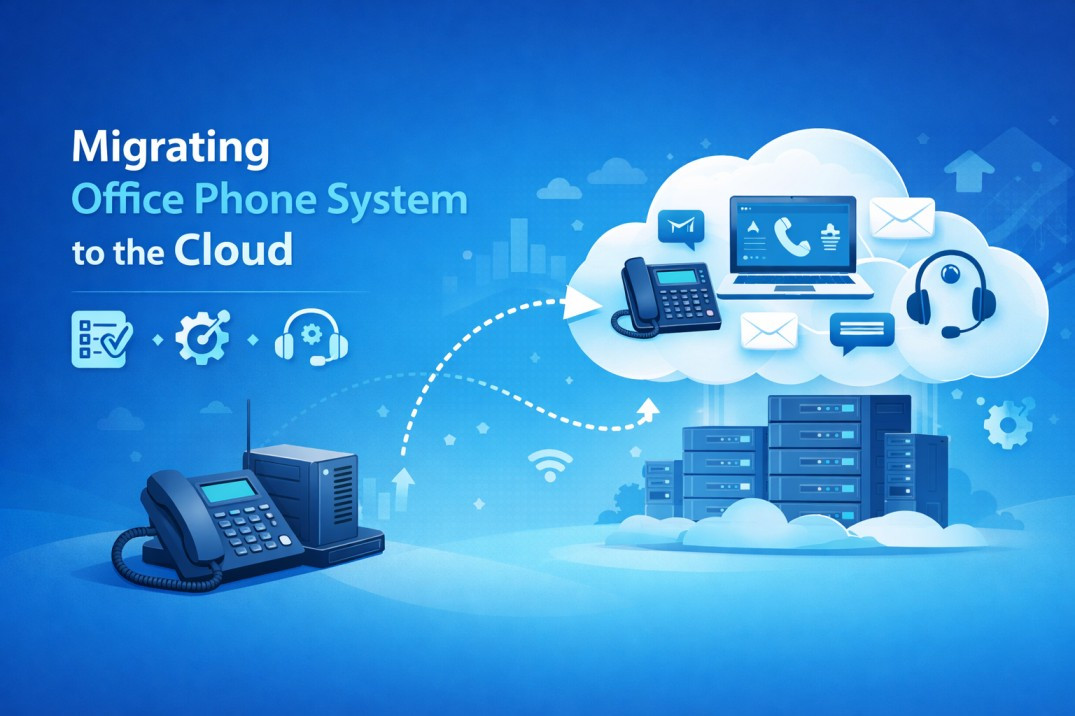
According to Statista, the global Unified Communications as a Service (UCaaS) market is projected to exceed $90 billion by 2027, growing at a CAGR of over 17%. This shift is driven by the increasing need for scalable, cost-effective, and remote-friendly communication systems.
In India, small and medium businesses are increasingly adopting digital tools. A NASSCOM SME report highlights that over 65% of Indian SMEs are investing in cloud technologies to improve operational efficiency and customer experience. Among these technologies, Cloud PBX (Hosted PBX) solutions have become a key component of modern business communication.
Unlike traditional PBX systems that require expensive hardware installations and maintenance, Cloud PBX systems operate entirely over the internet, allowing businesses to manage their phone systems through cloud infrastructure.
For small businesses, this means:
-
Lower infrastructure costs
-
Scalability for growing teams
-
Advanced call management features
-
Integration with CRM and business tools
-
Support for remote and hybrid work environments
Selecting the right Cloud PBX platform requires evaluating key features and choosing a reliable provider that can support long-term communication needs.
What is a Cloud PBX System?
A Cloud PBX (Private Branch Exchange) is a cloud-hosted telephone system that allows businesses to manage internal and external calls without installing physical telecom hardware.
Instead of relying on traditional landline infrastructure, cloud PBX systems use VoIP (Voice over Internet Protocol) to route calls through internet networks.
Employees can access the system using:
-
Mobile apps
-
Softphones (desktop applications)
-
Web dashboards
-
IP phones
Advantages of Cloud PBX
|
Feature |
Traditional PBX |
Cloud PBX |
|
Infrastructure |
On-premise hardware |
Cloud hosted |
|
Initial investment |
High |
Low |
|
Maintenance |
Manual |
Vendor managed |
|
Scalability |
Limited |
Highly scalable |
|
Remote work |
Difficult |
Easy |
Studies show that businesses adopting cloud communication systems can reduce telecom infrastructure costs by up to 60%.
Top Features to Look for in Cloud PBX Solutions
Selecting the right Cloud PBX provider requires evaluating features that impact productivity, customer experience, and scalability.
1. Multi-Level IVR (Interactive Voice Response)
IVR allows incoming calls to be automatically routed to the appropriate department or agent.
Typical IVR flow:
Press 1 → Sales
Press 2 → Customer Support
Press 3 → Billing
Benefits
-
Reduces manual call handling
-
Improves customer navigation
-
Enables 24/7 call routing
Advanced IVR systems now support AI-based voice interactions and regional language support, which is particularly useful in markets like India.
2. Smart Call Routing
Smart routing ensures that calls reach the most appropriate agent based on predefined rules.
Types of routing include:
-
Round-robin distribution
-
Skill-based routing
-
Priority routing
-
Time-based routing
-
Geographic routing
According to Zendesk customer service research, nearly 60% of customers abandon calls when transferred multiple times, making intelligent routing essential.
3. Call Recording and Monitoring
Call recording is an essential feature for businesses that want to maintain quality and compliance.
Use cases
-
Sales training
-
Customer dispute resolution
-
Performance monitoring
-
Compliance audits
Advanced systems also provide real-time call monitoring and whisper coaching, allowing supervisors to guide agents during live calls.
4. CRM Integration
Modern businesses rely on CRM systems to manage leads and customer relationships.
Cloud PBX systems integrate with CRMs such as:
-
Salesforce
-
HubSpot
-
Zoho CRM
-
Freshsales
Benefits
-
Automatic call logging
-
Customer data pop-ups during calls
-
Lead tracking and sales analytics
Research shows that CRM-integrated telephony can improve sales productivity by nearly 30%.
5. AI Voice Bots and Automation
AI-powered voice bots are becoming an integral part of cloud telephony platforms.
Voice bots can handle:
-
Appointment scheduling
-
Order status updates
-
Customer onboarding
-
Frequently asked questions
According to Gartner, 70% of customer interactions are expected to involve AI automation by 2027.
6. Call Analytics and Reporting
Cloud PBX systems generate detailed reports that help businesses understand communication performance.
Important metrics include:
-
Call volume
-
Missed calls
-
Average call duration
-
Agent performance
-
Conversion rates
These insights help businesses optimize sales processes and customer support operations.
7. Mobile and Remote Access
Modern work environments require employees to communicate from anywhere.
Cloud PBX platforms provide:
-
Mobile apps for business calling
-
Softphone applications
-
Web-based dashboards
This enables remote teams to maintain professional communication without revealing personal phone numbers.
8. High Uptime and Reliability
Communication downtime can directly impact customer experience and revenue.
Reliable cloud PBX providers offer:
-
99.9% uptime guarantees
-
Redundant telecom infrastructure
-
Distributed cloud servers
For customer-facing businesses, telecom reliability is mission critical.
9. Security and Compliance
Cloud PBX providers must follow telecom regulations and security best practices.
Key security measures include:
-
SIP encryption
-
Secure APIs
-
Role-based access controls
-
Audit logging
Businesses operating in India must ensure compliance with TRAI telecom guidelines.
10. Scalability
Cloud PBX systems allow businesses to easily scale their communication infrastructure.
Companies can quickly:
-
Add new users
-
Create additional virtual numbers
-
Expand to multiple cities
-
Increase support capacity
This makes cloud PBX ideal for startups and rapidly growing companies.
Best Cloud PBX Providers for Small Businesses in India
Several providers offer cloud PBX solutions globally. Below are some reliable platforms suitable for small businesses.
1. CloudConnect (India)
CloudConnect is a licensed B2B digital telecom platform (VNO) designed for growing businesses in India.
Key Features
-
Multi-level IVR
-
Smart call routing
-
CRM integrations
-
AI voice bots
-
Call recording and analytics
-
Scalable Contact Center infrastructure
CloudConnect positions itself as India’s first licensed B2B digital telco focused on business communication infrastructure.
2. Ozonetel (India)
Ozonetel provides enterprise-grade cloud contact center and telephony solutions.
Key Features
-
Omnichannel contact center
-
AI voice bots
-
Workforce management tools
-
Advanced analytics
-
CRM integrations
3. RingCentral (USA)
RingCentral is one of the most widely used global UCaaS platforms.
Key Capabilities
-
Cloud PBX and VoIP calling
-
Video conferencing
-
Team messaging
-
Contact center solutions
-
Extensive integrations
4. 8x8 (USA)
8x8 provides unified communications and cloud contact center solutions.
Key Features
-
Global VoIP calling
-
AI-powered analytics
-
Contact center solutions
-
Workforce engagement tools
It is particularly popular among global distributed teams.
5. Nextiva (USA)
Nextiva is a business communication platform designed for small and medium businesses.
Key Features
-
VoIP calling
-
Business phone systems
-
CRM integrations
-
Customer experience analytics
Nextiva is known for its reliability and strong customer support infrastructure.
Conclusion
Cloud PBX systems have become essential for modern businesses seeking scalable and cost-efficient communication infrastructure.
For small businesses in India, adopting a cloud PBX platform enables:
-
Professional customer communication
-
Intelligent call routing
-
AI-powered automation
-
Remote team collaboration
-
Data-driven customer engagement
When selecting a provider, businesses should evaluate critical factors such as IVR capabilities, CRM integrations, analytics, uptime reliability, security, and scalability.
Choosing the right cloud PBX solution can significantly improve customer experience, sales productivity, and operational efficiency.
Frequently Asked Questions (FAQ)
1. What is the difference between VoIP and Cloud PBX?
VoIP is the technology that enables voice communication over the internet, while Cloud PBX is a complete phone system built on top of VoIP.
2. Is Cloud PBX suitable for small businesses?
Yes. Cloud PBX is ideal for small businesses because it reduces infrastructure costs while providing enterprise-level communication features.
3. What is the typical cost of Cloud PBX in India?
Most cloud PBX solutions cost between ₹600 and ₹2000 per user per month, depending on features and integrations.
4. Can Cloud PBX integrate with CRM systems?
Yes. Most modern platforms integrate with CRM tools like Salesforce, HubSpot, Zoho CRM, and Freshsales.
5. Is Cloud PBX secure?
Leading providers use SIP encryption, secure APIs, and role-based access control to ensure secure communication.
6. Does Cloud PBX support remote teams?
Yes. Employees can use mobile apps, softphones, or web dashboards to make and receive business calls from anywhere.
7. Which industries benefit most from Cloud PBX?
Industries that rely heavily on customer communication benefit the most, including:
-
E-commerce
-
EdTech
-
Healthcare
-
Real estate
-
Financial services
-
SaaS companies