The Problem With How BFSI Handles Customer Calls Today
If you work in a bank, NBFC, or insurance company, you already know the pain. Thousands of customers calling in every day — asking about EMI dates, loan balances, KYC status, policy renewals. Hundreds of agents making collection calls, many of which go unanswered. Compliance teams worrying about whether calls were made within RBI's permitted hours. And a growing backlog that never seems to shrink.
The numbers make the scale of the problem clear:
|
74% of BFSI customer interactions in India happen over voice calls [1] |
₹680 Cr estimated annual cost of manual collection calling for mid-size NBFCs [2] |
40% of inbound loan query calls are about the same 5 routine questions [3] |
2.8x more likely: customers pay on time when reminded via automated call [4] |
The good news? Cloud telephony can automate most of this — and do it better, faster, and at a fraction of the cost. India's BFSI sector is finally catching up, with cloud communication adoption in financial services growing at 31% year-on-year. [5]
This guide explains exactly how cloud telephony is being used for KYC verification, loan query handling, and loan collections — and what your organisation needs to do to get started.
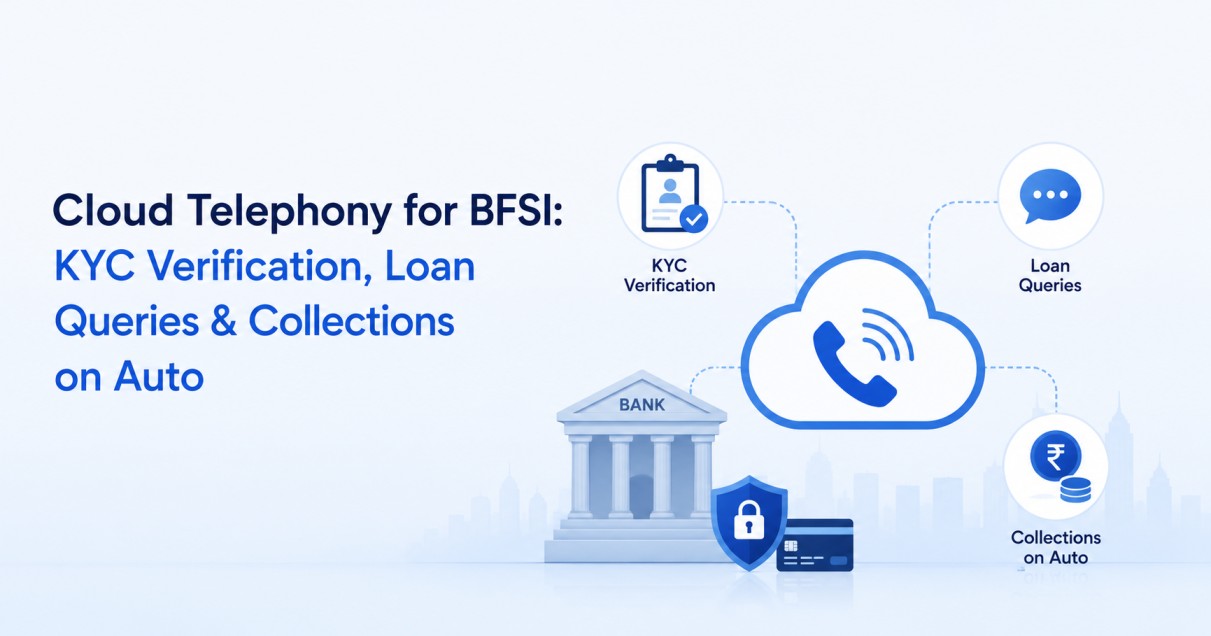
1. KYC Verification: From Branch Visits to Automated Voice Calls
KYC is one of the most time-consuming processes in BFSI. Traditionally, it meant branch visits, paper forms, and manual verification. Video KYC helped — but it still requires an agent on the other side. Cloud telephony takes it further.
How It Works
When a customer completes a digital application — for a loan, account, or insurance policy — an automated voice call is triggered immediately. The call plays a recorded consent script, asks the customer to confirm their identity using a One-Time Password (OTP) sent to their registered mobile, and records their verbal confirmation. The entire interaction takes under two minutes and is logged automatically in the CRM.
|
💡 Real-World Impact: A leading private sector bank in India reduced its KYC turnaround time from 3 days to 4 hours after deploying automated tele-verification through cloud telephony — without adding a single agent. [6] |
For NBFCs running high-volume lending operations — personal loans, two-wheeler finance, microfinance — this is transformative. Instead of calling 500 customers manually, the platform dials all 500 simultaneously, completes verifications, and uploads results to the loan management system automatically.
• What gets automated:
• Tele-verification calls with recorded consent
• OTP confirmation and identity matching via IVR
• Automatic CRM update on successful verification
• Re-attempt scheduling for missed calls
2. Loan Query Handling: Let the IVR Answer the Repetitive Stuff
Ask any contact centre manager in a bank or NBFC what their agents spend most of their time on. The answer is almost always the same: telling customers their EMI date, outstanding balance, prepayment charges, and loan account number. Over and over again.
These are not complex queries. They do not need a trained agent. And yet they consume up to 40% of inbound call volume in a typical NBFC contact centre. [3] Cloud telephony solves this with a well-designed IVR system backed by real-time integration with the core banking system.
What a Smart Loan IVR Looks Like
A customer calls the helpline. The IVR authenticates them using their registered mobile number and last 4 digits of their loan account. Within 30 seconds, they can hear their outstanding balance, next EMI date, and payment confirmation — without speaking to anyone. For more complex queries, the IVR routes them to the right team instantly, with the customer's details already on the agent's screen.
The result: shorter call queues, lower Average Handling Time (AHT), and agents who spend their time on things that actually need a human — complaints, restructuring requests, high-value customer conversations.
|
Use Case |
How Cloud Telephony Automates It |
Business Impact |
|
KYC Verification |
Automated voice OTP, consent capture & identity confirmation calls |
Zero manual call centre agents needed for routine KYC |
|
Loan Query Handling |
AI IVR handles EMI dates, outstanding balance, foreclosure queries |
Up to 70% of inbound loan queries resolved without an agent |
|
Collection Calls |
Predictive dialer + AI voice bot for overdue EMI reminders |
3x more connects per agent hour vs manual dialling |
|
Account Opening |
Tele-verification calls with recorded consent for digital accounts |
Reduces branch visits; speeds up onboarding by 40% |
|
Insurance Renewals |
Automated outbound reminders with IVR payment confirmation |
Renewal conversion rates improve 18–25% with timely nudges |
|
Grievance Redressal |
IVR triage routes complaint calls to the right team instantly |
Average handling time drops by 35% with smart routing |
3. Loan Collections: More Connects, Better Recovery, Fewer Complaints
Collections is where cloud telephony has arguably its biggest impact in BFSI. Manual collection calling is expensive, inconsistent, and — when done badly — a compliance nightmare. Cloud telephony changes all three.
The Predictive Dialer Difference
A predictive dialer does not wait for an agent to manually dial the next number. It dials multiple customers simultaneously, detects when a call is answered, and connects a live agent instantly — skipping busy signals, voicemails, and unanswered calls automatically. The result is that agents spend 40–50 minutes of every hour in actual conversation, versus 15–20 minutes with manual dialling. [7]
For early-stage delinquency (DPD 1–30), many NBFCs are going further — deploying AI voice bots to make the first contact. The bot identifies the customer, reminds them of the overdue amount, and offers a payment link via SMS. If the customer wants to speak to someone or disputes the amount, it transfers to a human agent seamlessly.
|
📊 Data Point: NBFCs using AI-powered outbound calling for early-stage collections report a 28% improvement in recovery rates for DPD 1–30 accounts, compared to manual calling. [8] |
Compliance Built In — Not Bolted On
The RBI Fair Practice Code mandates that collection calls be made only between 8 AM and 7 PM. Manual teams slip up. Cloud telephony platforms enforce this automatically — calls outside the permitted window simply do not go out. DND scrubbing, 140-series number compliance, and call recording consent are all handled at the platform level.
|
Regulation |
How Cloud Telephony Keeps You Compliant |
|
RBI Fair Practice Code |
All collection calls must be made between 8 AM and 7 PM — cloud telephony platforms enforce this automatically via call scheduling |
|
TRAI DND Regulations |
DND scrubbing must happen before every outbound campaign — cloud telephony platforms automate this in real time |
|
140-Series Numbers |
All commercial outbound calls must originate from 140-series numbers — a DOT-licensed cloud telephony provider handles this by default |
|
Call Recording Consent |
Customers must be informed of recording — pre-call IVR consent messages automate this at every interaction |
|
Voice KYC Data Residency |
Under DPDP Act 2023, KYC voice data must be stored within India — verify your vendor's data center location before signing |
Conclusion: BFSI's Communication Stack Needs an Upgrade
The banks and NBFCs winning in India's competitive lending market are not the ones with the most agents. They are the ones whose systems work while the agents sleep — calling customers, verifying KYC, answering loan queries, and nudging overdue accounts, all automatically.
Cloud telephony is not a futuristic investment for BFSI. It is a present-day operational necessity. With 74% of customer interactions still happening over voice, automating that channel is the single highest-ROI communication upgrade available to BFSI organisations today.
CloudConnect for BFSI
|
CloudConnect is India's first and only DOT-licensed B2B Virtual Network Operator — ISO 9001 & ISO 27001 certified, with 100% Indian data centers. Trusted by leading NBFCs, banks, and insurance companies across India. • ✅ Automated KYC tele-verification with CRM integration • ✅ Smart IVR for loan queries — EMI, balance, foreclosure — without agents • ✅ Predictive dialer + AI voice bots for outbound collections • ✅ RBI-compliant call scheduling (8 AM–7 PM enforcement) • ✅ 140-series numbers + TRAI DND scrubbing — fully automated • ✅ DPDP Act compliant — all voice KYC data stored in India • ✅ Trusted by ART Housing Finance, QX Global & 350+ enterprises Talk to a BFSI specialist at cloudconnect.in |
Frequently Asked Questions
Q: Can cloud telephony integrate with our existing core banking system?
A: Yes. Cloud telephony platforms like CloudConnect offer REST APIs and pre-built connectors for major core banking systems, loan management platforms (Finnone, LoanOS), and CRMs (Salesforce, Zoho, Freshsales). Integration typically takes 2–4 weeks for standard setups. This enables real-time data sync — so IVR responses and collection call outcomes are automatically updated in your system of record.
Q: Is automated collection calling compliant with RBI guidelines?
A: Yes — when done correctly. The RBI Fair Practice Code requires collection calls between 8 AM and 7 PM, prohibits calls to references or family members without consent, and mandates caller identification. A well-configured cloud telephony platform enforces all of these automatically. It also maintains full call recordings for audit purposes, which is a regulatory requirement for NBFC collections.
Q: What is the difference between a predictive dialer and an AI voice bot for collections?
A: A predictive dialer automatically dials multiple numbers and connects a live agent when a call is answered — removing dead time between calls. An AI voice bot makes the call itself, speaks to the customer, and handles the interaction without a human agent. For BFSI, predictive dialers are used for mid and late-stage delinquency where negotiation is needed, while AI voice bots are ideal for early-stage (DPD 1–30) payment reminders where the interaction is routine.
Q: How secure is voice KYC data stored on cloud telephony platforms?
A: Under India's DPDP Act 2023, all personal data including voice KYC recordings must be stored within Indian territory. Before selecting a vendor, confirm that their data centers are physically located in India and that they can provide a signed Data Processing Agreement. CloudConnect's infrastructure is 100% India-based, ISO 27001 certified, and fully DPDP compliant.
Q: How long does it take to deploy cloud telephony for a BFSI contact centre?
A: A standard deployment for a 50–200 seat BFSI contact centre typically takes 3–6 weeks, covering IVR design, CRM integration, number provisioning, compliance configuration, and agent training. Simpler use cases — like automated KYC verification calls or outbound EMI reminders — can go live in under 2 weeks with minimal IT involvement.
References
[1] KPMG India. (2025). India BFSI Customer Communication Survey — Voice Channel Dominance. kpmg.com/in
[3] Frost & Sullivan. (2024). BFSI Contact Centre Inbound Query Analysis — India. frost.com
[5] IDC India. (2025). Cloud Communication Adoption in Indian BFSI — Annual Growth Report. idc.com
[6] Nasscom. (2025). Digital KYC Transformation Case Studies — Indian Banking Sector. nasscom.in
[7] TSIA. (2024). Predictive Dialer Productivity Benchmarks — Financial Services Contact Centres. tsia.com