India's shift to cloud-based calling is no longer early-stage — it's measurable. Businesses across the country are adopting cloud-based IVR systems to manage customer calls, improve response times, and build professional customer experiences without investing in expensive on-premise telephone infrastructure. The scale of that shift shows up clearly in the market data.
|
Market / Metric |
2025–26 Value |
Forecast |
CAGR |
|
India cloud-based contact center market |
USD 1.4 billion (2025) |
USD 7.9 billion by 2034 |
20.53% |
|
India contact center software market |
USD 2.1 billion (2026) |
USD 9.6 billion by 2034 |
19.98% |
|
India CPaaS (Communication Platform as a Service) market |
USD 1.28 billion (2026) |
USD 2.36 billion by 2031 |
13.02% |
|
Global cloud telephony services market |
USD 29.17 billion (2026) |
USD 45.57 billion by 2031 |
9.32% |
Sources: IMARC Group (India cloud-based contact center market, India contact center software market); Mordor Intelligence (India CPaaS market, cloud telephony services market). Full citations in the References section.
For startups, SMEs, D2C brands, healthcare providers, educational institutions, and enterprises, choosing the right IVR service provider is an important decision. The right solution can help reduce missed calls, route customers to the right department, automate repetitive queries, and integrate calling with CRM systems. This guide covers what IVR does, the data behind why it matters in 2026, pricing benchmarks, and how to choose the right IVR solution for your business.
What Is an IVR Service Provider?
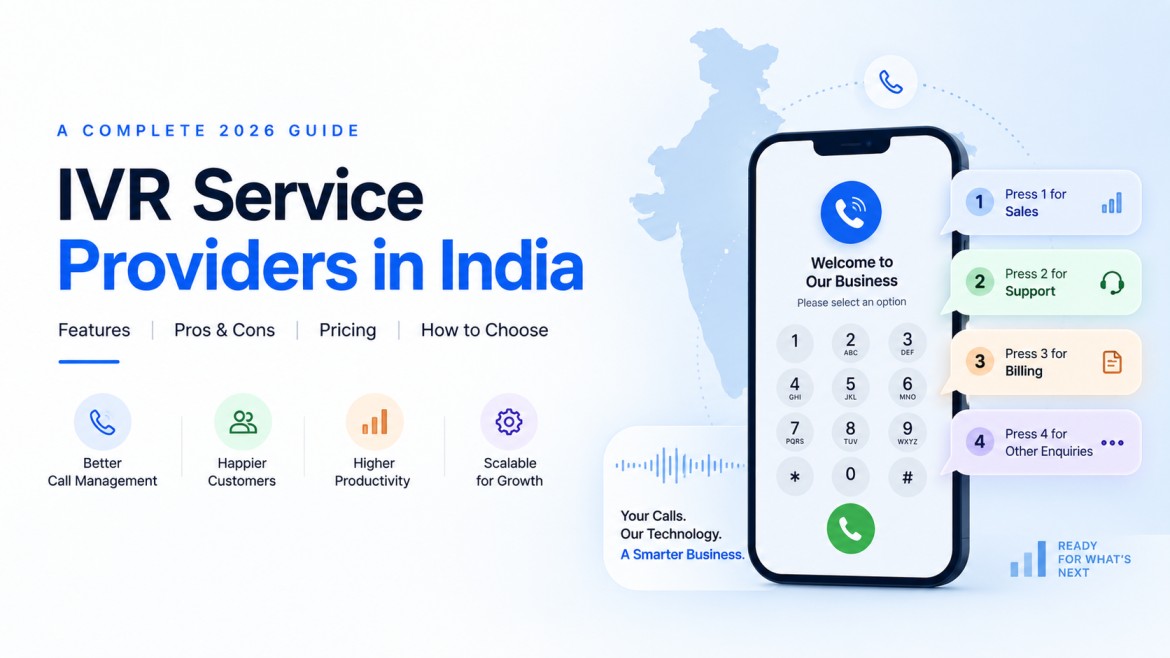
An IVR (Interactive Voice Response) service provider offers the technology businesses use to automate and manage telephone interactions. When customers call a business and hear a message such as “Press 1 for Sales, Press 2 for Support,” they are interacting with an IVR system.
An IVR service provider typically supplies the phone infrastructure, virtual numbers, voice prompts, call-routing software, and reporting tools required to manage incoming and outgoing calls.
Traditional IVR vs Cloud IVR
|
Feature |
Traditional IVR |
Cloud IVR |
|
Infrastructure |
On-premise hardware |
Cloud-hosted |
|
Setup |
Hardware and telecom installation |
Online configuration and provisioning |
|
Scalability |
Requires additional infrastructure |
Can scale with business needs |
|
Remote access |
Limited |
Accessible through web dashboards |
|
CRM integration |
Often requires custom integration |
APIs and built-in integrations |
|
Maintenance |
Hardware and software maintenance |
Provider-managed infrastructure |
|
Call analytics |
Depends on system |
Usually available through dashboards |
|
AI integration |
Often limited |
Can support AI voice bots and automation |
Why Businesses in India Need a Cloud IVR System
1. Manage High Call Volumes
Department-wise, business-hours, agent-availability, customer-priority, and language-based routing all matter more as call volume grows. Labour is the largest cost line behind that volume — industry analysis puts labour at up to 95% of contact centre expenses, out of roughly 17 million contact centre agents working worldwide — which is why routing logic that reduces per-call handling time has an outsized effect on cost.
2. Reduce Missed Calls
This is where the cost of not having a structured first response shows up most directly. Research on unanswered business calls consistently finds that most missed callers do not leave a voicemail and do not call back — they call the next business on their list instead. Structured queuing, callback requests, and after-hours voicemail-to-workflow options exist specifically to close that gap.
3. Improve Customer Experience
Voice remains India's most trusted business channel. A 2026 study by Truecaller, Tata Tele Business Services, and Kantar — surveying 1,000 consumers and 500+ businesses across 17 Indian cities — found that 76% of consumers prefer a voice call from a business over email, SMS, or chat. But the same study found that 79% of businesses report customers actively avoid answering calls from unrecognised numbers, which makes professional greetings, consistent caller identity, and clear menu options a trust signal, not just a convenience feature.
4. Connect Calls With CRM Systems
Customer identification, agent screen-pop (where supported), call logging, follow-up task creation, and customer history visibility all reduce the manual work behind every call — relevant given that up to 95% of contact centre cost is labour, and repetitive data entry is one of the largest silent consumers of agent time.
5. Support Business Growth
Adding departments, users, remote teams, and locations without re-provisioning hardware is the direct product of the market shift already underway: India's cloud-based contact center market is forecast to grow at a 20.53% CAGR through 2034, more than double the growth rate of the broader IP telephony hardware market it is displacing.
IVR and Cloud Telephony Options in India in 2026
“Best” depends on the type of deployment, call volume, integrations, and budget. This section looks at CloudConnect, an India-first cloud communication platform, alongside the major global communication platforms that Indian enterprises with international operations commonly evaluate.
1. CloudConnect — Best for Enterprise Cloud IVR in India
Best for: Indian businesses seeking IVR with a broader cloud telephony and contact center ecosystem.
Key features
• Multi-level IVR menus
• Voice prompts and call routing
• CRM-based routing
• Virtual and toll-free numbers
• Call recording and analytics, depending on the solution
• Cloud PBX and business phone system
• Voice bots and AI-powered automation
• SIP trunking and business telephony
• Outbound calling solutions
Pros
• India-focused business communication platform, built on a DOT-licensed B2B VNO
• IVR can be evaluated alongside cloud PBX, voice bots, and contact center capabilities
• Useful for businesses that want to consolidate multiple communication tools
• Suitable for CRM-connected customer support and sales workflows
Cons
• Businesses looking only for a basic IVR menu may not need the complete communication suite
• Enterprise deployments may require a detailed solution design and commercial discussion
Ideal use cases
• Customer support helplines
• Sales and lead routing
• Healthcare appointment calls
• Education enquiries
• D2C customer service
• Logistics and delivery support
• BFSI customer communication
Explore: https://cloudconnect.in/
2. Twilio — Best for Programmable IVR and Global Applications
Best for: Developers and businesses building custom voice applications.
Key features
• Programmable voice
• IVR workflows
• Voice APIs
• Call routing
• Speech recognition integrations
• Text-to-speech integrations
• Global communications infrastructure
• Developer tools
Pros
• Flexible APIs
• Suitable for custom application development
• Strong global developer ecosystem
Cons
• Requires technical implementation
• India-specific telephony availability and regulatory requirements must be confirmed
• A programmable voice API is not the same as a fully managed Indian cloud telephony service
Ideal use cases
• SaaS products
• Custom customer service apps
• Global voice applications
Explore: https://www.twilio.com/
3. RingCentral — Best for Global Unified Communications
Best for: International businesses seeking a unified communication platform for distributed teams.
Key features
• Cloud phone system
• IVR
• Call routing
• Business messaging
• Video meetings
• Contact center capabilities
• Integrations
• Analytics
Pros
• Broad unified communications ecosystem
• Suitable for multi-country businesses
• Useful for voice and collaboration together
Cons
• Pricing may be higher for smaller Indian businesses
• Indian number availability and local telephony compliance should be verified
Ideal use cases
• Global offices
• Distributed teams
• Unified communications deployments
Explore: https://www.ringcentral.com/
4. 8x8 — Best for Global Contact Center and UCaaS
Best for: Enterprises managing international customer service, telephony, and collaboration operations.
Key features
• Cloud phone system
• IVR
• Contact center
• Call routing
• Analytics
• Business communications
• Integrations
Pros
• Suitable for global business environments
• Offers a broader UCaaS and CCaaS ecosystem
• Useful for organizations needing multiple communication channels
Cons
• May involve higher deployment complexity than a basic IVR solution
• Indian telephony availability and commercial terms require verification
Ideal use cases
• International contact centers
• Global support teams
• Unified communications deployments
Explore: https://www.8x8.com/
IVR Platform Comparison: India-First vs Global Platforms
For Indian businesses, the most important question is not simply which provider offers the most features. It is whether the provider can deliver the required phone connectivity, call routing, integrations, and support at a sustainable cost — inside a market growing at a 20.53% CAGR, where a large share of new entrants are still building out India-specific compliance and number-series support.
|
Provider |
Best for |
Cloud Telephony |
CRM / APIs |
Global Operations |
|
CloudConnect |
Indian enterprises |
Yes |
Yes |
Selected capabilities |
|
Twilio |
Programmable voice |
Yes |
Yes |
Strong |
|
RingCentral |
Unified communications |
Yes |
Yes |
Strong |
|
8x8 |
Global CCaaS |
Yes |
Yes |
Strong |
Note: This is a qualitative comparison based on publicly described product capabilities. It is not a verified benchmark of call quality, uptime, pricing, or performance. India calling availability and commercial terms should be confirmed with each provider.
What Features Should You Look for in an IVR Service Provider?
1. Multi-Level IVR
• Number of IVR levels supported
• Menu customization
• Call routing logic
• Language-based menus
• Business-hours routing
• Holiday routing
2. Virtual and Toll-Free Numbers
• Virtual business numbers
• Toll-free numbers
• Local numbers
• Number portability
• Multiple business numbers
• Number masking, where relevant
3. Call Recording
• Training and quality monitoring
• Dispute resolution
• Compliance workflows
• Storage duration
• Access permissions
• Customer consent requirements
4. CRM Integration
• Salesforce
• Zoho CRM
• HubSpot
• Freshworks
• LeadSquared
• Custom CRM systems
5. Call Analytics and Reporting
• Total calls
• Answered calls
• Missed calls
• Abandoned calls
• Average wait time
• Call duration
• Agent performance
• IVR menu selection
6. AI Voice Bot Integration
This is the fastest-growing category inside the IVR feature set. Gartner projects that 80% of routine customer interactions will be fully handled by AI in 2026, and a separate Gartner survey found 91% of customer service leaders are under executive pressure to implement AI this year — while 55% report stable staffing despite handling higher volumes, underscoring that AI voice capability is being layered onto existing routing, not replacing it.
• Natural-language conversations
• Automated FAQs
• Appointment booking
• Lead qualification
• Payment reminders
• Order status enquiries
• Call transfers to human agents
7. Security and Compliance
• Data protection practices
• Access controls
• Call recording permissions
• Encryption
• Data retention
• Audit logs
• Telecom compliance
• Vendor security documentation
IVR Service Provider Pricing in India
There is no single fixed price for an IVR system in India. Costs depend on the provider, call volume, number of users, features, integrations, and deployment model. Published market benchmarks for 2026 give a useful reference range:
|
Deployment tier |
Typical monthly range (2026 market benchmarks) |
|
Entry-level cloud telephony setup |
₹500 – ₹999 per month |
|
Startup IVR plans |
₹600 – ₹1,500 per month |
|
SME IVR plans (10–30 users, multi-level IVR, CRM integration) |
₹2,500 – ₹8,000 per month |
|
Enterprise IVR plans (unlimited channels, dedicated support) |
₹15,000 – ₹50,000 per month |
|
Per-minute IVR call charges |
₹0.40 – ₹0.65 per minute |
These are illustrative, third-party market benchmarks compiled from published 2026 Indian cloud telephony pricing research — not CloudConnect tariffs or any single vendor's rate card. Confirm current pricing directly with each provider.
Common pricing models
• Monthly subscription plans
• Per-user or per-agent pricing
• Per-minute calling charges
• Pay-as-you-go API pricing
• Custom enterprise contracts
Typical cost components
|
Cost component |
What it covers |
|
Monthly platform fee |
IVR software and dashboard |
|
Virtual number |
Business phone number rental |
|
Inbound minutes |
Calls received |
|
Outbound minutes |
Calls made |
|
Recording storage |
Storage and retention |
|
CRM integration |
Native or custom integration |
|
Setup fee |
Configuration and onboarding |
|
AI voice bot |
Separate automation usage, where applicable |
|
Support |
Service and implementation |
Example cost calculation
Suppose a business receives 10,000 inbound calls per month, with an average duration of 3 minutes. Total monthly call minutes: 10,000 × 3 = 30,000 minutes. At the published mid-market rate of roughly ₹0.50 per minute, the usage cost would be: 30,000 × ₹0.50 = ₹15,000. Add the monthly platform subscription, number rental, and applicable taxes to estimate the total cost. This is an illustrative calculation, not a CloudConnect tariff or market-average price.
What to ask before signing a contract
• Is the IVR subscription monthly or annual?
• Are inbound and outbound calls billed separately?
• Are virtual numbers included?
• Are recording and storage included?
• Are there setup charges?
• Is there a minimum monthly commitment?
• Are CRM integrations included?
• What happens if call volumes increase?
• Is there a separate charge for AI voice bots?
• Are GST and other applicable charges included in the quote?
Cloud IVR vs On-Premise IVR: Which Is Better?
|
Factor |
Cloud IVR |
On-Premise IVR |
|
Initial investment |
Usually lower infrastructure investment |
Hardware and installation costs |
|
Scalability |
Flexible |
Requires infrastructure planning |
|
Remote access |
Easier |
Depends on network setup |
|
Maintenance |
Provider-managed |
Business-managed |
|
Deployment |
Generally faster |
Can take longer |
|
Customization |
Depends on platform |
Greater infrastructure control |
|
Best for |
Growing and distributed businesses |
Specific legacy or controlled environments |
How to Choose the Best IVR Service Provider for Your Business
Step 1: Identify Your Call Volume
• Daily inbound calls
• Daily outbound calls
• Peak-hour call volume
• Average call duration
• Number of agents
• Number of departments
Step 2: Define Your IVR Call Flow
• Sales enquiries
• Customer support
• Billing
• Escalations
• After-hours routing
• Callback requests
Step 3: Decide Whether You Need AI
• Traditional IVR for menu-based routing and agent connection
• AI voice automation for conversational support, FAQs, booking, and lead qualification
Step 4: Evaluate Integrations
Ask the provider to demonstrate your actual workflow using your CRM, helpdesk, or ERP.
Step 5: Compare Total Cost of Ownership
• Subscription
• Call usage
• Number rental
• Recording
• Storage
• Integrations
• Setup
• Support
Step 6: Test Before Going Live
• Peak-hour calls
• Wrong menu selections
• Agent unavailable scenarios
• Call transfers
• Regional-language prompts
• CRM logging
• Recording access
• Callback workflows
Why CloudConnect Is a Strong IVR Option for Indian Businesses
CloudConnect is worth considering when the business wants IVR as part of a broader cloud communication platform rather than as an isolated feature. Its cloud telephony offering combines IVR with cloud PBX, virtual numbers, SIP trunking, outbound calling, voice broadcasting, and AI voice automation.
|
Why Choose CloudConnect? → India's first DOT-licensed B2B Virtual Network Operator (VNO) — ISO 9001 and ISO 27001 certified, built for regulated, high-volume B2B calling. → Trusted by 450+ enterprise clients across BFSI, D2C/e-commerce, logistics, real estate, auto dealers, retail, fintech, and EdTech. → 99.9% uptime SLA, with 100% Indian data centers for data residency and compliance confidence. → IVR sits alongside Cloud PBX, Cloud Call Center, SIP Trunking, and AI Voice Bots — one platform instead of stitching together multiple point solutions. → GeM Registered Seller status — a trust signal recognised by private-sector enterprise and BFSI buyers, on top of government procurement eligibility. |
Businesses that may benefit:
• Startups and SMEs
• D2C brands
• Healthcare providers
• EdTech companies
• Logistics businesses
• BFSI organizations
• Customer support teams
• Enterprises with multiple departments
Example: IVR for a D2C Brand
A D2C brand can configure an IVR like this:
1. Incoming customer call through a business virtual number
2. Welcome message and language selection
3. Press 1 for Orders
4. Press 2 for Support
5. Press 3 for Returns
6. Route the customer to the relevant team or workflow
7. Log the interaction in the CRM, where supported
This type of structured call flow can help a D2C brand direct customer enquiries to the appropriate team and connect calling with customer support workflows — relevant given that 76% of Indian consumers still say they prefer voice over digital channels for business communication.
Conclusion: Which IVR Service Provider Should You Choose?
The best IVR service provider in India depends on the business's operational needs, not simply the number of features listed on a website — and, increasingly, on how well a provider's number series, caller ID, and data residency hold up against a market where 79% of consumers already say they avoid answering unrecognised business numbers.
• CloudConnect: A strong option for Indian businesses evaluating integrated cloud telephony, IVR, PBX, and AI voice automation on a DOT-licensed, India-based platform.
• Twilio: Suitable for developer-led, programmable voice applications.
• RingCentral and 8x8: Worth evaluating for international unified communications and contact center deployments.
For an India-first business communication requirement, CloudConnect should be included in the shortlist. The final choice should be based on a product demo, verified India telephony availability, integration requirements, call volume, and a complete commercial quote.
Ready to improve your business calling experience? Explore CloudConnect's IVR and cloud telephony solutions to understand how your business can build a more professional, scalable, and connected customer communication system.
Frequently Asked Questions About IVR Service Providers in India
1. What is an IVR service provider?
An IVR service provider supplies the technology and telephony infrastructure required to automate incoming and outgoing calls. Businesses use IVR to greet callers, offer menu options, route calls, and manage customer communication.
2. Which is the best IVR service provider in India?
The best provider depends on your business requirements. CloudConnect is worth considering for businesses seeking integrated cloud telephony and IVR on an India-based, DOT-licensed platform. For international deployments, Twilio, RingCentral, and 8x8 are additional options to evaluate.
3. How much does an IVR system cost in India?
Published 2026 market benchmarks put startup IVR plans around ₹600–₹1,500 per month, SME plans around ₹2,500–₹8,000 per month, and enterprise plans around ₹15,000–₹50,000 per month, with per-minute call charges typically between ₹0.40 and ₹0.65. Actual pricing varies by provider, call volume, and feature set — request a quote based on your actual call volume.
4. Can an IVR system integrate with CRM software?
Yes. Many cloud IVR platforms support CRM integrations through native connectors or APIs. Depending on the provider, businesses may integrate with Salesforce, Zoho, HubSpot, Freshworks, LeadSquared, and custom CRM systems. Always verify whether the required integration is included in your plan.
5. What is the difference between IVR and an AI voice bot?
An IVR generally guides callers through predefined menus and routes them to the appropriate department. An AI voice bot can understand natural-language conversations and perform automated tasks such as answering FAQs, booking appointments, and qualifying leads — the category Gartner expects to handle 80% of routine customer interactions in 2026.
6. Can IVR support Hindi and regional Indian languages?
Yes, IVR can support regional-language voice prompts, provided the provider offers the required language options. Confirm whether the provider supports recorded prompts, text-to-speech, and AI conversation in your target languages.
7. Is cloud IVR better than a traditional on-premise IVR?
Cloud IVR is often a practical option for businesses that want flexible deployment, remote access, and reduced dependence on physical telephone infrastructure — which is part of why India's cloud-based contact center market is forecast to grow at a 20.53% CAGR through 2034. On-premise IVR may still be suitable for specific legacy systems or infrastructure requirements.
8. How do I choose the right IVR provider for my business?
Evaluate the provider based on call volume, peak concurrency, IVR customization, virtual and toll-free numbers, CRM integration, call recording and analytics, security, telecom compliance, AI voice bot capabilities, customer support, and total cost of ownership.
References
IMARC Group — India Cloud-Based Contact Center Market
Mordor Intelligence — India Communication Platform as a Service (CPaaS) Market
Mordor Intelligence — Cloud Telephony Service Market Size, Share & 2026–30 Outlook
Fortune Business Insights — Contact Center as a Service (CCaaS) Market
Truecaller & Tata Tele Business Services — The State of Business Calling 2026 (research by Kantar)
Gartner — Survey Finds Only 20% of Customer Service Leaders Report AI-Driven Headcount Reduction
Related Reading
Toll-Free Numbers in India: Features, Pricing & Best Providers
How to Get a DID Mobile Number in India for Your Business
Best Cloud Telephony Providers in India: Features, Pros & Cons
UCaaS vs. CCaaS: Understanding the Difference Between Two Cloud Communication Platforms
Verify before publishing: all statistics above are sourced from the reports cited in References and were current at the time of research. Market-size figures (IMARC, Mordor Intelligence, Fortune Business Insights) and pricing benchmarks update frequently and should be re-checked against the live source before this guide is published or refreshed.