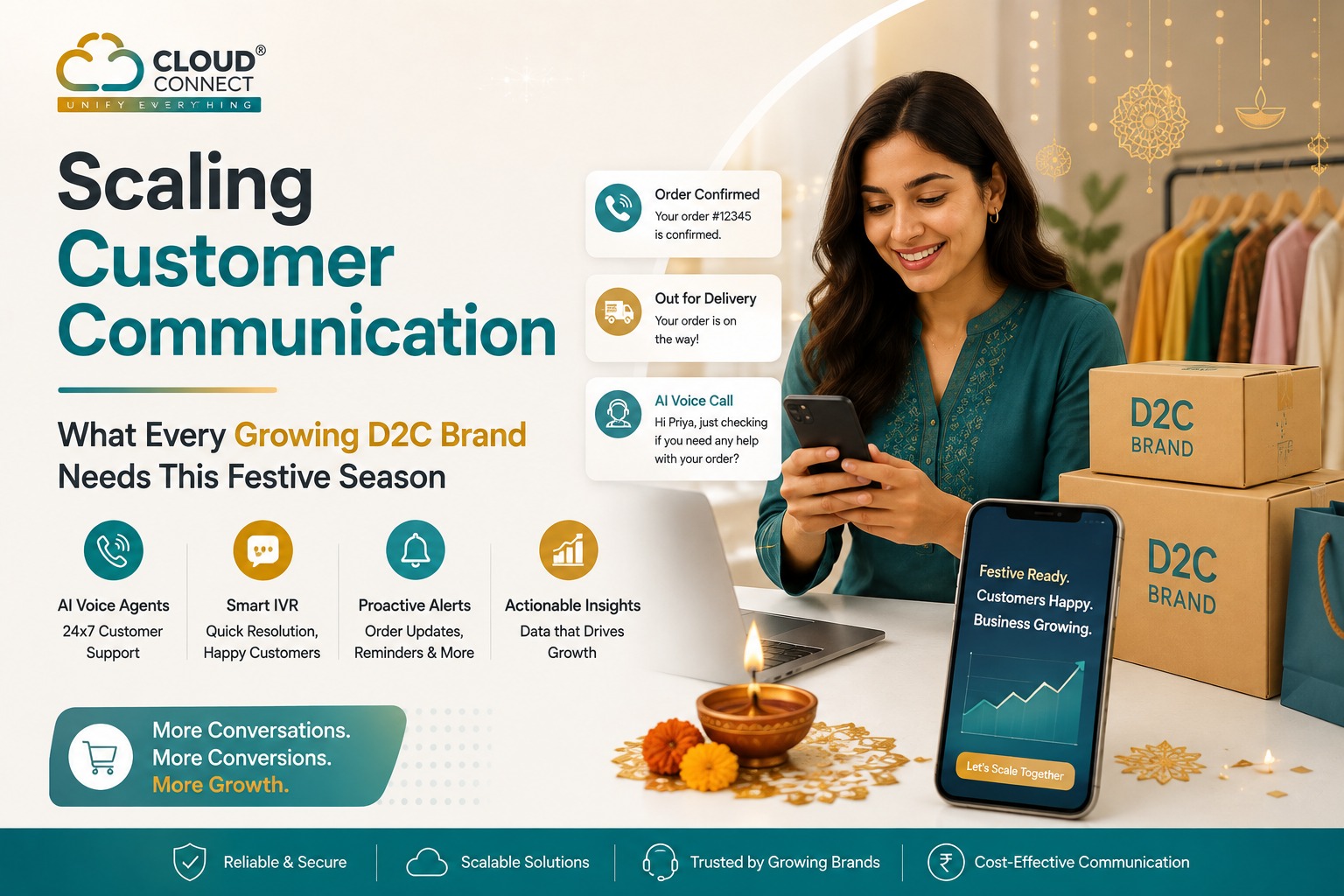
What Every Growing D2C Brand Needs This Festive Season
Your festive campaign just went live, the ad spend is flowing, and orders are climbing by the hour. But when a customer calls to confirm a COD order, or messages on WhatsApp asking where their Diwali gift has gone — does someone actually answer, and does your business even know it happened?
For most Indian D2C brands, that single question decides how much of this festive season's demand actually turns into revenue. India's festive e-commerce window has become too large, too compressed, and too unforgiving of silence to leave customer communication as an afterthought — at any stage of a brand's growth.
Festive Season 2026, By the Numbers
|
Metric |
Festive Season Data Point |
|
Online festive GMV (30–35 days to Diwali 2026) |
₹1.15 lakh crore, up 20–25% YoY — the strongest festive performance in five years |
|
D2C market size (India, 2026) |
USD 108.76 billion, growing at a 24.3% CAGR toward USD 322.1 billion by 2031 |
|
Shoppers from Tier 2 and Tier 3 cities |
60–65% of festive online shoppers during the first festive fortnight |
|
COD return-to-origin during festive quarter |
As high as 58% across tracked shipments — a direct hit to margins without strong pre-delivery communication |
|
Quick commerce festive growth |
Forecast at up to ~150% YoY, layered on a 110–130% CAGR since 2021 |
|
Meta customer acquisition cost, 2025 vs 2026 |
Rose from roughly ₹380 to ₹502, pushing repeat-purchase communication to the center of profitability |
Sources: Redseer Strategy Consultants, Unicommerce India D2C Report 2026, Mordor Intelligence, IBEF. Figures are directional and should be checked against the latest primary releases before being quoted externally.
1. Why Festive Season Breaks Customer Communication — At Every Stage
Festive demand in India doesn't arrive gradually. It arrives in a compressed, multi-week surge, layered across Independence Day, Ganesh Chaturthi, Navratri, Dhanteras, and Diwali, with order volumes for many D2C brands running three to five times their normal monthly baseline.
What breaks first is rarely the website or the warehouse — it's the communication layer sitting between them. A missed call becomes a lost COD confirmation. An unanswered WhatsApp message becomes a chargeback dispute. A support queue with no visibility becomes a flood of "where is my order" complaints on social media, right when brand sentiment matters most.
The specific failure point is different depending on how big the brand already is — which is why the right communication setup for a 0–1 brand looks nothing like the right setup for a 10–100 brand. The five sections below map that out.
2. Phase 0–1: Building the Communication Foundation
At this stage, the brand is usually a founder, maybe one or two teammates, and a Shopify or WooCommerce store doing anywhere from a handful to a few hundred orders a month. The festive-season risk isn't complexity — it's simply going unreachable at the exact moment a first-time customer is deciding whether to trust a new, unfamiliar brand.
• The problem: A personal mobile number gets used for customer calls, WhatsApp, courier coordination, and vendor calls all at once. During a festive spike, it becomes impossible to tell a genuine customer call from noise, and missed calls have no record or callback trail.
• The use case that matters most: A single cloud-hosted virtual business number that customers see consistently across the website, invoices, and ads — one that can ring to a phone today and scale to a small team next quarter without changing the number customers already trust.
• What to put in place before the festive rush: A toll-free or local virtual number with call recording and missed-call alerts, WhatsApp Business (not just personal WhatsApp) for order confirmations and updates, and a simple IVR greeting that reassures a first-time festive shopper the brand is real and reachable.
• What can wait: Multi-agent routing, predictive dialers, and dedicated campaign numbers — these solve problems a 0–1 brand doesn't have yet. Over-investing here just adds cost without adding trust.
3. Phase 1–10: Scaling Without Breaking
This is the phase where a brand has product-market fit, a growing SKU catalog, and a small but real support team — typically five to twenty people. Festive season is exactly when the gap between "we have a support team" and "we have a support system" becomes painfully visible: call volumes triple, WhatsApp threads pile up, and agents start missing follow-ups because nothing is centrally tracked.
• The problem: Multiple agents handling calls and chats independently means no queuing, no routing by language or region, and no shared view of which customer has already been contacted — leading to duplicate outreach on some orders and complete silence on others.
• The use case that matters most: A cloud contact center that queues and routes inbound calls across agents, logs every interaction against the order ID, and pushes COD confirmation calls out proactively before festive dispatch — directly cutting into the high return-to-origin rates that plague COD-heavy brands during peak season.
• What to put in place before the festive rush: Multi-agent call routing with skill- or language-based distribution, WhatsApp Business API integrated with the helpdesk or CRM so agents see order history instantly, click-to-call from the CRM for outbound confirmation campaigns, and real-time dashboards showing queue length and abandoned-call rate during peak hours.
• Where brands underinvest: Analytics. Most 1–10 brands can tell you call volume but not which festive campaign, city, or product line is generating the most support load — data that would let them fix the actual product or delivery issue instead of just adding more agents every October.
4. Phase 10–100: Enterprise-Grade Communication Infrastructure
Brands at this scale are typically running national campaigns, multiple warehouses, and support across several shifts or regions. The festive-season risk here isn't going silent — it's fragmentation: a customer who called once, chatted on WhatsApp once, and emailed once, with three different agents holding three different pieces of the story.
• The problem: Disconnected systems across voice, WhatsApp, email, and social support mean SLA breaches go unnoticed until they show up as public complaints, and a spike on one campaign can silently starve another of agent capacity.
• The use case that matters most: Omnichannel orchestration — a unified view where voice, WhatsApp, and chat all feed the same customer timeline, with AI voice bots absorbing routine festive queries (order status, return policy, delivery windows) so human agents are reserved for escalations and high-value orders.
• What to put in place before the festive rush: Dedicated, trackable numbers per campaign or city to measure ROI by channel, predictive dialers for large-scale outbound confirmation or win-back calls, AI voice bots for tier-one query deflection, and a guaranteed uptime SLA — festive-week downtime on a contact center is not an inconvenience, it's a direct revenue loss.
• What becomes non-negotiable: Data security and compliance. At this scale, brands are handling large volumes of customer PII during the highest-fraud period of the year, so ISO 27001-grade data handling and India-based data residency stop being a preference and become a buyer requirement, especially for BFSI-adjacent or high-AOV categories.
5. The Common Thread: What Cloud Telephony Solves at Every Stage
Strip away the scale differences and the same four capabilities show up as the backbone of festive-ready communication, whether a brand is doing 50 orders a month or 50,000:
• A number that never looks unreachable — whether that's one virtual line for a founder or a hundred routed lines for a national campaign.
• Voice and WhatsApp working together — voice for trust and urgency, WhatsApp for scale and convenience, not one replacing the other.
• A record of every interaction against every order — so no festive customer has to repeat their story to a second agent.
• Infrastructure that flexes with the surge — capacity that scales up for the six-week festive window without the brand paying for that capacity all year.
Brands that treat this as one continuous system — rather than rebuilding their support stack every year as they outgrow the last one — are the ones who convert festive-season traffic into repeat customers instead of one-time transactions and support tickets.
At a Glance: Communication Needs Across Every Growth Phase
|
Dimension |
Phase 0–1 (Founding) |
Phase 1–10 (Scaling) |
Phase 10–100 (Enterprise) |
|
Typical order volume |
Under ~500 orders/month |
500 – 20,000 orders/month |
20,000+ orders/month, multi-warehouse |
|
Support team |
Founder or 1–2 people wearing every hat |
Dedicated 5–20 person support team |
Multi-shift contact center across regions |
|
Festive-season risk |
Missed calls and DMs go unanswered; no record of who was contacted |
Agents overwhelmed; COD confirmation calls delayed, RTO climbs |
Fragmented systems across channels; SLA breaches, brand-wide trust hit |
|
Core need |
One reliable number that never appears "busy" or unreachable |
Call routing, queuing, and WhatsApp Business API at scale |
Omnichannel orchestration with AI-assisted triage and analytics |
|
Right-fit solution |
Cloud-hosted virtual number + WhatsApp Business + basic IVR |
Multi-agent cloud contact center + CRM/helpdesk integration |
AI voice bots, predictive dialers, dedicated campaign lines, full API stack |
|
Why Choose CloudConnect? • India's first DOT-licensed Virtual Network Operator (VNO) — built for the compliance and scale that BFSI, D2C, and enterprise brands need during peak season. • ISO 9001 and ISO 27001 certified, with 100% Indian data centers — critical when handling high customer-data volumes during the highest-fraud window of the year. • 99.9% uptime SLA — festive-week downtime on your contact center isn't an inconvenience, it's lost revenue. • Trusted by 450+ enterprise customers across BFSI, real estate, auto dealerships, D2C, and quick commerce to scale communication from a single virtual number to a full omnichannel, AI-assisted contact center. Explore solutions at cloudconnect.in |
Conclusion
Festive season doesn't wait for a brand's support infrastructure to catch up — it simply exposes the gap, in real time, in front of the customers a brand most wants to keep. Whether the goal is answering a first festive-season call without dropping it, cutting COD returns with proactive confirmation, or orchestrating voice, WhatsApp, and AI across a national campaign, the underlying discipline is the same: build communication capacity ahead of the surge, not during it.
The brands that get this right this Diwali won't just survive the traffic spike — they'll walk out of festive season with a base of repeat customers who trust that someone always picks up.
Frequently Asked Questions
How much communication infrastructure does a 0–1 D2C brand actually need before its first festive season?
More than most founders expect, but less than they fear. A single cloud-hosted business number that rings to a phone or a small team, paired with WhatsApp Business for order updates, covers most early-stage volume. The real requirement isn't scale — it's reliability, so no festive-season customer hits a dead line or an unanswered chat while the founder is packing orders.
What is the single biggest communication mistake growing D2C brands make during festive season?
Treating customer communication as a support cost to trim rather than a revenue and retention lever. Confirmation calls before COD dispatch, proactive delay updates, and WhatsApp order tracking directly reduce return-to-origin and cart abandonment — both of which spike during festive traffic.
When should a brand move from a basic virtual number to a full cloud contact center?
Generally once order volume crosses a few hundred a month and a single person can no longer answer calls, WhatsApp messages, and email in real time without customers waiting. At that point, call queuing, agent routing, and reporting stop being nice-to-haves and start protecting revenue directly.
Do AI voice bots make sense for a brand still in the 1–10 growth phase, or only for large enterprises?
They make sense earlier than most brands assume. A voice bot handling routine festive queries — order status, delivery timelines, return policy — frees a small human team to focus on high-value or upset customers, which matters most exactly when call volumes triple during a festive week.
How does cloud telephony help reduce COD returns during festive season specifically?
Automated or agent-led confirmation calls before dispatch catch wrong addresses, impulsive orders, and customers who no longer want the item — before a shipment is even created. Given how high COD return-to-origin runs during festive peaks, this single step protects margin more than almost any other communication investment.
What should a 10–100 scale D2C brand prioritize that smaller brands don't need yet?
Redundancy and data discipline. At that scale, a brand is typically running simultaneous campaigns across cities and channels, so it needs dedicated tracked numbers per campaign, 99.9%+ uptime SLAs, ISO-grade data security for customer records, and analytics that show which channel and which agent are actually driving retention — not just call volume.
Can WhatsApp Business alone replace a cloud telephony setup for festive season?
Not fully. WhatsApp is excellent for order updates, reminders, and low-friction queries, but voice remains essential for COD confirmation, high-value order support, and any customer who's frustrated enough to want to be heard rather than typed at. The brands that scale well use both together, not one instead of the other.
About CloudConnect
CloudConnect helps businesses build reliable and scalable communication infrastructure with advanced voice and business communication solutions. As leading cloud telephony providers in India and experienced SIP trunk providers, we offer powerful PBX solutions, cloud telephony, IVR, and call center solutions to streamline business communication.
References
• Unicommerce — India D2C Report 2026: Operations, RTO & Growth Data
• Mordor Intelligence — India D2C E-commerce Market Analysis
• First Resort — India's Festive Retail Economy 2026: Diwali Trade & GMV Data
• AppBrew — The Definitive Ecommerce Festive Season Marketing Calendar for India (2026)
• SaaSUltra — E-commerce Statistics India 2026: Market Size, Growth, Trends & Key Data
Related Reading
Toll-Free Numbers in India: Features, Pricing & Best Providers
How to Get a DID Mobile Number in India for Your Business
Best Cloud Telephony Providers in India: Features, Pros & Cons
UCaaS vs. CCaaS: Understanding the Difference Between Two Cloud Communication Platforms