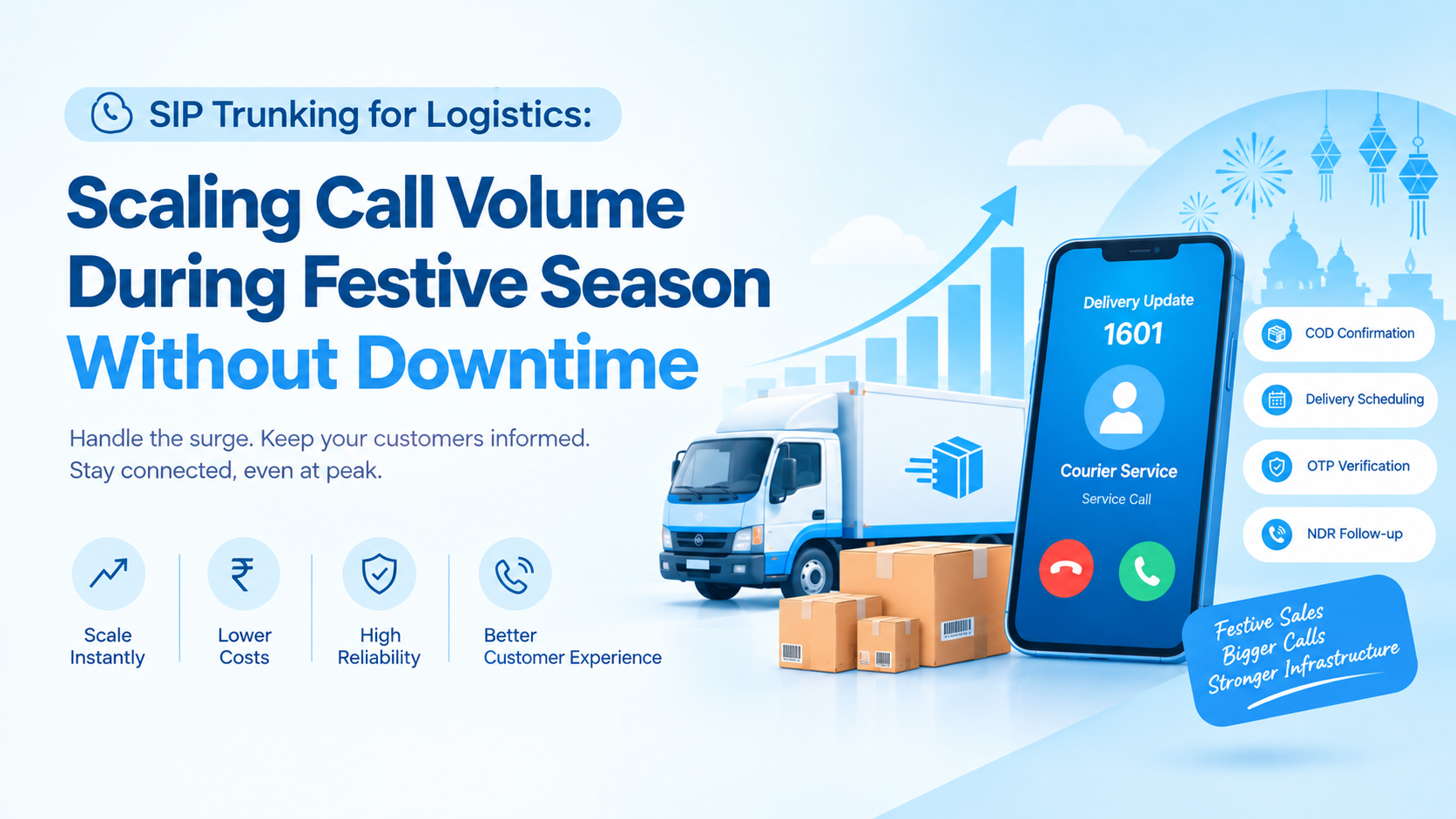
What happens to your delivery confirmation calls when order volumes jump 24% overnight and stay there for five weeks straight? For most logistics and courier operations running on fixed phone lines, the honest answer is: some of them simply don't get made — and every unmade COD confirmation or delivery-scheduling call is a parcel one step closer to a Return to Origin. Navratri through Diwali is the single biggest concentrated call-volume event on the Indian logistics calendar, and it exposes exactly which businesses built their calling infrastructure for an average day and which built it for a peak one.
The Numbers That Matter
Figures below are compiled from festive-season industry data and telecom market research as of September 2026 — cross-check current figures with primary sources (Unicommerce, CAIT, Mordor Intelligence, IAMAI) before external publication.
|
Metric |
Figure |
|---|---|
|
Diwali 2025 D2C GMV growth (YoY) |
47% YoY; 2026 projected at 35-40% (Fynd data) |
|
Pre-Navratri D2C order volume growth |
+16% YoY as early as August (Fynd data) |
|
Navratri-Diwali 2025 festive trade (CAIT survey) |
₹5.4 lakh crore in goods, up 25% YoY |
|
Diwali 2025 e-commerce order volume growth |
+24% YoY; COD GMV grew 35% in the same window (Unicommerce) |
|
COD-order RTO rate, festive quarter vs. baseline |
Up to ~58% of COD orders returned in FY26 festive quarter vs. <15% for prepaid (Unicommerce) |
|
India cloud telephony market size / growth |
₹3,200+ crore (2024), growing at 18-22% CAGR through 2028 |
|
Typical SIP trunking cost savings vs. legacy PRI/ISDN |
25-65% lower cost, per industry benchmarks |
1. Why Festive Season Breaks Traditional Telephony
The Navratri-to-Diwali stretch isn't just a busier month — it's a demand shock concentrated into roughly 30-35 calendar days. Fynd's data shows pre-Navratri D2C order volumes were already up 16% year-on-year as early as August, and Diwali D2C GMV grew 47% year-on-year in 2025, with 2026 projected at 35-40% growth. CAIT's nationwide survey put Navratri-Diwali 2025 festive trade at ₹5.4 lakh crore in goods — a 25% jump over the prior year — while Unicommerce recorded e-commerce order volumes up 24% year-on-year over the same window, with COD GMV alone climbing 35%.
Every one of those additional orders eventually becomes a phone call: a COD confirmation before dispatch, a delivery-scheduling call, an OTP verification, or an NDR follow-up after a failed attempt. Traditional PRI/ISDN telephony is built around fixed channel counts tied to physical lines — capacity that's either provisioned months in advance (and sits idle for most of the year) or simply runs out precisely when order volume peaks. The result during festive weeks is longer hold times, blocked outbound calling, and delivery teams unable to place confirmation calls fast enough to keep pace with the parcel volume moving through the network.
2. What Is SIP Trunking and Why Elasticity Matters
SIP (Session Initiation Protocol) trunking replaces physical PRI/ISDN lines with a virtual connection between your PBX (or cloud PBX) and the public telephone network, carried over the internet. Instead of a fixed number of physical channels, a SIP trunk allocates concurrent call channels that can be scaled up or down — often within hours rather than weeks — through a dashboard or API call to your telecom provider.
That elasticity is the entire point for a business with a five-week demand spike. India's cloud telephony market, valued at over ₹3,200 crore in 2024, is projected to grow at 18-22% CAGR through 2028, and industry benchmarks consistently show SIP trunking delivering 25-65% cost savings over legacy PRI lines — savings that come specifically from paying for capacity aligned to actual usage rather than a year-round worst-case provision.
|
Dimension |
Legacy PRI / ISDN Lines |
SIP Trunking |
|---|---|---|
|
Capacity scaling |
Fixed channels per physical line; new capacity needs new hardware and lead time |
Channels added or reduced on demand, often within hours, via a dashboard or API call |
|
Festive-season readiness |
Capacity must be over-provisioned months in advance, sitting idle the rest of the year |
Burst capacity provisioned just for the peak window, paid for only when used |
|
Failover / redundancy |
Single physical line/exchange dependency; a fault can take the whole line down |
Geographic redundancy and automatic failover across data centers and carriers |
|
Cost structure |
High fixed cost regardless of actual usage during lean months |
Usage-aligned, elastic cost — 25-65% lower than PRI per industry benchmarks |
|
Integration |
Limited CRM/IVR integration; often requires on-premise PBX hardware |
Native integration with Cloud PBX, IVR, CRM, AI voice bots, and CDR reporting |
3. The Festive Call Surge: Mapping Volume to Call Type
Not all calls scale the same way during the festive window, and logistics operators planning capacity should size for the specific call types that spike hardest — not just an average daily call count.
|
Call Type |
Festive-Season Trigger |
Why It Needs Elastic Capacity |
|---|---|---|
|
COD confirmation calls |
Order volumes climb 24%+ YoY through Navratri-Diwali; COD GMV alone rose 35% in Diwali 2025 |
Every additional COD order is a confirmation call that must go out before dispatch, at the exact moment volumes peak |
|
Delivery scheduling / rescheduling |
Compressed 30-35 day festive delivery window concentrates volume into far fewer calendar days |
Call volume per day, not per month, is what determines whether lines are busy or answered |
|
NDR (non-delivery report) follow-up |
COD RTO can climb toward ~58% in the festive quarter against under 15% for prepaid |
Fast NDR follow-up calls are the highest-leverage lever for pulling failed deliveries back before RTO — but only if lines are free to make them |
|
OTP and delivery-attempt verification |
Every parcel handoff needs an OTP or verification touchpoint |
These are short, high-frequency calls that multiply directly with parcel count — exactly the load pattern SIP elasticity is built for |
The NDR follow-up row deserves particular attention. Unicommerce data shows COD orders in the FY26 festive quarter returning to origin at rates approaching 58%, against under 15% for prepaid orders in the same window — and industry RTO guides consistently point to fast, automated confirmation and follow-up calls as the single highest-leverage lever for pulling a shipment back from a failed delivery before it becomes an RTO. If your calling capacity is maxed out on inbound and outbound COD confirmation volume, NDR follow-up calls are usually the first thing to get delayed — which is precisely when RTO losses compound.
4. Built for Peak, Not Just Average: Preventing Downtime at Scale
Elastic capacity solves the volume problem; it doesn't by itself solve the reliability problem. A festive-season SIP trunking setup built for logistics needs to combine capacity elasticity with infrastructure resilience:
-
On-demand channel scaling: provision burst capacity ahead of Navratri and scale down after Diwali, rather than paying for peak-level channels all year.
-
Geographic redundancy and automatic failover: calls reroute across data centers and carrier paths if one path degrades, so a single point of failure doesn't take your delivery-confirmation lines down mid-surge.
-
99.9%+ uptime SLA: the standard benchmark for cloud telephony infrastructure — and the minimum bar during the highest-stakes five weeks of the year.
-
Integration with Cloud PBX, IVR, and CRM: so scaled call volume still routes correctly, logs correctly, and reflects in CDRs for later analysis rather than creating a reconciliation problem in November.
-
AI voice bots for repetitive, high-volume calls: automating COD confirmation and delivery-scheduling calls at scale, reserving live agents for exceptions and at-risk NDR cases.
The distinction matters operationally: a business that scales channel count but keeps every call routed through a single carrier path or a single data center has simply moved its bottleneck, not removed it. Redundancy and elasticity need to be designed together, not treated as separate purchases.
5. The ROI: Turning Call Infrastructure Into an RTO-Reduction Tool
The business case for festive-ready SIP trunking isn't just about avoiding dropped calls — it's about what those calls prevent. Given that COD RTO already runs 20-35% nationally in a normal month and climbs further during festive peaks, every confirmation and NDR follow-up call that actually gets placed is a direct hedge against reverse logistics costs, which industry estimates put at roughly ₹150-300 per returned parcel in forward shipping, reverse logistics, and processing overhead alone.
Run the arithmetic at scale: a logistics operation processing tens of thousands of additional COD parcels through the festive window, at a 20-30% RTO delta between well-executed and poorly-executed confirmation calling, is looking at a meaningfully different reverse-logistics bill — one that dwarfs the incremental cost of scaling SIP channels for five weeks. Elastic call infrastructure isn't a cost center during festive season; it's one of the more direct levers logistics operators have on RTO itself.
|
Why Choose CloudConnect?
Get your call infrastructure festive-ready before the Navratri-Diwali surge hits. Visit cloudconnect.in to talk to our cloud telephony and SIP trunking team. |
Conclusion
Navratri to Diwali compresses a disproportionate share of India's annual e-commerce order volume into roughly a month — and every one of those orders eventually needs a phone call to confirm, schedule, or recover. Fixed-line telephony forces a choice between over-provisioning for a peak that lasts five weeks or under-provisioning and losing calls exactly when RTO risk is highest. SIP trunking removes that trade-off: capacity that scales with demand, backed by redundancy that keeps lines up through the biggest volume weeks of the year, turns your calling infrastructure from a bottleneck into a working part of your RTO defense.
Frequently Asked Questions
1. How quickly can SIP trunk capacity actually be scaled up before festive season?
With a cloud telephony provider, additional concurrent call channels can typically be provisioned within hours to a few days, compared to the weeks of lead time often required to add physical PRI lines. Exact timelines depend on your provider and the scale of the increase, so it's worth confirming turnaround with your SIP trunking partner well before Navratri rather than during it.
2. Do we need to keep the extra capacity all year round?
No — that's the core advantage of SIP trunking over legacy PRI lines. Channels can be scaled up ahead of the festive window and scaled back down once volumes normalize, so you're not paying for peak-level capacity during the quieter months of the year.
3. What happens if a carrier or data center has an outage during peak season?
A properly configured SIP trunking setup includes geographic redundancy and automatic failover across multiple data centers and carrier paths, so traffic reroutes automatically if one path degrades. This is a configuration and provider choice, not an inherent feature of SIP trunking itself — confirm your provider's failover architecture and SLA terms before peak season.
4. Can SIP trunking integrate with our existing IVR and CRM systems?
Yes, this is one of the main advantages over legacy telephony — SIP trunking is designed to work with Cloud PBX, IVR flows, CRM platforms, and CDR-based reporting, so scaled call volume during festive season still routes and logs the same way it does the rest of the year.
5. How does SIP trunking specifically help with RTO reduction?
It doesn't reduce RTO directly — it removes the capacity constraint that otherwise prevents COD confirmation and NDR follow-up calls from going out during high-volume periods. Since fast confirmation and follow-up calling is one of the most effective levers for pulling shipments back from failed delivery, having enough call capacity during the festive surge is a precondition for RTO-reduction efforts to actually work at scale.
6. Is SIP trunking more expensive than our current PRI lines during the festive spike?
Industry benchmarks generally show SIP trunking costing 25-65% less than legacy PRI/ISDN lines, and the elastic pricing model means you pay for the additional festive-season capacity only while you're using it, rather than provisioning and paying for peak capacity year-round.
7. Should AI voice bots replace live agents for festive-season calling?
Not entirely — AI voice bots are well suited to high-volume, repetitive calls like standard COD confirmations and delivery-scheduling reminders, freeing live agents to focus on exceptions, at-risk NDR cases, and customer escalations where a human touch matters more. Most logistics operators see the best results from a blended approach rather than full automation or full live-agent staffing.
About CloudConnect
CloudConnect helps businesses build reliable and scalable communication infrastructure with advanced voice and business communication solutions. As leading cloud telephony providers in India and experienced SIP trunk providers, we offer powerful PBX solutions, cloud telephony, IVR, and call center solutions to streamline business communication.
References
Business Standard — "Premium demand, bargain hunting set to drive festive online shopping," September 6, 2026. https://www.business-standard.com/industry/news/premium-demand-bargain-hunting-set-to-drive-festive-online-shopping-126090600310_1.html
Telangana Today — "India e-commerce, quick commerce platforms gear up for festive season." https://telanganatoday.com/india-e-commerce-quick-commerce-platforms-gear-up-for-festive-season
News on Air (PTI/CAIT survey) — "India's Retail Sector Hits Record Festive Sales of ₹5.4 Lakh Crore in Goods." https://www.newsonair.gov.in/indias-retail-sector-recorded-its-highest-ever-festive-season-sales-this-year-between-navratri-to-diwali-with-trade-touching-an-unprecedented-5-4-lakh-crore-rupees-in-goods-and-65-thousand-cr/
First Resort — "E-Commerce Returns & RTO in Indian Fashion 2026" (Unicommerce festive RTO and order-volume data). https://www.firstresort.in/blogs/research/fashion-ecommerce-returns-rto-india-2026
ClickPost — "Top 12 Cash on Delivery (COD) Services in India [2026]" (COD/RTO benchmark data). https://www.clickpost.ai/blog/cod-cash-on-delivery-courier-services
ShipMozo — "How to Reduce RTO in eCommerce: 2026 Guide for Indian Sellers." https://www.shipmozo.com/blog/how-to-reduce-rto-in-ecommerce
LeadNXT — "Cloud Telephony Solutions in India - Ultimate 2026 Business Guide" (India cloud telephony market sizing). https://www.leadnxt.com/blog/2026/04/cloud-telephony-solutions-india/
DIDLogic — "Best SIP Trunk Provider In India" (India cloud telephony CAGR, ResearchAndMarkets estimate). https://didlogic.com/blog/best-sip-trunk-provider-india/
Mordor Intelligence — "SIP Trunking Market Size, Share Analysis, Forecast" (cost-savings and CAGR benchmarks). https://www.mordorintelligence.com/industry-reports/sip-trunking-market
Related Reading
Toll-Free Numbers in India: Features, Pricing & Best Providers
How to Get a DID Mobile Number in India for Your Business
Best Cloud Telephony Providers in India: Features, Pros & Cons
UCaaS vs. CCaaS: Understanding the Difference Between Two Cloud Communication Platforms