Voice automation is changing the way businesses talk to their customers. From customer support and appointment reminders to sales calls, AI-powered voice bots are now becoming a key part of business communication.
But for voice bots to call or receive calls from real phone numbers, they need a strong telecom setup. This is where SIP trunking comes in.
Let’s look at some important data points:
-
According to Juniper Research, voice bots may handle over 70% of customer interactions by 2030
-
MarketsandMarkets estimates the conversational AI market will grow from $13.2 billion in 2024 to $49+ billion by 2030
-
IBM reports that AI in customer support can reduce costs by up to 30%
-
AI-powered contact centers see 40–50% faster response times
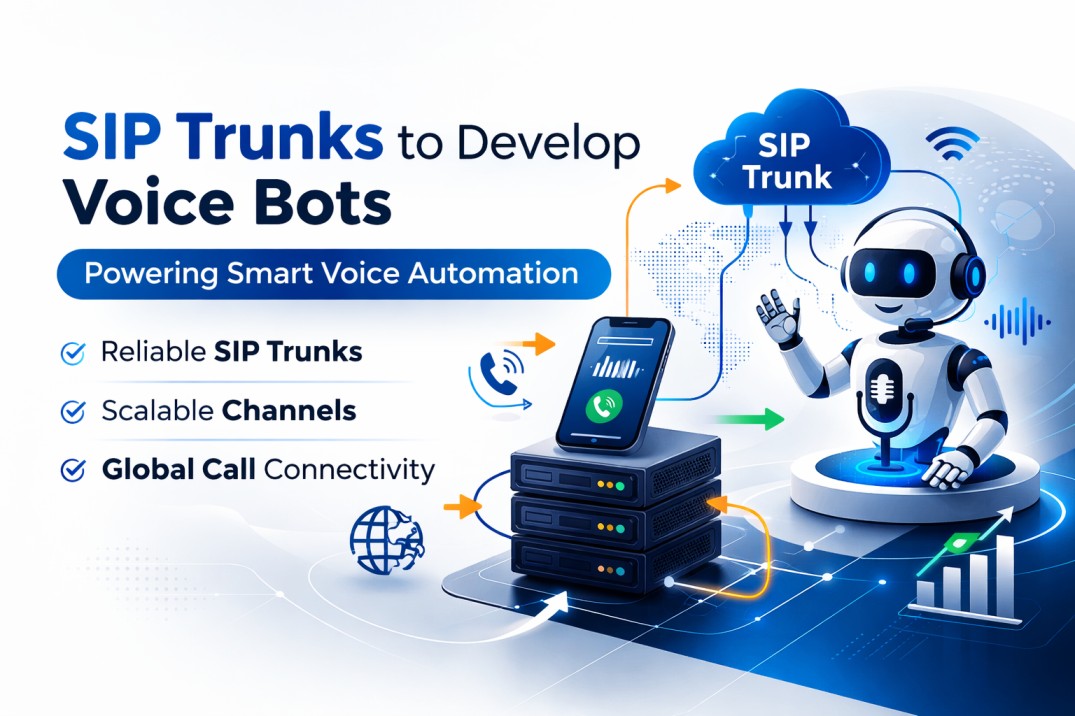
To make this level of automation possible over phone networks, businesses use SIP trunks, which connect voice bots to telecom networks.
In this blog, we’ll explain how SIP trunks work with voice bots, their benefits, and how you can set them up.
What is SIP Trunking?
SIP (Session Initiation Protocol) is a technology that helps you make and manage voice calls over the internet.
A SIP trunk connects your business system (like a PBX, contact center, or voice bot) to the telephone network (PSTN).
Instead of using traditional phone lines, SIP trunks use the internet. This makes communication more flexible and scalable.
Key Features of SIP Trunks
-
Cloud-based calling
-
Make and receive calls globally
-
Easily scalable (add more call capacity anytime)
-
Lower communication costs
-
Easy integration with AI tools
SIP trunking is commonly used in contact centers, IVR systems, and voice bots.
What is a Voice Bot?
A voice bot is an AI system that talks to users using voice. It can understand what people say and respond in real time.
Voice bots use:
-
Speech Recognition (ASR) – converts voice to text
-
Natural Language Processing (NLP) – understands meaning
-
Machine Learning – improves over time
-
Text-to-Speech (TTS) – converts text to voice
Common Use Cases
Voice bots are used for:
-
Customer support
-
Appointment booking
-
Payment reminders
-
Lead qualification
-
Order tracking
-
Banking help
-
Healthcare follow-ups
To work over phone calls, voice bots need to connect to telecom networks—and that’s done using SIP trunks.
Why SIP Trunks Are Important for Voice Bots
Voice bots need to make and receive calls just like humans.
SIP trunks make this possible by connecting them to telecom networks.
What SIP Trunks Enable
1. Inbound Calls
Customers can call your number and talk to a voice bot.
2. Outbound Calls
Voice bots can call customers for reminders, surveys, or marketing.
3. Smart Call Routing
Calls can go from bot to human agent when needed.
4. Handle High Call Volume
Manage thousands of calls at the same time.
5. Global Reach
Operate in multiple countries with virtual numbers.
How SIP Trunks Work with Voice Bots
Here’s a simple flow:
-
A customer makes or receives a call
-
The telecom network carries the call
-
The SIP trunk provider connects the call to your system
-
The voice bot processes the conversation
-
The bot responds or transfers the call
Voice bots can also connect to systems like:
-
CRM
-
Booking platforms
-
Order systems
This helps them give real-time and personalized responses.
Benefits of Using SIP Trunks for Voice Bots
1. Lower Costs
No need for physical phone lines or hardware.
You pay only for what you use.
2. Easy to Scale
Handle hundreds or thousands of calls without changing infrastructure.
3. Global Calling
Use local numbers in different countries and serve global customers.
4. Easy AI Integration
Works with platforms like:
-
Dialogflow
-
Amazon Lex
-
Azure Speech
-
Custom AI tools
5. High Reliability
Most providers offer:
-
99.9% uptime
-
Backup routing
-
Stable call quality
Steps to Build a Voice Bot Using SIP Trunks
Step 1: Choose a SIP Provider
Pick a provider with good uptime, global coverage, and scalable channels.
Step 2: Set Up Your Voice Bot
Use an AI platform with speech recognition and NLP.
Step 3: Connect SIP Trunk
Configure routing, authentication, and endpoints.
Step 4: Design Conversation Flow
Create greetings, responses, and fallback options.
Step 5: Integrate Systems
Connect CRM, databases, or booking tools.
Step 6: Test and Launch
Test all scenarios and then go live.
Industries Using Voice Bots with SIP
-
Banking
-
Healthcare
-
E-commerce
-
Telecom
-
Travel
What CloudConnect Enables for Voice Bots
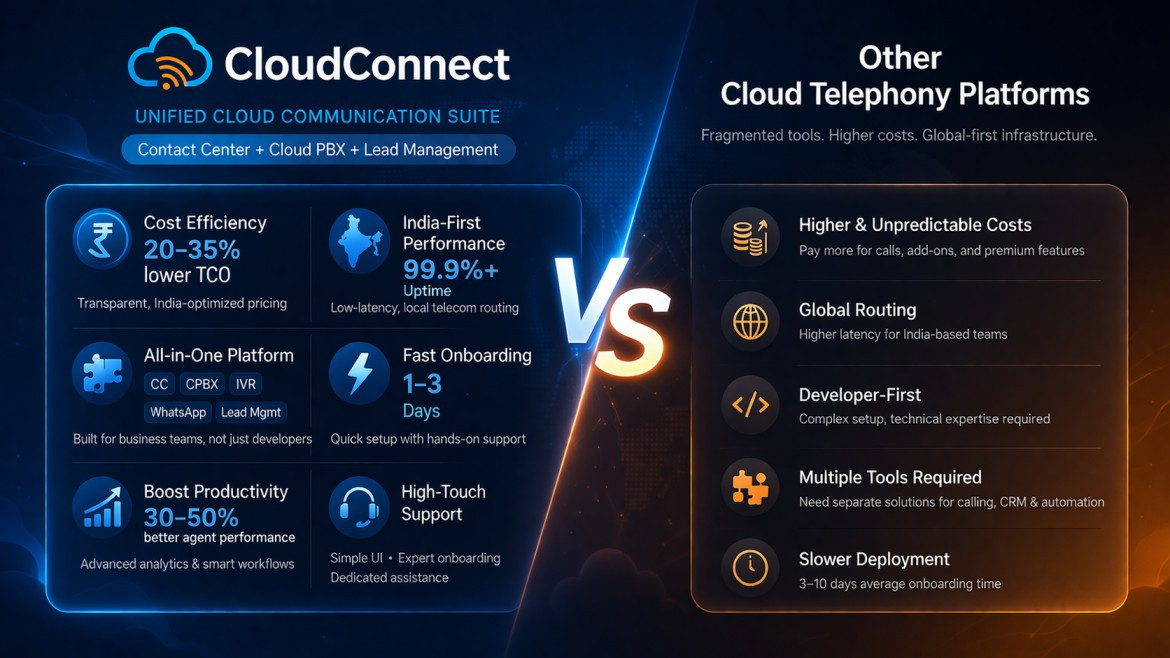
CloudConnect is India’s 1st licensed B2B Digital Telco (VNO), trusted by 350+ brands.
With CloudConnect SIP trunks and channels, businesses can:
-
Handle inbound calls using AI voice bots
-
Run outbound calling campaigns
-
Scale to hundreds or thousands of calls using channels
-
Route calls between bots and human agents
-
Operate globally with virtual numbers
CloudConnect provides both SIP trunks and scalable channels, making it easy to build and grow voice bot systems.
Conclusion
Voice bots are becoming a core part of modern business communication. They help automate customer interactions, reduce costs, and improve response times.
But to work over phone networks, they need a strong telecom backbone.
That’s where SIP trunking comes in.
Solutions like CloudConnect provide reliable SIP trunks and scalable channels, helping businesses:
-
connect AI systems to telecom networks
-
manage high call volumes
-
scale easily
If you’re planning to build a voice bot, combining AI + SIP trunking (like CloudConnect) is the right way forward.
Frequently Asked Questions (FAQ)
1. What is SIP trunking in voice bots?
It connects voice bots to telecom networks so they can make and receive calls.
2. What does CloudConnect provide?
CloudConnect provides SIP trunks and scalable channels for voice bots and business calling.
3. What are SIP channels?
Channels define how many calls you can handle at the same time.
4. Can voice bots make outbound calls?
Yes, they can call users for reminders, marketing, or support.
5. Can I scale calls easily?
Yes. You can increase channels instantly without hardware changes.
6. Are SIP-based voice bots secure?
Yes, with proper encryption and authentication, they are secure.
References
MarketsandMarkets – Conversational AI Market Report
https://www.marketsandmarkets.com
Juniper Research – AI Market Forecast
https://www.juniperresearch.com
IBM – AI Customer Support Report
https://www.ibm.com
Google Dialogflow
https://cloud.google.com/dialogflow
Microsoft Azure Speech
https://learn.microsoft.com