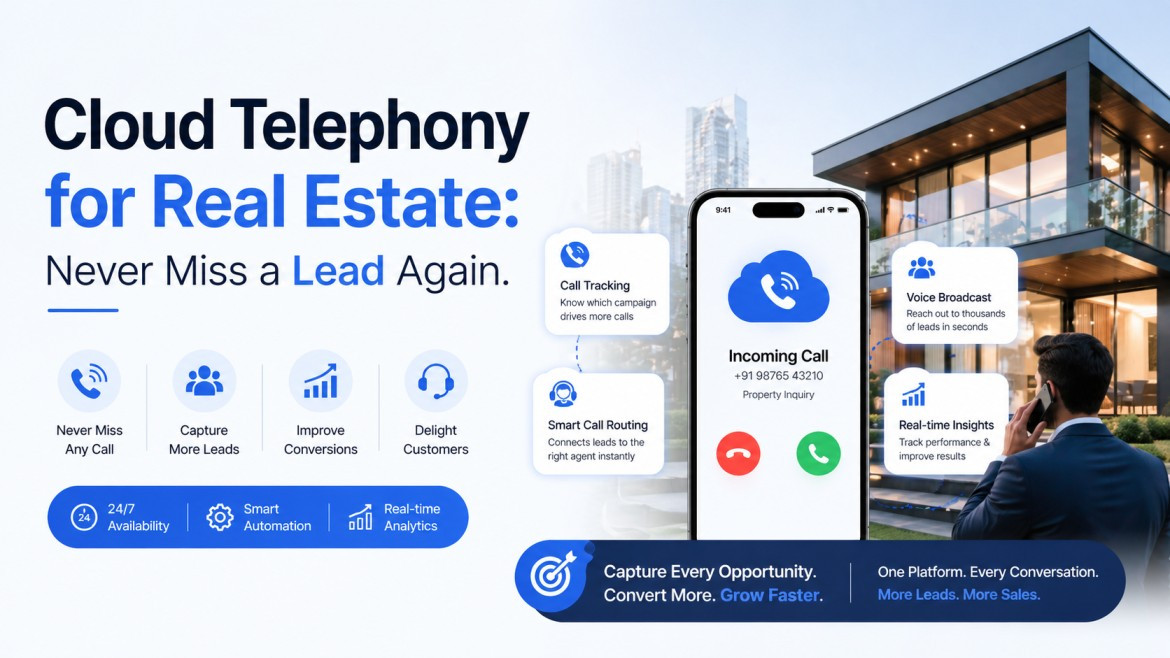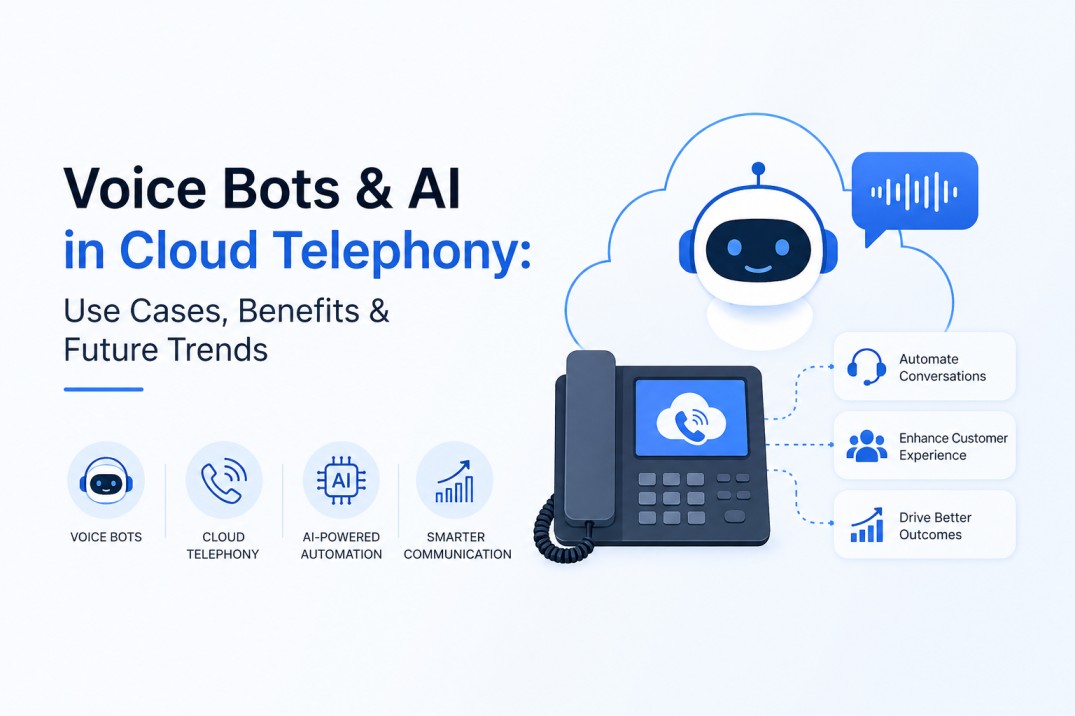
The way businesses communicate with customers is undergoing a massive shift—driven by AI and automation.
-
Over 80% of customer interactions are expected to be handled by AI by 2027 (Gartner)
-
Businesses using AI-powered voice bots report up to 40% reduction in operational costs
-
73% of customers prefer quick, automated responses for basic queries (Salesforce)
-
Call centers using AI see 30–50% improvement in response time
In this landscape, voice bots integrated with cloud telephony are becoming a game-changer—enabling businesses to automate conversations, scale support, and deliver consistent customer experiences.
What Are Voice Bots in Cloud Telephony?
Voice bots are AI-powered systems that can handle inbound and outbound calls without human intervention. Unlike traditional IVR systems, modern voice bots use:
-
Natural Language Processing (NLP)
-
Speech recognition & synthesis
-
Machine learning algorithms
When integrated with cloud telephony, voice bots become part of a unified communication system, capable of managing calls, understanding intent, and executing actions in real time.
Key Use Cases of Voice Bots in Cloud Telephony
1. Customer Support Automation
Voice bots can handle frequently asked queries such as:
-
Order status
-
Appointment confirmations
-
Account-related queries
📊 Businesses report up to 60% reduction in support workload using AI voice automation.
2. Lead Qualification & Sales Calls
Voice bots can:
-
Call leads instantly
-
Ask qualification questions
-
Route high-intent prospects to human agents
📊 Companies using AI for lead qualification see 2–3x higher conversion rates.
3. Appointment Booking & Reminders
Widely used in healthcare, salons, and service industries:
-
Automated appointment scheduling
-
Reminder calls to reduce no-shows
📊 AI reminders can reduce no-show rates by up to 35%.
4. Payment Reminders & Collections
Voice bots are highly effective for:
-
EMI reminders
-
Subscription renewals
-
Payment follow-ups
📊 BFSI companies report 20–25% improvement in collections efficiency.
5. Surveys & Feedback Collection
Post-interaction feedback can be automated:
-
NPS surveys
-
Customer satisfaction calls
📊 Automated surveys see 3x higher response rates compared to manual calls.
6. Emergency Alerts & Notifications
Used by enterprises and government bodies for:
-
Mass alerts
-
Critical notifications
-
Service updates
Key Benefits of Voice Bots in Cloud Telephony
🚀 1. 24/7 Availability
Voice bots ensure your business is always accessible—without increasing manpower.
💰 2. Cost Optimization
-
Reduce dependency on large support teams
-
Lower cost per interaction
📊 Businesses save up to 30–50% on customer support costs.
⚡ 3. Faster Response Time
AI eliminates waiting queues and instantly responds to customers.
📈 4. Scalability
Handle thousands of calls simultaneously—without infrastructure limitations.
🎯 5. Improved Customer Experience
-
Consistent responses
-
Reduced wait time
-
Personalized interactions
📊 6. Data & Insights
Voice bots generate valuable data:
-
Call outcomes
-
Customer intent
-
Behavior patterns
This helps in continuous optimization of customer journeys.
Voice Bots vs Traditional IVR
|
Feature |
Traditional IVR |
AI Voice Bots |
|
Interaction |
Menu-based |
Conversational |
|
Flexibility |
Limited |
Highly adaptive |
|
Personalization |
Minimal |
High |
|
Learning Ability |
None |
Improves over time |
|
User Experience |
Rigid |
Natural & seamless |
Challenges & Considerations
While powerful, businesses should be mindful of:
-
Initial setup & training of AI models
-
Handling complex queries (human fallback needed)
-
Language & accent optimization
-
Data privacy and compliance
Future of Voice Bots in Cloud Telephony
The future is moving toward:
-
Hyper-personalized conversations using AI
-
Integration with CRM, WhatsApp, and omnichannel platforms
-
Multilingual voice bots for regional markets (critical in India)
-
Emotion detection & sentiment-based responses
📊 By 2030, AI is expected to handle 90% of routine customer interactions.
Conclusion
Voice bots and AI in cloud telephony are no longer optional—they are becoming essential for businesses aiming to scale efficiently while delivering superior customer experiences.
From automating support to improving conversions, the impact is clear:
faster, smarter, and more scalable communication.
About CloudConnect
CloudConnect is India's most popular Cloud Teleplony Solution Provider, trusted by 400+ enterprises.
👉 AI-powered automation + omnichannel engagement + real-time analytics
As India’s first licensed B2B Digital Telco (VNO), CloudConnect empowers businesses to transition to a fully cloud-based communication system.
What this enables:
✔ Manage calls, leads, and support on a single platform
✔ Automate workflows
✔ Track performance across teams in real time
✔ Scale operations without infrastructure constraints
FAQs
1. What is a voice bot in cloud telephony?
A voice bot is an AI-powered system that can handle calls, understand customer queries, and respond intelligently without human intervention.
2. How is a voice bot different from IVR?
IVR is menu-based, while voice bots are conversational and use AI to understand natural language.
3. Can voice bots handle multiple languages?
Yes, modern voice bots support multilingual communication, especially useful in markets like India.
4. Are voice bots secure?
Yes, when implemented with proper compliance and data security measures, they are safe for business use.
5. Which industries benefit the most from voice bots?
Healthcare, BFSI, e-commerce, education, and real estate see the highest adoption and ROI.
References