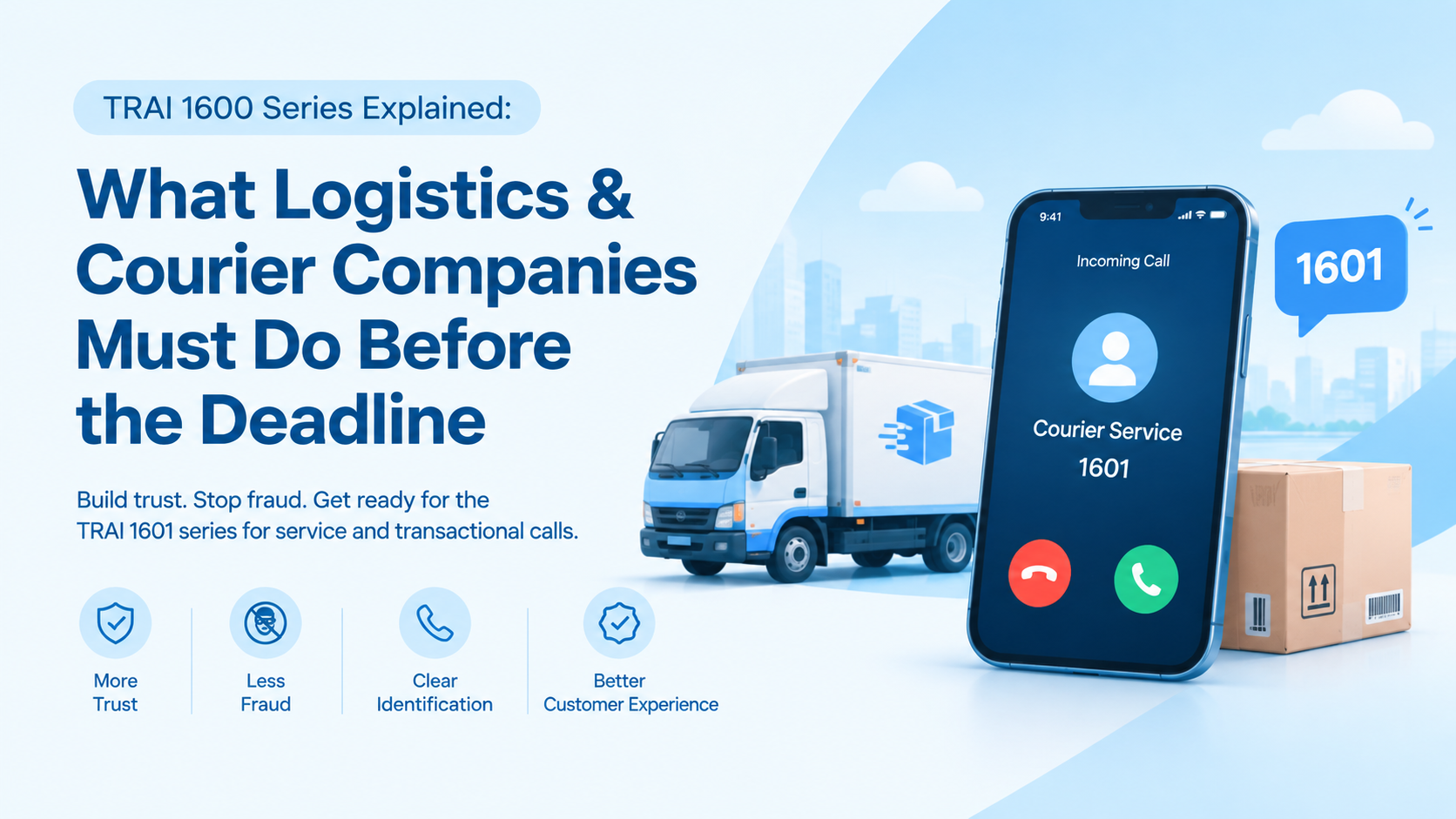
TRAI 1600 Series Explained:
What Logistics & Courier Companies Must Do Before the Deadline
Every day, millions of Indian consumers pick up their phones to a call about a parcel — a delivery attempt, an OTP, a reschedule request, a COD confirmation. And every day, a growing number of them simply don't answer, because they can no longer tell a genuine courier call from a fraudster impersonating one. TRAI's answer to that trust gap is the new 1601 numbering series — and if you run a logistics or courier business in India, the clock on adopting it is already running.
The Numbers That Matter
Before getting into the regulation itself, here is the data that frames why this shift matters and how urgent it is. (Figures below are drawn from TRAI communications and industry reporting as of September 2026 — verify the latest numbers with TRAI's official notifications before using them in external communication.)
|
Metric |
Figure |
|---|---|
|
TSP onboarding window for 1601-series numbers |
90 days from TRAI's August 10, 2026 directive |
|
Sectors covered in Phase 1 of the 1601 series |
Utilities (DISCOMs, water, city gas, LPG) and logistics/courier services |
|
1600-series call volume, Q1 FY 2026-27 |
~1.15 billion calls (TRAI data, reported Aug 2026) |
|
BFSI entities already on the 1600 series |
485+ entities, 2,800+ numbers allotted (pre-migration deadline count) |
|
Courier-impersonation fraud complaints (NCRP, 2024) |
45,000+ complaints; ~₹1,200 crore in reported losses |
|
India's e-commerce logistics market, 2026 |
Estimated USD 7-10+ billion, growing at a 9-19% CAGR (estimates vary by research house) |
1. What Is the TRAI 1601 Series — and How Is It Different from 1600?
On August 10, 2026, the Telecom Regulatory Authority of India (TRAI) directed telecom service providers (TSPs) to begin issuing a new 1601-series number range for service and transactional voice calls made by entities outside the BFSI and government space. This extends a framework TRAI first built for banks and financial institutions.
The original 1600 series was reserved exclusively for entities regulated by the RBI, SEBI, IRDAI, and PFRDA, plus government-to-citizen communication, following a TRAI directive issued in November 2025. Commercial banks were required to migrate by January 1, 2026, with large NBFCs, payment banks, small finance banks, mutual funds, and pension bodies following through phased deadlines into March 2026.
TRAI has now extended the same trusted-numbering logic to Phase 1 of a new rollout covering:
-
Utilities: electricity distribution companies, water utilities, city gas distribution companies, LPG distribution entities, and other utility service providers
-
Logistics and courier services: courier firms, express logistics companies, parcel delivery service providers, and freight and logistics operators engaged in delivery of consignments
The distinction between 1600 and 1601 matters operationally: they are separate number ranges, administered under the same principle, but 1601 is not open to BFSI entities, and 1600 is not open to logistics or utility companies. Each sector stays on its designated range.
|
Series |
Who Uses It |
Call Type Permitted |
|---|---|---|
|
140 series |
Registered telemarketers, any sector |
Promotional / telemarketing calls only |
|
1600 series |
RBI, SEBI, IRDAI, PFRDA-regulated BFSI entities; government-to-citizen communication |
Service and transactional calls only |
|
1601 series |
Utilities and logistics/courier entities (Phase 1); more sectors expected in later phases |
Service and transactional calls only — never promotional |
2. Why TRAI Mandated the Shift: The Fraud and Trust Problem
The 1601 series exists because the current system — ordinary 10-digit mobile numbers used for service calls — has become a primary vehicle for impersonation fraud, and logistics and courier brands are among the most impersonated categories in India today.
The scale of courier-related fraud is well documented. The National Cybercrime Reporting Portal (NCRP) logged over 45,000 complaints specifically tagged as courier impersonation in 2024 alone, with reported losses of roughly ₹1,200 crore. The pattern is consistent across cases: a caller claims to represent a known courier brand, alleges a parcel has been intercepted by customs for containing contraband, then transfers the call to a fake 'law enforcement officer' who pressures the victim into a wire transfer under threat of arrest. Nationally, Indians lost an estimated ₹22,495 crore to cyber fraud in 2025, with delivery-notification scams called out as a recognizable, recurring category.
TRAI's logic mirrors what it did for BFSI: if consumers can instantly recognize that a call is coming from a dedicated, verified series — rather than a random 10-digit number — genuine service calls become easier to trust, and fraudulent calls using spoofed or random numbers become easier to flag and block.
It's worth being candid about the friction this has produced in the BFSI rollout, since logistics companies are about to inherit the same dynamic. Truecaller has publicly reported that, in the eight months of BFSI's 1600-series operation, users ignored roughly 79% of calls from the series and manually blocked around 74 million such calls — a consequence, Truecaller argues, of TRAI restricting caller-ID apps from showing community spam flags on 1600-series numbers. The takeaway for logistics and courier operators is that simply obtaining a 1601 number is not, by itself, a trust guarantee — it needs to be paired with consistent caller identification, SMS/WhatsApp cross-verification, and customer education so the number is actually recognized rather than reflexively ignored.
3. Who Is Covered: Eligibility for Logistics & Courier Companies
TRAI's Phase 1 directive is specific about who can be allotted a 1601-series number, and — just as importantly — who cannot.
|
Eligible for 1601-series numbers |
Not eligible (per TRAI's directive) |
|---|---|
|
Courier companies |
Aggregators and intermediaries acting on behalf of eligible entities |
|
Express logistics companies |
Marketing or lead-gen desks placing promotional calls (must use 140 series) |
|
Parcel delivery service providers |
Entities that cannot furnish an undertaking of exclusive transactional use |
|
Freight and logistics operators handling consignment delivery |
Unverified or newly incorporated entities pending TSP due diligence |
Two operational details stand out for logistics and courier businesses:
-
Direct allotment only: TSPs are directed to allot 1601 numbers to eligible entities directly, not to intermediaries or aggregators operating on their behalf. If your calling operations run through a third-party BPO, fleet aggregator, or logistics marketplace, the number itself is still allotted to your registered entity, and that arrangement needs to be documented.
-
Undertaking of exclusive use: TSPs must obtain a formal undertaking from each entity that the 1601 number will be used exclusively for service and transactional voice calls — never for promotional or marketing calls, which remain the domain of the 140 series.
4. The 90-Day Migration Window: What Happens Next
TRAI's August 10, 2026 directive gives telecom service providers 90 days to verify eligibility and complete onboarding of Phase 1 entities — placing the operational deadline for TSPs at roughly early November 2026. For logistics and courier companies, that window is effectively your migration runway too, since your number can only go live once your TSP has verified and provisioned it.
A practical migration sequence looks like this:
-
Confirm eligibility: verify your entity falls within TRAI's Phase 1 logistics/courier definition (courier firm, express logistics operator, parcel delivery provider, or freight/consignment delivery operator).
-
Approach your TSP or CPaaS/cloud telephony partner to apply for 1601-series numbers and complete KYC and eligibility verification.
-
Sign the undertaking committing to exclusive transactional/service use of the allotted number(s).
-
Map every existing calling workflow — delivery confirmation, OTP verification, reschedule requests, COD confirmation, RTO/return calls — to the new number range.
-
Update IVR flows, click-to-call systems, CRM integrations, and CDR/call-logging systems so the new number is reflected consistently across every customer touchpoint.
-
Run parallel testing before cutover: keep the old number active during a transition period while validating call delivery, caller ID display, and IVR routing on the new number.
-
Brief frontline delivery, call center, and customer support teams so they can explain the new number if customers ask.
Businesses that use outsourced call centers or third-party calling desks should note that TSPs have made clear this dependency does not extend the deadline — an entity's obligations are the same whether its calls originate in-house or through an outsourced desk.
5. Beyond Compliance: Making Your 1601 Number Actually Work
Securing a compliant number is the regulatory floor, not the finish line. Given the adoption friction already visible in the BFSI rollout, logistics and courier companies have an opportunity to get ahead of the same problem rather than repeat it. A few things make the difference between a 1601 number that gets answered and one that gets ignored like any other unknown caller:
-
Cloud PBX and SIP trunking that route every outbound delivery, OTP, and confirmation call through the verified number — with zero fallback to ad hoc mobile numbers from warehouse or hub staff.
-
AI voice bots for high-volume, repetitive calls (delivery confirmations, address verification, reschedule requests), so the verified number is associated with a fast, consistent experience rather than long hold times.
-
CDR-backed reporting that gives compliance teams an auditable log of every call made from the 1601 number, supporting the undertaking given to your TSP.
-
Cross-channel reinforcement — pairing the voice call with an SMS or WhatsApp notification from the same registered brand name, so customers have more than one signal that the call is genuine.
-
Customer-facing communication (on your website, order confirmation emails, and app) explaining that delivery-related calls will now come from a 1601 number, to reduce first-contact hesitation.
This is precisely where cloud telephony infrastructure — not just a compliant number — determines whether the migration improves delivery success rates or simply relocates the same operational habits to a new number.
|
Why Choose CloudConnect?
Get your logistics or courier business migration-ready before the 90-day window closes. Visit cloudconnect.in to talk to our compliance and cloud telephony team. |
Conclusion
The shift from 1600 to 1601 is TRAI extending a fraud-prevention framework that started with banks into the sectors Indian consumers interact with just as often: their electricity provider and their courier. For logistics and courier companies, the 90-day TSP onboarding window that opened on August 10, 2026 is a hard operational deadline, not a suggestion — and the entities that treat this as a full communications-infrastructure upgrade, rather than a number swap, will be the ones that see delivery pickup rates and customer trust actually improve rather than replicate the adoption friction seen in the BFSI rollout.
Frequently Asked Questions
1. Is the 1601 series mandatory for all logistics and courier companies?
TRAI's Phase 1 directive covers courier firms, express logistics companies, parcel delivery service providers, and freight/logistics operators engaged in consignment delivery. If your business falls into one of these categories and makes service or transactional calls to customers, migration is expected within the TSP's 90-day onboarding window. Confirm your specific eligibility and timeline with your TSP or telecom regulatory advisor, as classification details can vary by business structure.
2. What is the actual deadline for logistics companies to migrate?
TRAI's directive, issued August 10, 2026, requires TSPs to complete verification and onboarding of Phase 1 eligible entities within 90 days — placing the operational cutoff at approximately early November 2026. Businesses should confirm exact dates directly with TRAI notifications or their TSP, as implementation timelines are ultimately set by the telecom operators executing the directive.
3. Can we keep using our existing 10-digit mobile numbers for delivery calls?
TRAI's stated intent is to move service and transactional calls for covered sectors onto the dedicated numbering series to curb impersonation fraud. Continuing to rely solely on standard 10-digit numbers for these calls runs counter to that intent and carries reputational and potential compliance risk as enforcement develops. It's advisable to plan for full migration rather than partial or delayed adoption.
4. Does the 1601 series apply to promotional or marketing calls?
No. TRAI has been explicit that 1601-series numbers (like the 1600 series) are for service and transactional calls only. Promotional and telemarketing calls must continue to use the 140 series, regardless of sector.
5. What if our calling operations run through a third-party BPO or aggregator?
TRAI's directive specifies that 1601-series numbers are allotted directly to eligible entities, not to intermediaries or aggregators. If a third party places calls on your behalf, the number allocation and the compliance undertaking still sit with your registered entity — plan your vendor agreements and technical integration accordingly.
6. Will a 1601 number automatically improve our call pickup rates?
Not automatically. Experience from the BFSI 1600-series rollout shows that a compliant number alone doesn't guarantee trust — Truecaller has reported ignore rates near 79% on 1600-series calls over an eight-month period. Pairing the number with consistent caller ID, SMS/WhatsApp cross-verification, and customer communication about the new number materially improves the odds that it's actually answered.
7. How does cloud telephony infrastructure help with this migration?
A Cloud PBX and SIP trunking setup lets you route all outbound delivery, OTP, and confirmation calls through your verified 1601 number consistently, rather than depending on individual staff mobile numbers. It also gives you CDR-based logs to support the compliance undertaking given to your TSP, and can incorporate AI voice bots to handle high call volumes during peak delivery seasons without compromising the verified-number requirement.
About CloudConnect
CloudConnect helps businesses build reliable and scalable communication infrastructure with advanced voice and business communication solutions. As leading cloud telephony providers in India and experienced SIP trunk providers, we offer powerful PBX solutions, cloud telephony, IVR, and call center solutions to streamline business communication.
References
Business Standard — "TRAI directs utilities, courier and logistics providers to use 1601 series," August 10, 2026. https://www.business-standard.com/industry/news/trai-directs-utilities-courier-and-logistics-providers-to-use-1601-series-126081001287_1.html
The Print (PTI) — "TRAI directs use of 1601-series for service, transactional calls by utilities, logistics cos," August 2026. https://theprint.in/economy/trai-directs-use-of-1601-series-for-service-transactional-calls-by-utilities-logistics-cos/3010594/
MediaNama — "TRAI issues 1601 series for utilities, logistics and courier services," August 2026. https://www.medianama.com/2026/08/223-trai-1601-series-logistics-courier-services/
Business Standard — "TRAI directs financial entities to use '1600' number series from 2026," November 20, 2025. https://www.business-standard.com/industry/news/trai-directs-bfsi-use-1600-number-series-2026-125111900941_1.html
TechCrunch — "Truecaller clashes with India's telecom regulator over anti-spam rules," July 8, 2026. https://techcrunch.com/2026/07/08/truecaller-clashes-with-indias-telecom-regulator-over-anti-spam-rules/
Kaval — "Misinformation and Online Scam Statistics in India: 2026 Report." https://kaval.chat/blog/misinformation-scam-statistics-india-2026/
RTI Wiki — "FedEx / Courier Scam Recovery 2026" (NCRP 2024 courier-impersonation complaint data). https://righttoinformation.wiki/fedex-courier-scam-recovery
Mordor Intelligence — "India E-commerce Logistics Market — Size, Share, Growth & Trends Analysis." https://www.mordorintelligence.com/industry-reports/india-e-commerce-logistics-market
Grand View Research (Horizon Databook) — "India Logistics Market Size & Outlook, 2026-2033." https://www.grandviewresearch.com/horizon/outlook/logistics-market/india
Related Reading
Toll-Free Numbers in India: Features, Pricing & Best Providers
How to Get a DID Mobile Number in India for Your Business
Best Cloud Telephony Providers in India: Features, Pros & Cons
UCaaS vs. CCaaS: Understanding the Difference Between Two Cloud Communication Platforms
Disclaimer: All statistics, deadlines, and figures in this article are compiled from public regulatory notifications and media reporting as of September 2026. TRAI directives and TSP implementation timelines can be revised; verify current figures and dates against official TRAI notifications before external publication.